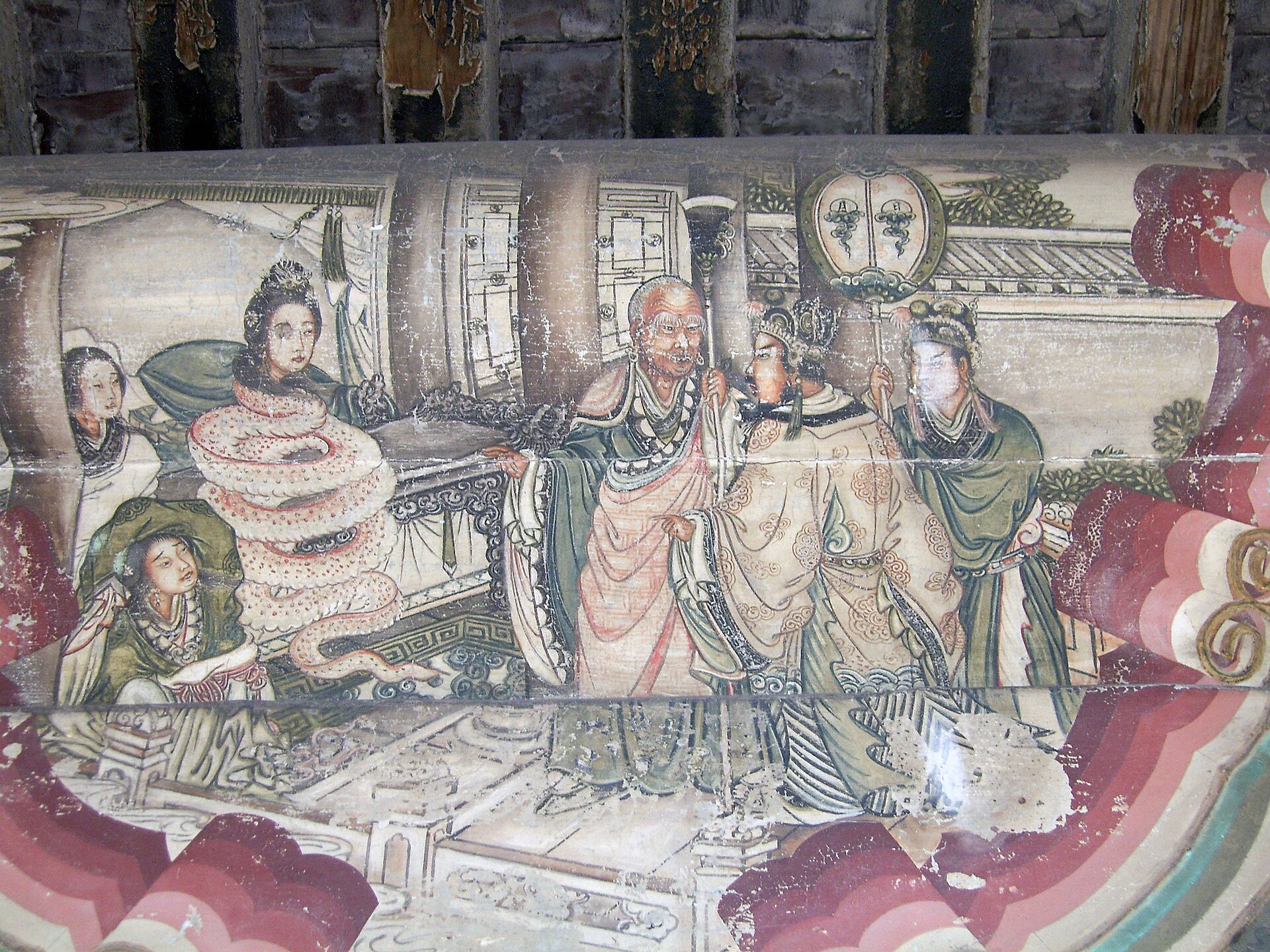
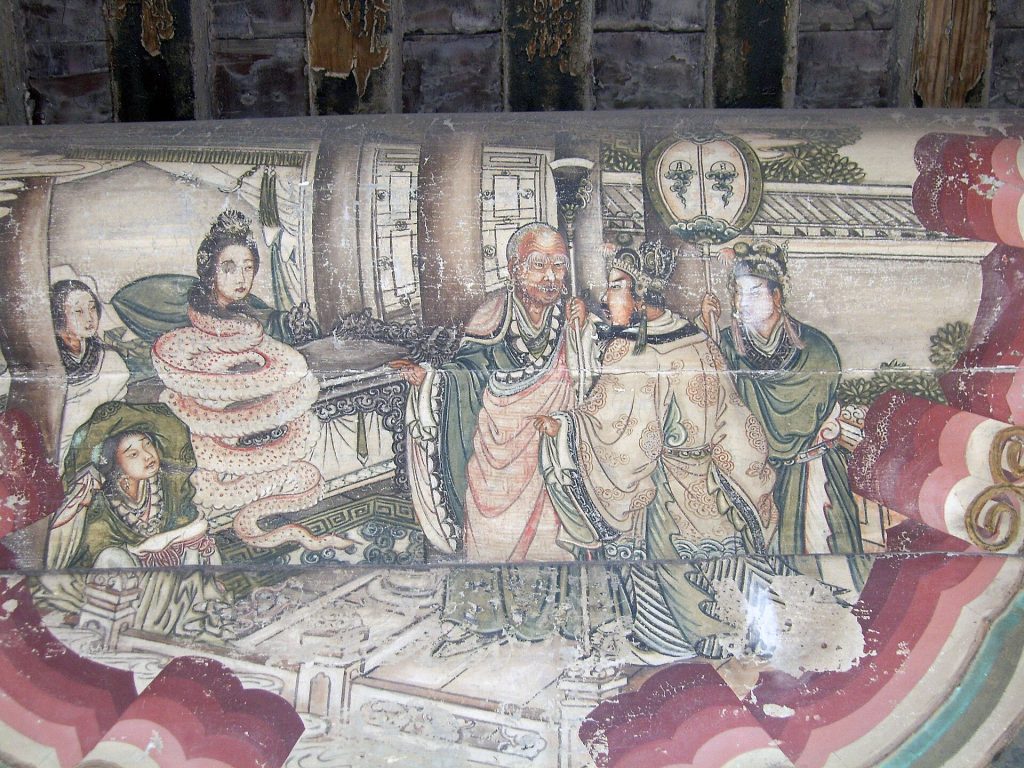
The rain on West Lake doesn’t fall straight down. It slants sideways, driven by a wind that carries the smell of wet lotus leaves and diesel from the tour boats. I stood under the red lanterns of the Broken Bridge just after dusk, watching the water turn the color of ink. A vendor nearby was packing up his tray of candied hawthorn sticks, the sugar coating hardening in the damp air. That’s the moment the story feels closest — not in a theater or a picture book, but here, where the pavement stays slick and the willow branches brush the shoulders of couples walking slow. The legend says a white snake spirit practiced Daoist cultivation for a thousand years on Mount Emei, then came to Hangzhou in human form. She met a scholar named Xu Xian on this bridge, or maybe in a boat nearby, depending on who tells it. They married, opened a medicine shop, and lived quietly until a monk named Fahai decided their union violated the natural order. The rest is flood water, a golden bowl, a pagoda prison, and a son who eventually tops the imperial exams to free his mother. But the version that matters is the one you walk through.
The Bridge Where It Started
Broken Bridge isn’t broken. It’s a stone arch painted white, curved over the narrow channel where the Inner Lake meets the Outer Lake. Early morning is the only time you get it to yourself. By nine, the tour groups arrive with flags and megaphones, and the romance evaporates. I go at six, when the tea houses along the shore are still shuttered and the only sound is the slap of a fisherman’s pole against his hull. The bridge rail is cold under your palm. You can see Leifeng Pagoda across the water, its silhouette sharp against the sky. That’s where the white snake was pinned, the story goes, crushed under five colors of stone. The current pagoda is a reconstruction from 2002, built over the ruins of the original that collapsed in 1924. Locals will tell you the old bricks were stolen by neighbors who believed powder from the tower cured illness. Maybe they did. The new one has an elevator and a gift shop selling jade pendants shaped like snakes.
The Medicine Shop on the Hill
Up the hill from the bridge, past the crowds posing with umbrellas, a narrow lane leads to a courtyard house with a faded sign: “Bao He Tang.” The name means “Hall of Harmonious Preservation.” Inside, the smell hits you first — dried tangerine peel, licorice root, angelica, something metallic and sweet. Wooden drawers line the walls, labeled in faded calligraphy. An old man in a blue cotton jacket sits behind a low table, grinding herbs in a stone mortar. He doesn’t look up when you enter. This isn’t a museum. It’s a working pharmacy, one of the few that still claims lineage to the shop Xu Xian and the White Snake ran in the story. The prescription counter is worn smooth where generations of wrists have rested. If you ask about the legend, the old man might shrug and say, “She knew her herbs. That part is true.” He’ll sell you a packet of cough pills wrapped in rice paper, tied with red string. No receipt. No English label. You take them on faith.
Leifeng Pagoda at Night
The pagoda looks different after the last tour bus leaves. The floodlights wash the white walls pale, and the shadow of the eaves stretches long across the grass. I climbed the spiral staircase to the top floor one autumn evening, legs burning, and looked down at the lake. The water was flat, reflecting the lights of the hotels on the far shore like scattered coins. No snakes. No monks. Just a couple arguing quietly near the base, a security guard checking his phone, a bat circling the lantern. The exhibit rooms inside tell the story in dioramas — wax figures of the White Snake spitting water to flood Jinshan Temple, of Fahai glowing gold, of the husband fainting when he sees his wife’s true form. The captions are in Mandarin and stiff English. But the real story is in the graffiti scratched into the wooden window frames: names, dates, “I miss you,” “Come back.” Some are decades old. The tower has always been a place where people leave things they can’t say out loud.
The Flood at Jinshan Temple
Jinshan Temple sits on an island northwest of the lake, reached by a causeway that floods when the water rises. In the legend, the White Snake summons a deluge to rescue her husband, drowning monks and collapsing halls. The temple today is a compound of yellow walls and gray tiles, rebuilt more times than anyone counts. Incense smoke curls from the courtyard burners. Monks in gray robes sweep the steps with bamboo brooms. A sign asks visitors not to photograph the main hall. I watched an elderly woman kneel on a cushion, pressing her forehead to the stone, her lips moving. She stayed that way for twenty minutes. No one rushed her. The lake lapped at the seawall below, gray-green and calm. It’s hard to imagine a flood here, hard to imagine a snake spirit commanding the wind. But then a gust came off the water, rattling the temple bells, and the woman stood, brushed dust from her knees, and walked toward the ferry without looking back.
What the Opera Gets Wrong
Peking Opera turns the White Snake into a warrior — headdress flashing, sleeves whipping, voice piercing the rafters. The “Water Fight” scene is famous: the actress balances on a single leg, mimicking waves with her arms, while the orchestra crashes cymbals and gongs. It’s spectacular. It’s also a lie. The White Snake of the folktale doesn’t fight with acrobatics. She fights with patience. She boils medicine for a neighbor’s sick child. She stitches embroidery by lamplight to pay the rent when business is slow. She endures Fahai’s harassment for years before the flood. The opera strips the domestic out of her, leaving only the supernatural. I saw a performance at the Hangzhou Grand Theatre last spring. The audience gasped at the backflips. An old woman beside me snorted. “She never did a cartwheel in her life,” she whispered. “She was a wife. She made tea.” When the show ended, the crowd applauded the spectacle. The old woman stayed seated, staring at the empty stage.
How to Walk the Story Yourself
Start at Broken Bridge before seven a.m. Bring a thermos of hot water. Stand at the center of the arch and look toward Leifeng Pagoda. Don’t take a photo. Just look.
Walk the Su Causeway north to the Bao He Tang pharmacy. Knock if the gate is closed. Buy something small — loquat syrup, honeysuckle tea. Talk to the pharmacist if he’s willing. Ask what the White Snake would have prescribed for a persistent cough.
Take the ferry to Jinshan Temple. Sit in the courtyard for fifteen minutes. Watch the monks. Watch the water. Don’t pray unless you mean it.
Return to the lake at sunset. Find a spot on the grass near the pagoda, not the viewing platform. Eat a peeled orange. Listen to the old men playing erhu under the willows.
If you see a snake — a real one, sunning on the path — step around it. Don’t kill it. Don’t scream. The locals don’t. They know the story isn’t about monsters. It’s about what you’re willing to endure for the life you chose.