The box was not from a supermarket
She set it on my desk on a Thursday afternoon, two days before Mid-Autumn, as if it were ordinary mail. Pale cardboard. A small grease bloom at one corner. No gold tower branding, no celebrity pastry chef on the lid. “自己做的,尝尝。” (I made them — try some.)
I said thank you too fast, the way foreigners do when we are buying time for our faces to catch up. Homemade mooncakes. In an office that usually runs on delivery and CC’d calendars.
Mid-Autumn 2026 lands on Friday 25 September (about 25–27 September), with makeup work on 20 September, Golden Week 1–7 October, and makeup on 10 October (国办发明电〔2025〕7号). Everyone else was forwarding group-buy links for branded boxes. She had flour under her metaphorical fingernails. I had a meeting in twelve minutes and a sudden problem: how do you repay a gift that is not priced?
This is a Stories piece — first person, with the clumsy bits left in — and the takeaways I wish I had taped to my monitor.
I had been preparing for the wrong exam
I had read the useful guides: buying mooncakes as a foreigner, office gift etiquette, even our own tale about bringing fruit instead of mooncakes. My brain filed Mid-Autumn under “purchase the correct object.” Homemade was not in the multiple-choice options.
She worked two desks away — the person who always knew which printer jam was theater and which was real. We were friendly, not intimate. I had assumed festival gifting would flow downward from HR or sideways as identical boxes. I had not budgeted for intimacy arriving in pastry form.
The first slice taught me the stakes
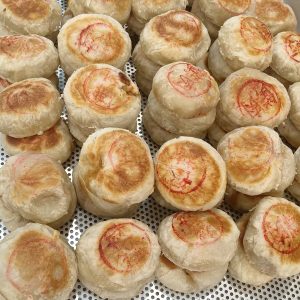
At lunch I opened the box in the pantry, not at my desk. Four small cakes, slightly uneven, stamped with a handmade mold that had slipped on one edge. The smell was lotus and something toasty. I cut a wedge. It was denser than the commercial ones, less glossy, more honest.
A coworker walked in, saw the box, and made the face Chinese colleagues make when they recognize labor: eyebrows up, voice soft. “她每年都做一点。” (She makes a few every year.) Not hundreds. A few. Which meant my four were not a marketing sample. They were inventory from a finite batch.
I ate slowly. I did not photograph the cross-section for Moments. Some gifts want an audience; this one wanted a closed mouth and a later message.
Reciprocity panic is a real condition
By 3 p.m. my mind had opened a spreadsheet nobody asked for:
- Buy a finer commercial box and present it tomorrow? (Risk: looks like I am pricing her work.)
- Bake something back? (Risk: my oven skills are a rumor.)
- Fruit and tea? (Risk: fruit trauma flashbacks from another story.)
- A handwritten note and a modest return later? (Boring. Possibly correct.)
I messaged a Chinese friend outside the company: “同事给了自制月饼,我应该马上回吗?” (Colleague gave homemade mooncakes — should I reciprocate immediately?)
Her reply landed like a seatbelt: “先认真谢谢,吃了反馈。别用更贵的盒子压过去。过两天带点她喜欢的小东西就行。” (Thank her properly first, eat, give feedback. Don’t crush it with a pricier box. In a couple of days bring a small thing she likes.)
Reciprocity, she was saying, is a conversation — not an auction.
What I wrote on WeChat that night
I took a photo of the empty wrapper on my home plate — not styled, just true — and wrote:
“今天的月饼太用心了,我在家认真吃了,皮和馅都很香。谢谢你愿意分享自己做的。中秋快乐!”
(Today’s mooncakes were so thoughtful — I ate them properly at home; crust and filling were lovely. Thank you for sharing something you made. Happy Mid-Autumn!)
She replied with a sticker and “下次告诉我甜度怎么样.” (Tell me next time how the sweetness was.) An invitation to continue, not to escalate.
The note mattered more than any counter-gift I could have launched the same afternoon.
Two days later I brought tea, not a trophy
I knew she kept a mug of dark tea on her desk like a personality trait. I brought a small tin of something decent from a normal shop — not a luxury mall flex — and said, “这是一点茶叶,不是‘还’月饼,就是想着你泡茶.” (Some tea — not ‘repaying’ the mooncakes, just thinking of you and your tea habit.)
She laughed at the careful framing. The laugh meant the framing had been transparent and also fine. We did not do a ceremony. We did not call the department over. Homemade gifts often want a small radius.
What I got wrong at first
I almost performed gratitude too loudly in the team group. That would have drafted her into a public spotlight she had not asked for — including pressure on other colleagues who had not baked. Private thanks first; public mention only if she posted first.
I almost asked for the recipe in the same breath as thank you. Curiosity is good; demanding labor (“write me the grams”) is another gift extraction. I waited a week. She offered a rough method on her own.
I almost stored the cakes in a warm drawer “for later” as if they were immortal. Homemade is perishable hospitality. Eat sooner. Fridge if she says so.
The wider office weather around us
HR still handed out branded boxes. Someone still joked about salted egg yolks. A manager still forwarded a Mid-Autumn party invite — the kind of gathering we describe in Culture as what to expect at a Mid-Autumn office party. None of that canceled the homemade thread. Festivals hold multiple registers at once: corporate, family, and the quiet desk-to-desk kind.
Golden Week ticket talk hummed in the background — trains, makeup days, who was on duty. I thought about how easy it is, as a foreigner, to treat every Chinese festival as a logistics problem. She had treated it as a kitchen problem. The kitchen problem felt more like belonging.
Practical takeaways I now keep
1. If someone shares homemade festival food, thank specifically — name the effort, not only the calories.
2. Do not immediately over-gift — especially not with a costlier commercial tower that turns affection into comparison.
3. Report back after eating — a short WeChat with honest taste notes completes the loop.
4. Keep the radius small unless they choose publicity.
5. Return with preference knowledge — tea, fruit they like, a book, help on a task — not a generic SKU.
6. Ask before you post — flour and family recipes can be private.
7. Learn the calendar, but leave room for gestures that are not on HR’s PDF.
If you are the foreigner who only knows supermarket mooncakes, start there — guides exist for a reason. Just leave a blank line in your plan labeled “human.” That line is where homemade arrives.
Coda: the mold with the slipped edge
I kept the memory of the imperfect stamp longer than the taste. Commercial cakes are designed to photograph. Hers was designed to be handed across a desk without a press release. When National Day decorations went up the following week and the office began its Golden Week migration, I still had the tea tin on my shelf. It was not a symbol of China in the abstract. It was a symbol of one colleague who decided I was inside the few.
I used to think Mid-Autumn competence meant buying the correct box. Now I think it also means recognizing when someone has already spent their evening on you — and answering in a scale that honors the evening, not the mall.
Questions about living and working in China? Write Lovely China at [email protected]. Lovely China was founded in 2025 to help English-speaking visitors and expats find practical footing — including the soft skills that never appear on a visa form.