The bus from Kaili to Xijiang rattles over a mountain pass, the road clinging to a ridge above terraced paddies that step down into mist. Inside, a woman in a pleated indigo skirt adjusts a silver headdress the width of a dinner plate, the pendants catching the weak afternoon light. She is heading home for the Sisters’ Meal Festival. I am heading there to watch. The distance between us is only the aisle, but the gap in what we carry—generations of stitching, songs, silver, and survival—feels like the valley below.
Silver as Savings, Silver as Story
In the market lane of Langde Upper Village, an old silversmith sits cross-legged on a wooden stool, hammering a sheet of white metal over an anvil worn smooth by decades of strikes. The rhythm is hypnotic: *ting-ting-pause, ting-ting-pause*. He isn’t making jewelry for tourists. He is crafting a neck ring for a newborn’s hundred-day celebration, the silver meant to protect the child from spirits that steal breath in the night.
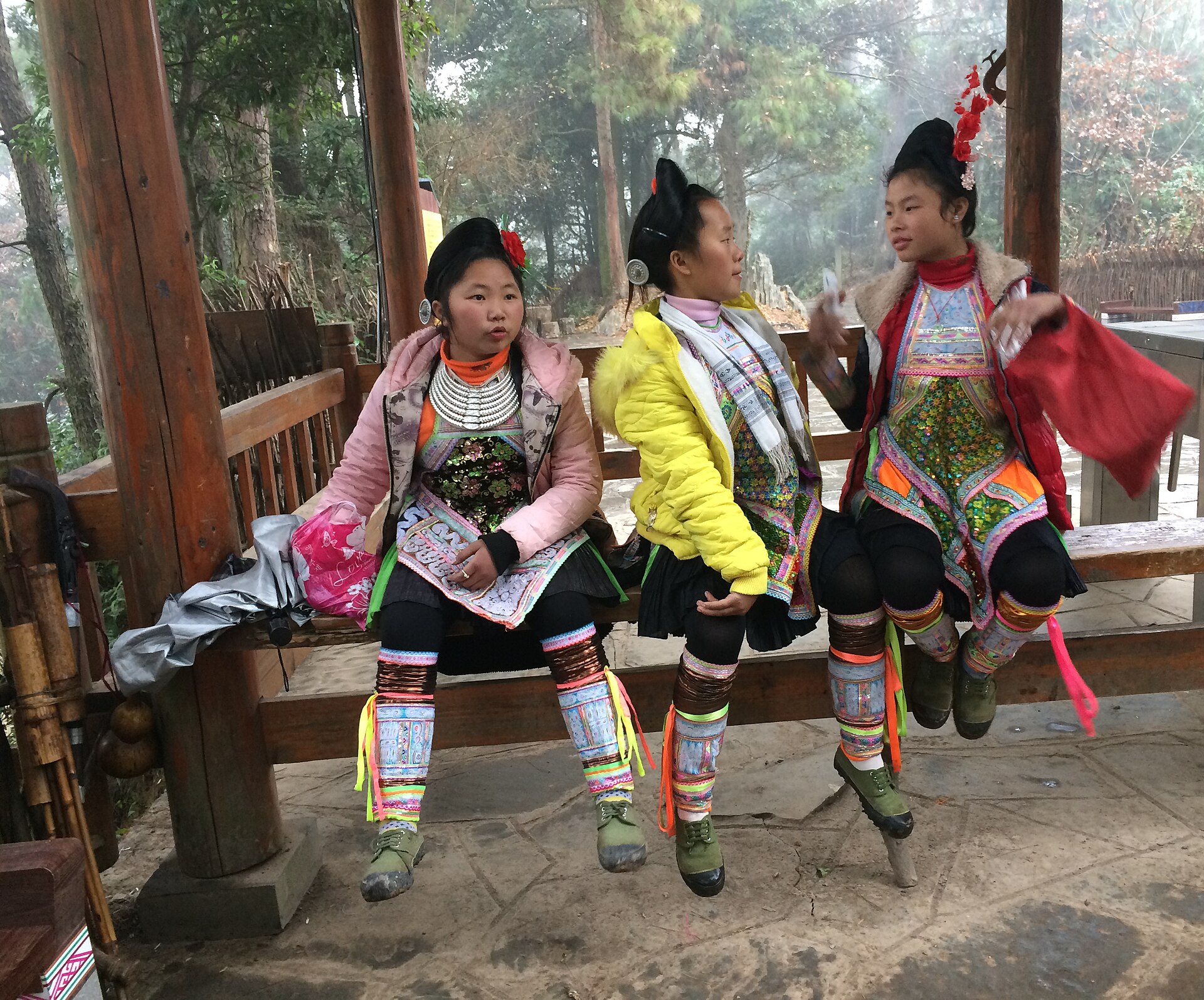
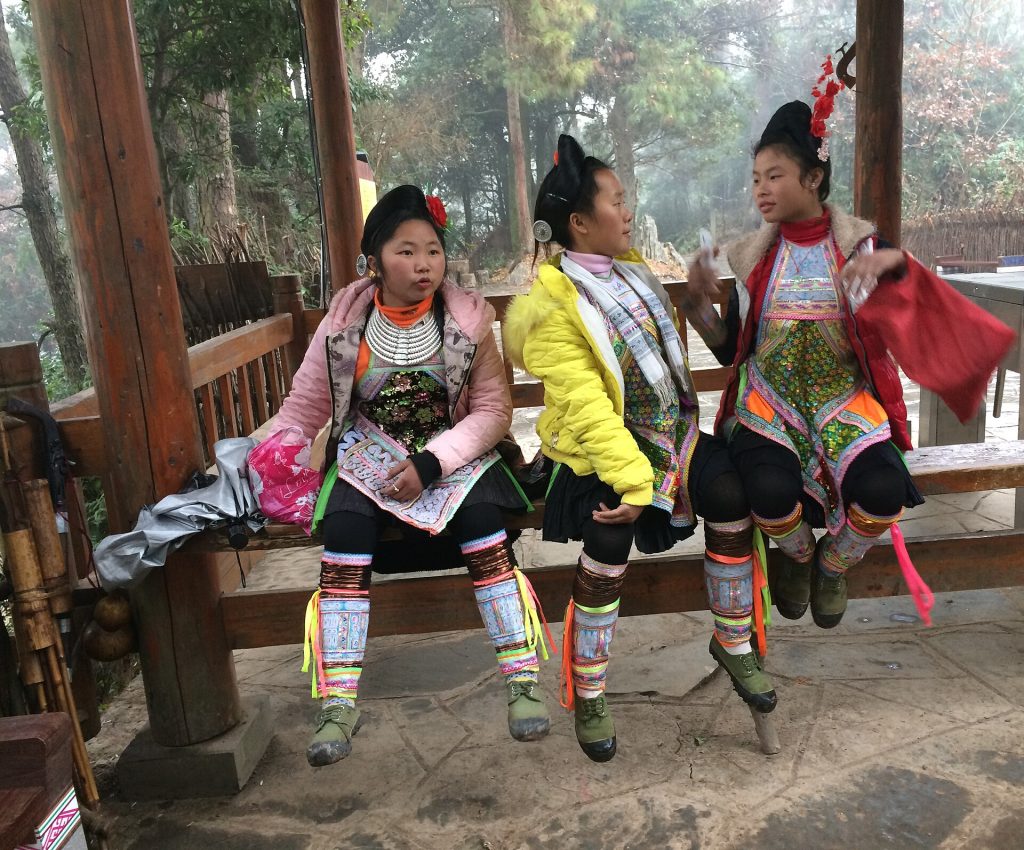
Among Miao communities, silver functions as portable wealth, dowry, and spiritual armor all at once. A family’s status reads in the weight of a woman’s festival attire—horned headdresses layered with chains, phoenix crowns trembling with bells, neck rings stacked to the chin. A full set can exceed ten kilograms. Women wear them for hours during dancing, the sound a constant shimmer that announces their presence before they enter a courtyard.
Headdress frames: hammered from thin sheets, shaped over wooden molds, often topped with silver horns or phoenix wings.
Neck rings: solid or hollow tubes, sometimes engraved with dragon motifs, stacked in odd numbers for luck.
Chest plaques: rectangular or heart-shaped, chased with flowers, birds, or the butterfly mother from creation myths.
Ear pendants: long drops that brush the shoulders, each movement a flash.
Bracelets and anklets: cuffs wide as a thumb, clasped with hidden springs.
If you buy a piece, ask the maker to explain the pattern. A butterfly means origin; a fish, fertility; a spiral, the cycle of seasons. Mass-produced replicas from factories in Guangdong lack these narratives. The weight difference is immediate—hand-hammered silver feels dense and cool; cast pieces feel light and warm quickly in the palm.
Cloth That Speaks Without Words
In a courtyard house in Datang Short Skirt Village, a grandmother unfolds a length of indigo cotton. The fabric is stiff, smelling of wood ash and fermented dye. She points to a band of embroidery along the hem: tiny triangles marching in rows, each stitched with a single thread, no knots visible on the reverse. “This is the mountain path our ancestors walked,” she says in Southwestern Mandarin, her Miao dialect too fast for me to follow. “The triangles are the switchbacks. The red thread is the blood spilled on the climb.”
Miao textiles are archives worn on the body. Without a widely used written script until missionaries devised one in the late nineteenth century, patterns recorded migrations, battles, treaties, and cosmology. Pleated skirts—sometimes forty meters of fabric folded into hundreds of knife-sharp pleats—hold pleating memory in the fibers. A woman sits on a low stool, a pleating knife in hand, running the blade along each fold to refresh it after washing. The sound is a soft *shhh-shhh*, like wind through bamboo.
Base cloth: hand-loomed cotton or hemp, narrow width, sewn selvedge to selvedge.
Indigo dye: fermented in earthen jars for weeks, dipped twenty to forty times for black-blue depth.
Embroidery stitches: satin stitch for solid areas, braid stitch for outlines, seed stitch for texture, couched metal thread for highlights.
Motif placement: collar bands protect the throat; sleeve cuffs guard the wrists; skirt hems defend the legs—all vulnerable points for wandering spirits.
Pleating: done wet, set with rice paste, pressed under stone weights for days.
A visitor who pulls out a phone to photograph a woman’s skirt without asking commits a breach worse than rudeness—it treats living culture as scenery. Ask first. Offer a small gift: a pack of good cigarettes for an elder, a notebook for a girl who shows you her stitching. Sit on the threshold stool. Drink the oil tea offered in a wooden bowl, bitter and salty with puffed rice. The conversation that follows will teach you more than any museum label.
Festivals Where the Village Becomes a Stage
The Lusheng Festival in Zhouxi kicks off before dawn. Men and boys circle a fire pit, each blowing a *lusheng*—a mouth organ of six bamboo pipes fitted into a gourd wind chest. The sound is reedy, polyphonic, vibrating in the chest cavity. They dance counterclockwise, feet stamping in unison, the silver on their chests flashing. Women form an outer ring, steps smaller, skirts swaying. The dance lasts three days. By the final afternoon, the reed tongues in the pipes have warped from moisture; players swap instruments like guitarists changing guitars mid-set.
The Sisters’ Meal Festival in Taijiang follows a different script. Young women spend days cooking glutinous rice dyed with maple leaves (red), turmeric (yellow), purple vine (purple), and mugwort (green). They pack the rice into bamboo tubes, seal them with banana leaves, and steam them over wood fires. At the riverside, they wait. Young men arrive singing antiphonal songs—call and response, improvising verses about the girl’s eyes, her embroidery, her family’s buffalo. If a girl accepts a suitor’s song, she hands him a rice parcel. Inside, a hidden token tells the future: chopsticks mean “come eat at my house”; a chili means “you’re too hot, slow down”; a garlic clove means “no, go away”; a cotton flower means “let’s be friends first.”
Lusheng Festival: usually the 16th to 20th of the first lunar month; check locally, dates shift.
Sisters’ Meal Festival: fifteenth day of the third lunar month; main activities in Taijiang and Shidong townships.
New Rice Festival: eighth lunar month, celebrating first harvest; families offer new grain to ancestors before eating.
Dragon Boat Festival on the Qingshui River: not the Han version—Miao boats are narrower, crews sing while rowing, races last all afternoon.
What to bring: rain gear (mountain weather turns fast), a stool if you plan to sit for hours, cash for food stalls (no mobile signal for QR codes in some valleys).
Outsiders often cluster at the edges, cameras raised. Locals notice. The better spot is beside the drum tower, where elders sit judging the dancers’ form. They will explain the score if you ask quietly: “That boy’s knee lift is weak—his grandfather would have slapped his thigh.” Humor is a doorway. Laugh with them at a missed step, and you become part of the crowd, not a spectator.
Daily Rhythms: Fields, Fire Pits, and the Drum Tower
Morning in a Miao village begins with the *thock-thock* of a wooden pestle in a stone mortar—pounding tea leaves for oil tea, or glutinous rice for cakes. Smoke curls from the central fire pit of a *diaojiaolou* stilt house, the hearth built on a bed of packed earth and ash three generations deep. The fire never fully dies; it is the household’s pulse. Above it, hams cure, corn dries, and herbs hang in bundles—mugwort for moxibustion, honeysuckle for fever, a root nobody translates but everyone knows cures a cough.
The drum tower stands at the village’s geometric heart. Not a clock tower—no clock. A meeting place, a courtroom, a guesthouse, a stage. The drum inside is a hollowed camphor log, skin stretched tight, beaten to summon villagers for weddings, funerals, disputes, or a visiting official. When the drum sounds, men gather on the tiered benches, pipes lit, tea bowls steaming. Women stand at the periphery, children weaving between legs. Decisions are made by consensus, not vote. A stranger who walks in during a session should bow to the eldest man, take the offered seat at the back, and stay silent until invited to speak.
Morning chores: feed pigs, collect eggs, carry water in shoulder poles from the spring, tend the fire.
Midday meal: oil tea with puffed rice, pickled vegetables, chili paste pounded fresh in a stone bowl.
Afternoon: field work (rice, rapeseed, tea), or handicraft production (embroidery, batik, silver) for cash income.
Evening: family eats around the fire pit; stories told in dialect, children memorizing epic songs line by line.
Night: drum tower locks; the village quiets except for the occasional dog bark or lusheng practice from a bachelor’s loft.
If you stay overnight in a family’s upper floor—sleeping on a bamboo mat over wooden planks, the roof tiles glowing faintly from the last fire embers—you will hear the house breathe. Timber joints creak with temperature changes. Rats may skitter in the ceiling. The hostess will wake you at five with a bowl of hot oil tea pressed into your hands before you’re fully upright. Drink it. It is the only polite response.
Mistakes That Close Doors
I watched a tour group enter a village during a funeral. They posed for selfies beside the coffin, flash on. The drum tower fell silent. An elder approached the guide, spoke low and fast, and the group was escorted out within ten minutes. The village closed to visitors for three days. No explanation given. None needed.
Death rituals are strict. White cloth hangs over the doorway. No singing, no lusheng, no bright colors for forty-nine days. A foreigner who wears a red jacket to a wake signals ignorance so profound it offends the ancestors. If you hear wailing from a house, detour. Do not photograph. Do not ask “what happened.” Your presence is already an intrusion; curiosity compounds it.
Never step on the threshold beam of a *diaojiaolou*—it holds the family’s protective spirits.
Do not touch a child’s silver amulet without the mother’s permission; it breaks the spiritual seal.
Refuse the first bowl of rice wine offered by a host—you will be asked three times. Accept on the third. Sip, don’t gulp.
Never point at a person with chopsticks, or stick them upright in rice—both mimic funeral rites.
Do not praise a baby’s beauty loudly—”so fat, so cute” attracts the *gu* spirit that steals health. Say “hard to raise” instead.
Language trips up even well-meaning guests. “Miao” is an exonym; many prefer “Hmong” or their specific subgroup name—Hmub, Xong, A-Hmao. Using the wrong label in a mixed group can cause quiet offense. Listen to how people introduce themselves. Mirror their term. If you are corrected, nod, repeat the correct word, and move on. No apologies needed; the correction was the teaching.
Leaving Without Taking
The last bus down the mountain leaves at four. The silversmith has packed his tools. The grandmother has folded her indigo cloth. The lusheng players have wiped condensation from their reeds. I carry a small silver fish pendant bought from the smith—he insisted I take it without payment, saying “You listened.” I carry a notebook of pattern sketches the girl in Datang drew for me. I carry the taste of oil tea, bitter and warm.
The Miao people I met did not perform for me. They lived while I watched. The difference matters. If you go, walk slowly. Speak softly. Eat what is offered. Ask before you point a lens. And when the drum beats, stand at the back of the crowd. Let the sound move through you. That is the only way to hear what the patterns are saying.