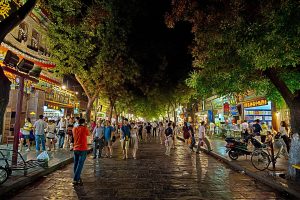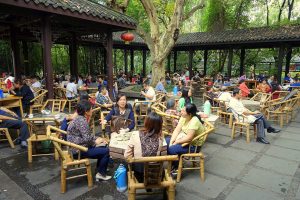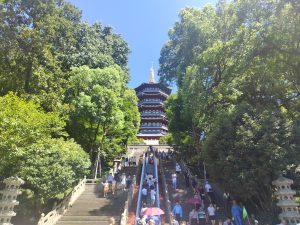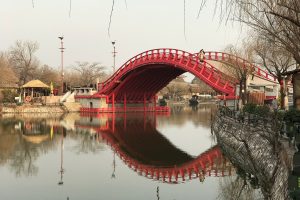
The minibus rattles to a halt on a dusty pullout just north of the old town’s north gate. Steam rises from a vendor’s copper pot of rice noodles, and the air smells of woodsmoke and wet stone. Cangshan’s peaks loom close enough to touch, their ridges striped with snow even as the valley bakes in late spring sun. You step down onto cracked flagstones, adjust your pack, and realize the “ancient” city wall beside you is mostly new brick mortared over a core of rammed earth. This is Dali: half museum, half living market, all of it perched between a lake and a mountain range that decides the weather for everyone.
Getting There and the First Kilometer
Most travelers fly into Dali Fengyi Airport or arrive on the high‑speed rail line that now stitches Kunming to Lijiang in under three hours. From the station, a green city bus (route 8 or 4) drops you at the north gate for a few yuan; a taxi costs roughly thirty and saves twenty minutes of stop‑and‑go traffic. If you come overnight on the sleeper from Kunming, the platform is chaotic at dawn — porters shouting, breakfast carts steaming — but the walk from the station square straight down Renmin Road lands you at the old town’s edge in thirty minutes flat. Skip the horse‑cart touts at the gate; they charge tourist rates for a ride you can make on foot while orienting yourself.
Where to Sleep: Alley vs. Lakeside
The old town’s grid of cobbled lanes hides dozens of courtyard guesthouses. Book a room with a rooftop terrace facing west — you’ll watch the sun ignite Cangshan’s nineteen peaks while drinking tea you brewed yourself. Prices climb sharply during the Third Moon Fair (the third lunar month) and the October holiday week; reserve a month ahead or accept a windowless back room. Quieter alternatives cluster around Erhai’s eastern shore: Caicun and Shuanglang have converted fisherman’s cottages with lake views and bicycles included. The trade‑off is a thirty‑minute bus ride into the old town for dinner, but you gain mornings where the only sound is water lapping the seawall.
Two Wheels and the Lake Loop
Rent a sturdy mountain bike — not a city cruiser — from a shop near the south gate. Test the brakes on the steep descent from the Chongsheng Temple parking lot before you commit. The full Erhai loop is roughly 120 kilometers of lakeside road, village lanes, and occasional highway shoulder. Most riders break it into two days: clockwise to Xizhou on day one, overnight in a Bai family courtyard, then the western shore back to Dali on day two. Pack a windbreaker; the lake funnels gusts that can knock a loaded pannier sideways. Stop at the “S‑bay” viewpoint mid‑afternoon for grilled fish wrapped in lotus leaf, sold from a blue tricycle by a woman who remembers every foreigner’s face.
Cangshan: Cable Car or Cloud Pass?
Three cable‑car lines climb the mountain from different gates. The Gantong route (west of the old town) deposits you at 3,200 meters with a boardwalk that skirts sheer cliffs — spectacular but crowded after ten a.m. For solitude, hike up the Cloud Pass trail from the university campus behind the north gate. The path climbs through rhododendron forest, crosses a scree field, and emerges on a ridge where yak herders boil tea in dented aluminum kettles. Allow six hours round‑trip; carry two liters of water and a headlamp. Weather turns fast — mist can erase the trail markers in minutes. Locals say the mountain “closes its eyes” at noon; believe them and start at first light.
Market Days and Bai Hospitality
Xizhou’s morning market runs every fifth day on the lunar calendar (the 2nd, 7th, 12th, 17th, 22nd, 27th). Arrive before eight when farmers unload baskets of purple eggplant, fermented bean curd, and live carp. The Bai women in indigo headscarves will invite you to taste “three‑course tea” — bitter, sweet, then spicy — poured from a long‑spouted copper pot. Accept with both hands; refusing is impolite. In the old town, the Saturday night market on Foreigner Street sells tie‑dye scarves and silver jewelry, but the real action is the back‑alley hot‑pot stalls where locals order by weight: sliced beef tripe, lotus root, hand‑rolled noodles. Point at the pot, hold up fingers for portions, and pay when you leave.
Common Missteps
- Treating the old town as a theme park open 24/7 — most family shops shutter by ten, and the gates lock at midnight.
- Buying “antique” Bai textiles from stalls that also sell plastic keychains; genuine pieces are woven at home and sold by appointment.
- Assuming Erhai’s water is clean enough to swim; agricultural runoff makes it murky by summer. Stick to the designated beach at Shuanglang.
- Skipping travel insurance that covers altitude — Cangshan’s passes exceed 3,500 meters, and even fit hikers get headaches.
- Expecting English menus outside the main tourist strip. Carry a photo dictionary or the Pleco app; pointing at a neighbor’s bowl works better than charades.
You’ll leave Dali with dust on your calves, a bag of vacuum‑packed ham, and the taste of that third cup of tea — chili heat blooming behind the sweetness. The mountain stays, the lake stays, and the next bus north to Tiger Leaping Gorge pulls out at seven sharp. Be on it.