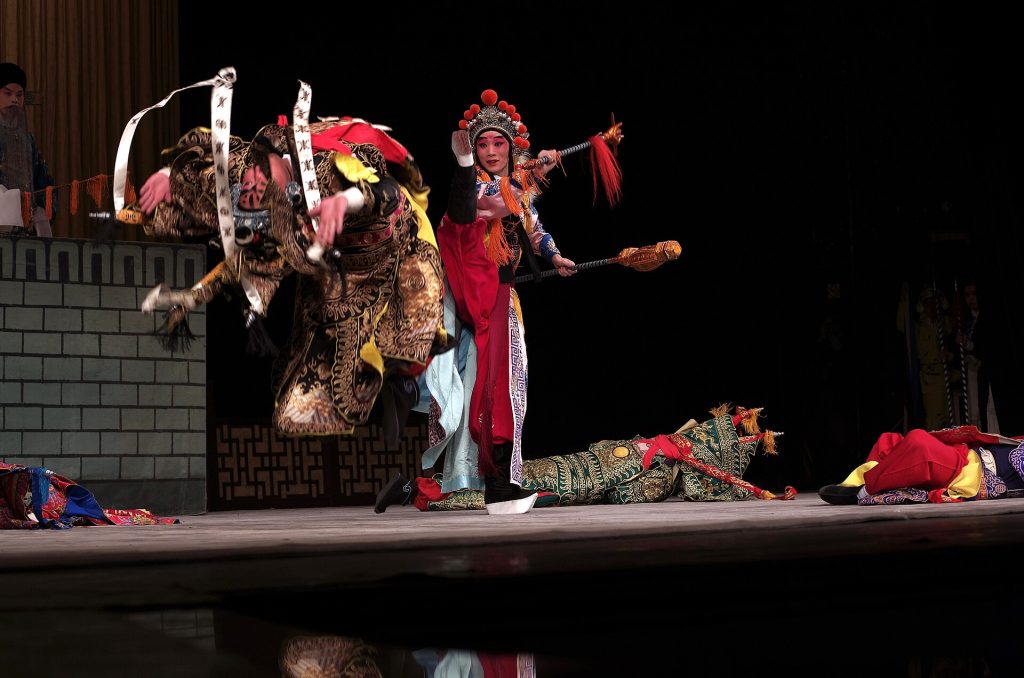
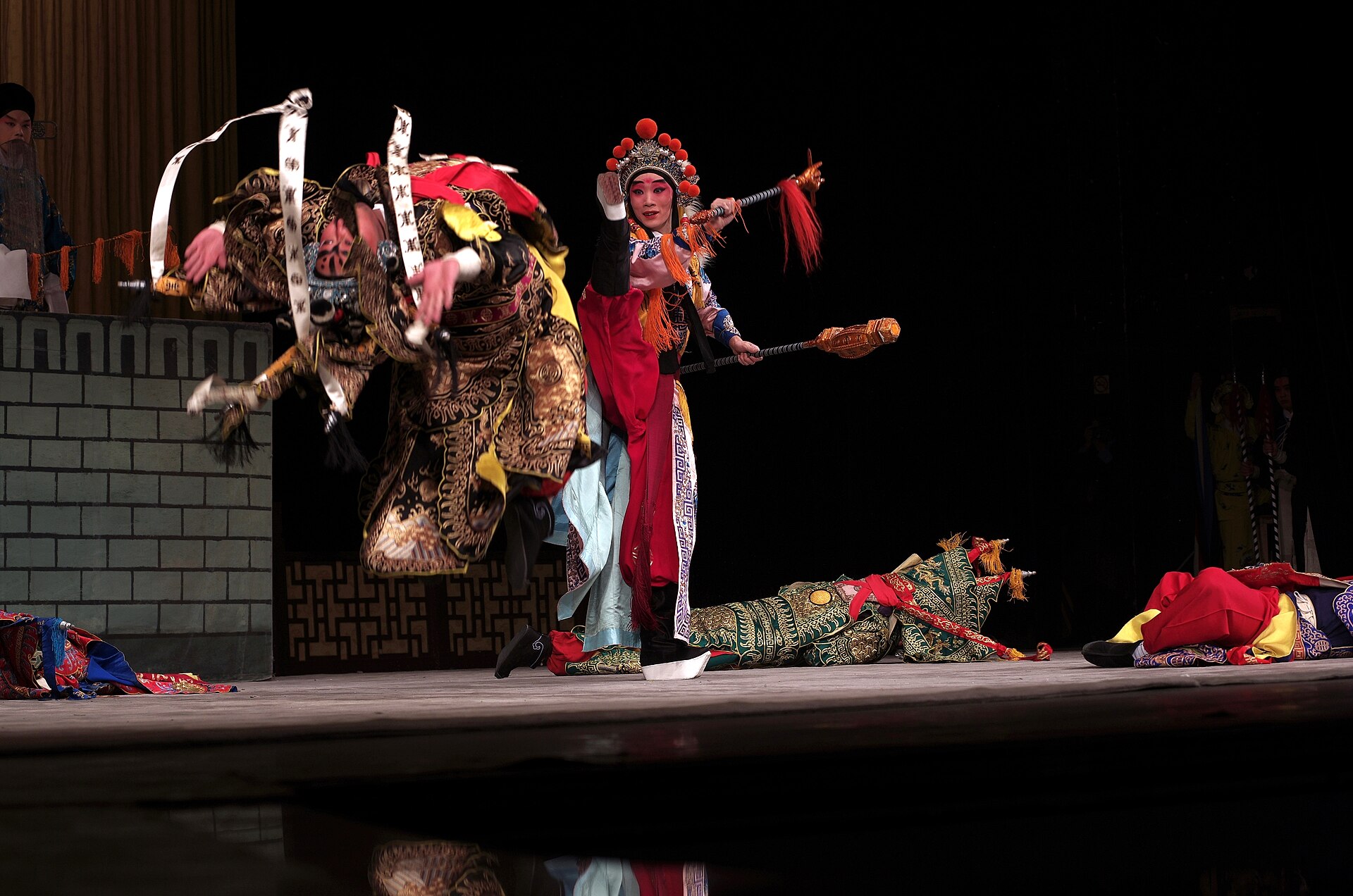
The house lights dim at the Huguang Guild Hall. A single gong strike hangs in the air, sharp and final. On the bare stage, a performer in a water-sleeve costume flicks silk the length of her arm, and the fabric catches the light like liquid mercury. No curtain rises. No set changes. The entire world — a palace garden, a battlefield, a mountain pass — lives in the angle of a wrist, the stamp of a boot, the pitch of a falsetto that slides into a growl. This is not theater you watch. It is theater you learn to read.
What the roles actually mean
Four archetypes carry every story. Shēng are the men — scholars, generals, emperors. The lǎoshēng wears a beard and sings in a mellow baritone; the xiǎoshēng is young, clean-shaven, and often sounds like a woman because his voice has not broken onstage. Dàn are the women. The qīngyī walks with tiny, gliding steps, sleeves covering her hands, voice high and trembling with restraint. The huādàn flirts, teases, and chatters in a natural speaking register. Jìng are the painted faces — warriors, judges, bandits. Their makeup maps character: red for loyalty, white for treachery, black for blunt integrity, gold for gods and spirits. Chǒu is the clown, a white patch on the nose signaling he can speak plainly, break the fourth wall, and puncture the hero’s dignity with a joke.
Beginners stare at the paint and miss the code. A jìng with a black face and a white crescent on the forehead is not just a fierce general — he is Bao Zheng, the incorruptible judge who tried the emperor’s own relatives. The makeup is the resume. Memorize the top ten patterns and the stage stops looking like chaos.
How a night unfolds
Performances rarely run straight through a three-hour epic anymore. Troupes serve “zhezixi” — highlight acts — so a program might stitch together the duel from Farewell My Concubine, the courtroom scene from The Case of the Black Basin, and the acrobatic spear fight from Havoc in Heaven. You buy a ticket for the evening, not a single narrative. Arrive twenty minutes early. The lobby sells folding fans printed with role masks, and the tea is included in the price at most traditional venues. Sip it while the orchestra — jinghu fiddle, yueqin moon lute, clappers, gongs — tunes in plain view. The musicians are part of the show. The conductor cues a cymbal crash the exact millisecond a performer’s heel strikes the floor.
Subtitles run on screens above the stage: Chinese on one side, English on the other. They translate the poetry, not the plot. When the heroine sings “tears like broken pearls,” the screen reads exactly that. You must already know she has just learned her husband is dead. Read a synopsis on the subway ride over. The program booklet helps, but the light is too dim once the show starts.
Where to sit, where to watch
Three venues define the Beijing experience. The Huguang Guild Hall, rebuilt after fire, keeps the courtyard atmosphere: wooden pillars, rickety chairs, and a stage that feels close enough to smell the face powder. The National Centre for the Performing Arts — the giant egg west of Tiananmen — offers plush seats, air conditioning, and a touring troupe from Shanghai or Tianjin once a month. Liyuan Theatre inside the Qianmen Hotel runs a nightly tourist-friendly digest at 7:30 p.m., ninety minutes with English narration. Purists sneer, but the acrobatics are genuine and the tickets are easy to book online.
For a raw rehearsal vibe, walk into the back courtyard of the Beijing Peking Opera Theatre on a weekday morning. Students in tracksuits drill spear flips and backbends on concrete. No ticket required. Stand quiet against the wall. If the coach nods, you may stay.
What the orchestra tells you
The jinghu leads. Its two strings, bowed with a bamboo stick, slide between registers like a human voice. When the tempo accelerates into kuaisanyan — fast three-eye rhythm — the hero is charging into battle. When the gong rolls long and low, a ghost has entered. The clappers (ban) mark the beat, but the drummer is the real director. He watches the actor’s breath. If the singer holds a note a fraction longer, the drum waits. That elasticity is the art. Western ears expect a click track. Here, the music breathes with the performer.
Mistakes that mark you as a novice
- Applauding after every aria. The convention: clap when the performer strikes a final pose — “ding” — and holds it. That frozen moment is the bow.
- Expecting realistic props. A whip means a horse. An oar means a boat. A flag planted in the floor means an army. The stage stays empty so the imagination fills it.
- Confusing the falsetto. Male dàn specialists train from childhood to sing in a high register that is not imitation but a distinct vocal category. Calling it “men pretending to be women” earns a cold stare from the aficionado next to you.
- Leaving at intermission. The second half often contains the most difficult martial sequences. The monkey king’s staff work in Havoc in Heaven usually closes the program.
- Photographing with flash. The actors’ eyes are painted to catch stage light. A phone flash blinds them mid-backflip. House staff will eject you.
A practice you can try at home
You will not master the water sleeves in a living room, but you can train the gaze. Sit on a low stool. Hold a teacup with thumb and forefinger, pinky extended. Turn your head slowly left, eyes following an invisible bird. The neck moves first, then the shoulders, then the torso — never the hips. Count eight beats for a full rotation. Do it again right. This is shèn yǎn, spirit eyes. Every role, from emperor to bandit, begins here. When the bird lands, your fingers tighten on the cup. That tension is the story.
Next time you enter a guild hall, you will not just hear the gong. You will see the bird land.