The morning mist clings to the Songhua River, turning the water into a sheet of pale jade. From the riverside promenade near Beishan Park, you can hear the low churn of a freight barge pushing upstream before you see it. An old man in a Mao suit practices tai chi on the concrete plaza, his movements slow enough to match the current. Across the water, the onion domes of a Russian Orthodox church catch the first light, a reminder that this city has changed hands more times than the deck of cards in a back-alley game. Jilin City does not shout for attention; it simply exists, layered and lived-in, waiting for you to walk its grid.
Orienting Yourself on the Grid
The city center sits in a tidy rectangle. The Songhua River forms the southern boundary, broad and brown in summer, frozen hard enough for trucks in January. Railway tracks cut a straight line along the north. Tianjin Jie runs north-south on the eastern flank, Bei Da Jie mirrors it on the west. Inside this box, the rebuilt hutongs twist like intestines—narrow, shaded, smelling of coal smoke and frying dough. You do not need a map. Pick a direction and walk until you hit water or steel; the river and the tracks will always spit you back out onto a main road.
Most of the “old” architecture dates to the 1990s reconstruction, but the layout follows the Qing garrison plan. The mosques and small temples tucked between dumpling shops and phone-repair stalls are active, not museum pieces. If you hear the call to prayer echoing off tile roofs, you have found the Hui quarter near the river’s west bend. Stay long enough to watch the butcher shave lamb for hand-pulled noodles; the rhythm of his cleaver is the neighborhood’s metronome.
River Time: The Songhua in Four Seasons
The river is not scenery here; it is infrastructure. In the heat of the sixth lunar month, families stake out patches of grass on the north bank, spreading watermelon rinds and plastic stools. Vendors push carts of grilled squid and chilled mung bean soup through the crowds. Come the depth of winter, the surface thickens to a meter of ice. You will see sedan cars driving shortcuts across the frozen span, while farther out, fishermen sit on upturned buckets beside dark holes, pulling up carp the length of your forearm.
The rime ice—shuguang—arrives in the twelfth lunar month when the hydroelectric dam upstream releases water warmer than the air. Fog freezes on every willow branch and power line, coating the riverside trees in white feathers that shatter at a touch. The best viewing is before dawn from the Songhua River Bridge. Bring a thermos of hot barley tea. The tour buses arrive by nine; the magic lifts with the sun.
Eating Your Way Through the Hutongs
Food in Jilin City leans heavy, salty, and sour—the fuel for surviving wind that cuts through wool. The signature dish is guobaorou, sweet-and-sour pork strips battered twice so the crust survives a ladle of vinegar sauce. A proper version crackles like broken glass when you bite; the meat inside stays pink and juicy. Order it at any northeastern restaurant, but the stall on the corner of Changchun Lu and the third alley north of the railway station does it over charcoal, which adds a smoke the wok cannot fake.
- Guobaorou (锅包肉): pork tenderloin, potato starch, egg white, rice vinegar, sugar, ginger, garlic, carrot threads, green pepper.
- Batter: mix starch, egg white, and a splash of water until it drips in ribbons.
- First fry: 160°C oil, slide in strips, cook until pale gold, drain.
- Sauce: vinegar, sugar, minced ginger, garlic, splash of soy, thicken with starch slurry.
- Second fry: 190°C oil, refry strips ten seconds for crunch.
- Toss: throw pork into wok with sauce and vegetables, one quick turn, plate immediately.
Breakfast is a street affair. Look for the steam rising from a flat griddle before 7 a.m. Jianbing here skips the sweet bean sauce; instead, the cook smears fermented tofu and chili oil, adds a cracked egg, a handful of cilantro, and a crisp youtiao stick. Fold, slice, hand over in a paper bag. Eat standing, wiping fingers on the napkin provided. For a sit-down noon meal, seek a tieguo dun—iron-pot stew. The server brings a cast-iron pot sealed with dough around the rim. When the dough cracks, the seal breaks, releasing pork belly, vermicelli, cabbage, and blood sausage in a broth thickened by collagen. Tear the dough lid into the soup; it dissolves into dumpling skins.
Getting There and Moving Around
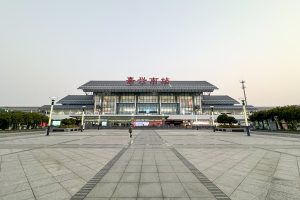
High-speed trains from Changchun take twenty minutes; from Shenyang, ninety. The station sits just north of the hutong district, a ten-minute walk to the river. Long-distance buses pull into the terminal on Beijing Jie, convenient if you are heading to the ski slopes at Beidahu or the crater lake of Changbai Mountain. Taxis are plentiful and metered, but drivers rarely speak English. Have your destination written in characters or pinned on a map app. The city bus network is dense—routes 1, 11, and 33 cover the river loop and the railway station. Pay with a transport card or exact change; drivers do not carry coins.
Shared bicycles cluster near every subway entrance and university gate. Scan the QR, unlock, ride. The terrain is flat, but winter ice turns bike lanes into skating rinks. If you visit between the tenth lunar month and the second, walk or take a car. The cold is not theoretical; exposed skin burns in minutes, and phone batteries die in pockets.
Mistakes That Mark You as a Novice
First, assuming the city shuts down after dark. The night market on Songjiang Zhong Lu wakes at 10 p.m. and runs until the sky lightens. Grilled lamb kidneys, stinky tofu, candied hawthorn on sticks—the crowd is locals off shift, not tourists. Second, skipping the Meteorite Museum on the university campus because it sounds academic. The 1,770-kilogram iron lump in the main hall fell in 1976; you can touch a fragment. It is the only time you will hold a piece of the asteroid belt without leaving the atmosphere.
Third, dressing for the calendar instead of the wind. A sunny day in the first lunar month can hit minus twenty with a wind chill that finds every gap in your collar. Locals wear knee-length down coats, fleece-lined boots, and silk long underwear. Buy the underwear at any department store basement; it costs less than a coffee back home and weighs nothing in your pack. Fourth, expecting English menus. Point at a neighbor’s bowl, use a translation app, or learn the characters for pork (zhu), beef (niu), lamb (yang), and “no chili” (bu yao la). The cook will respect the effort.
Finally, treating Jilin City as a mere transit hub for Changbai Mountain. Spend one night in a riverside guesthouse. Wake before dawn, walk to the bridge, watch the rime ice glow in the sodium lights. The city reveals itself in that quiet hour—no tour groups, no hawkers, just the river breathing steam into the freezing air. That memory outlasts any summit photo.