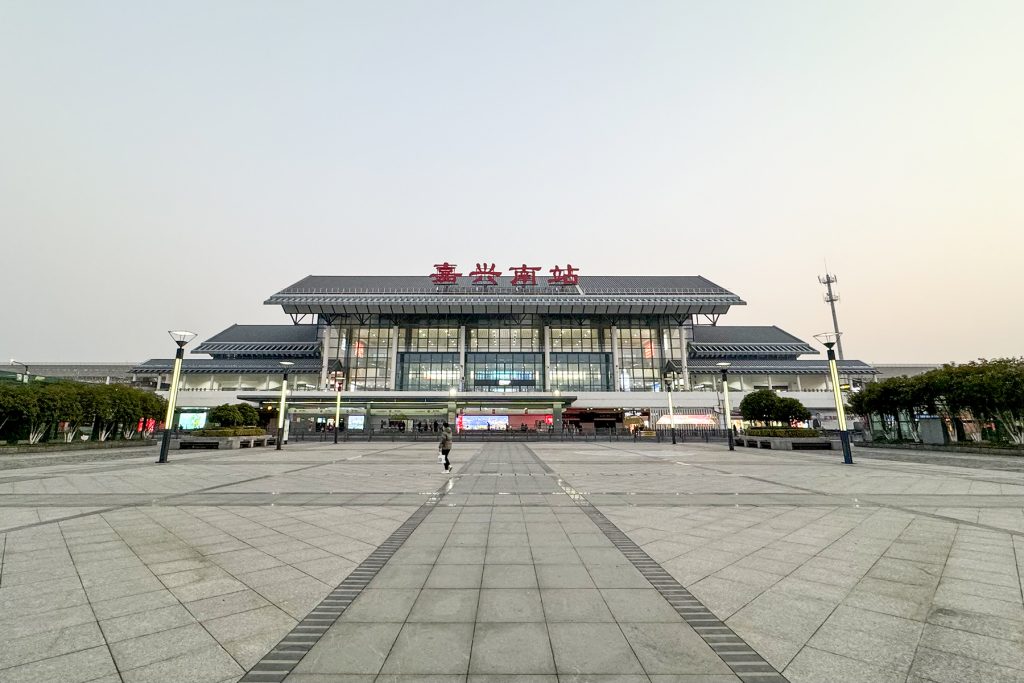
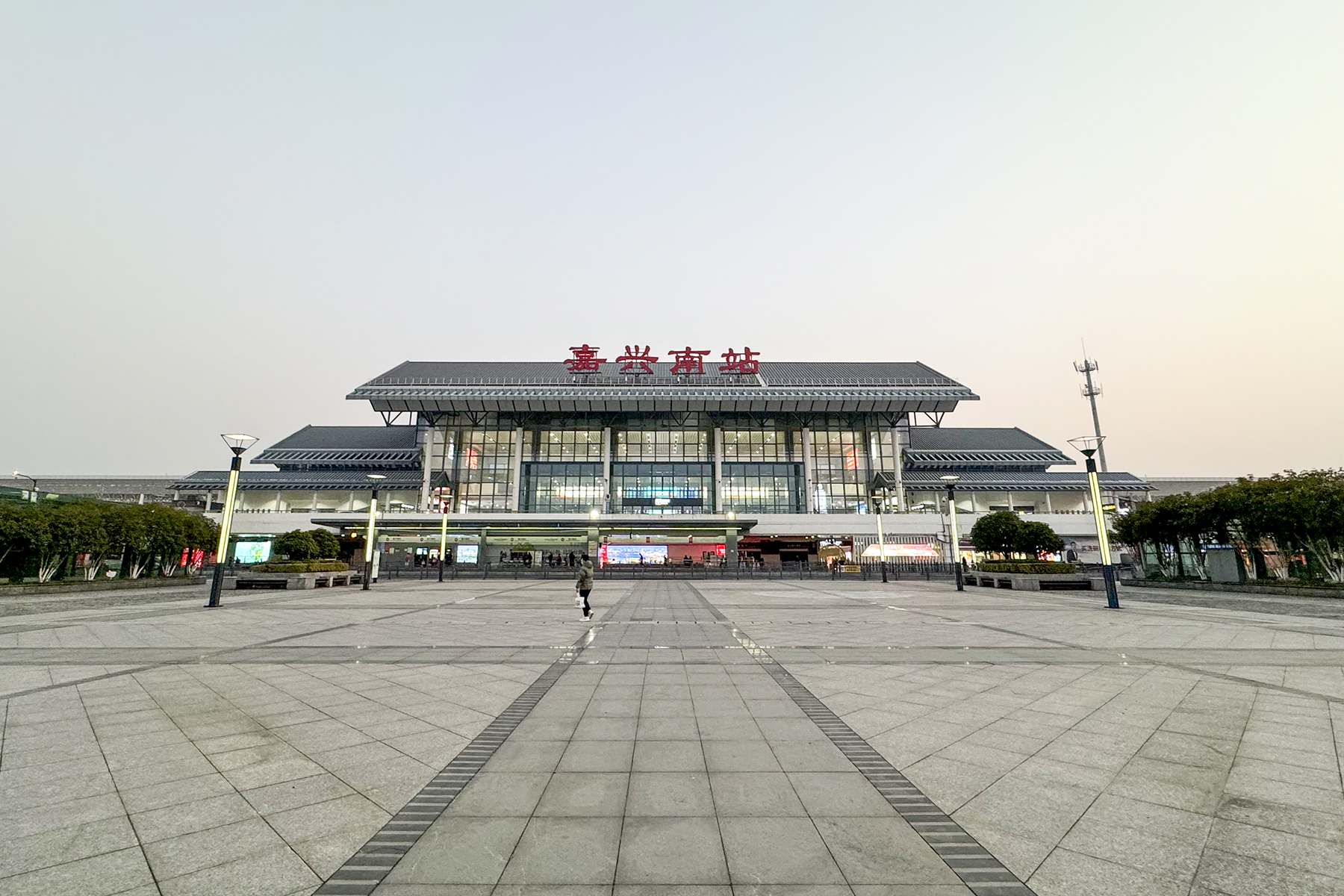
The high-speed train from Hongqiao slides into Jiaxing South in thirty-two minutes. Outside the station, the air smells of fried dough sticks and wet stone, and a row of electric bikes hums at the curb waiting for commuters. I step onto the pedestrian bridge that crosses the Beijing–Hangzhou Grand Canal, look down at a barge loaded with sand, and realize the city is already moving around me before I have even found a place to drop my bag.
Getting there and moving around
Trains from Shanghai, Hangzhou, Suzhou, and Nanjing run every fifteen to twenty minutes on the high-speed line; the conventional railway stops at the older Jiaxing station closer to the historic core. If you are coming from Shanghai for the day, the first morning departure gets you to South Lake before the tour groups arrive. Inside the city, the metro Line 1 links the high-speed station, the old town, and the South Lake scenic area. Buses cover the rest, but the most useful ride for a visitor is a shared e-bike — scan the QR code on the handlebar, pay a few yuan, and glide along the canal-side bike lanes that locals use for grocery runs.
South Lake: the boat, the island, the morning light
South Lake (Nanhu) is a wide, shallow sheet of water ringed by willows and stone embankments. The centerpiece is the Rainy Mist Tower on Misty Rain Island, reached by a short ferry ride from the south gate. I go at dawn, when the water is glass and the only sound is the ferry engine coughing. The tower’s red columns reflect perfectly; the view from the second floor takes in the whole lake, the distant pagoda of the Revolutionary Memorial Hall, and the rooftops of the old town peeking over the trees. Later in the day, the island fills with school groups and selfie sticks, so the early window is the one that feels like a painting rather than a checkpoint.
The old citadel and the streets around it
The old city wall is gone, but the Yuehe Historic Block preserves the grid of lanes that once sat inside it. Start at the Zicheng Gate reconstruction, then wander north along Yuehe Street. The storefronts are wooden, the signage hand-painted, and the upper floors still have the original latticed windows. A tailor measures a customer in a doorway; a tofu seller ladles steaming blocks into a plastic basin. Turn into a side alley and you find a courtyard house where an elderly woman rolls dough for scallion pancakes, the scent of oil and green onion drifting into the lane. There is no ticket gate — you simply walk, pause at a tea stall for a cup of Longjing, and let the rhythm of the neighborhood set the pace.
Wuzhen and Xitang: two canal towns, two rhythms
Both towns sit on the Grand Canal, both have stone bridges, whitewashed walls, and black-tiled roofs, but they wear tourism differently. Wuzhen’s East Scenic Zone feels curated: museums of woodcarving, indigo dyeing, and shadow puppetry line the main canal, and the evening light show projects history onto the water. I prefer the West Scenic Zone after the day-trippers leave — the guesthouses along the canal light lanterns, and you can sit on a stone step with a bowl of braised pork belly while the water laps the pilings. Xitang, thirty minutes west by bus, keeps a rougher edge. The covered corridors (langpeng) run for kilometers, so a sudden shower just means you walk under the eaves. The bars along the North Canal stay open late, playing folk songs on a cracked speaker, and the crowd skews younger — art students, backpackers, locals blowing off steam. If you have only one afternoon, Wuzhen gives you the postcard; if you have an evening, Xitang gives you the conversation.
Pinghu: the quiet neighbor
Pinghu rarely appears on the day-trip itineraries, and that is its charm. The old town sits on a peninsula jutting into East Lake. The Donghu Park loop is a flat five-kilometer walk past lotus ponds, a Ming-era pagoda, and a cluster of ancestral halls where families still burn incense on the first and fifteenth of each lunar month. The local specialty is pickled eel — thin slices cured in rice wine, ginger, and soy, served cold with a bowl of plain congee. I ate it at a family-run place on Zhongshan Road where the owner’s grandson did homework at the next table. No English menu, no pictures on the wall, just a chalkboard with the day’s catch. That anonymity is the point: you are a guest in someone’s daily life, not a spectator at a heritage site.
Food stops that are not tourist traps
Jiaxing’s cuisine leans sweet and savory, heavy on soy, rice wine, and freshwater fish. Three dishes you will see on every local table:
- Zongzi (肉粽) — glutinous rice wrapped in bamboo leaves with a core of marinated pork belly, chestnut, and mushroom. The rice should be sticky but distinct, the fat rendered into the grains. Buy them steaming hot from a stall near the South Lake north gate; eat with a dab of chili oil.
- Nanhu crab meat dumplings (南湖蟹肉小笼) — paper-thin wrappers, hot broth, sweet crab roe mixed with pork. Dip in black vinegar with shredded ginger. The best ones come from a second-floor shop on Yuehe Street where the bamboo steamers never stop cycling.
- Braised wheat gluten (红烧面筋) — chewy, spongy knots that soak up the dark soy braise. Vegetarians order it as a main; meat-eaters use it to mop up the sauce from the pork belly plate.
For a sit-down meal, head to the alley behind the Jiaxing Museum. A row of no-sign restaurants serves home-style dishes: steamed hairy crab in autumn, stir-fried river shrimp with tea leaves in spring, and a clay-pot rice with preserved sausage and greens year-round. Order by pointing at what the table next to you is eating.
What newcomers get wrong
- Treating the canal towns as a checklist. Rushing from bridge to museum to souvenir shop in two hours leaves you with photos but no feeling. Pick one town, stay for a meal, walk the back lanes after the crowds thin.
- Assuming the high-speed station is the city center. Jiaxing South is a modern transport hub surrounded by construction. The historic heart, South Lake, and the old streets are a metro stop or a ten-minute ride away.
- Skipping the off-season. Summer weekends are shoulder-to-shoulder. A misty autumn weekday or the week after the Spring Festival gives you the canals, the tea houses, and the boat rides almost to yourself.
- Expecting English signage beyond the main scenic zones. In the residential lanes of Yuehe or the back streets of Pinghu, menus and bus stops are Chinese only. Carry a translation app and a willingness to point.
I left Jiaxing on the last train of the night, the canal dark except for the reflection of the station lights. The city does not perform for visitors; it simply continues — fishermen mending nets at dawn, grandmothers bargaining over lotus roots, students cycling home under the willows. If you slow down enough to match that rhythm, even a day trip feels like a stay.