The steam rising from a copper hot pot in a Shenyang courtyard carries the scent of pickled cabbage, fatty pork, and fermented soybean paste. Around the table, a grandmother slips a dumpling into a toddler’s bowl with chopsticks that have seen four generations. She speaks Mandarin with a slight rounding of vowels, a rhythm that hints at a language now spoken fluently by only a handful of elders. No one at the table wears a qipao or a magua unless a camera appears. This is not a museum diorama. It is a Sunday lunch in a neighborhood where the apartment blocks look like any others in the northeast, yet the family name — Aisin Gioro, Niohuru, or a sinified Zhang, Zhao, or Li — carries a weight that the younger generation is still learning how to carry.
Names on the Doorplate
Walk through a residential compound in Liaoning or northern Hebei and you will see standard Chinese surnames on the mailboxes. That is the first thing a visitor misses. After the Qing fell, many Manchu families adopted single-character Han surnames to blend in. The imperial clan Aisin Gioro became Jin, Zhao, or Ai. Niohuru turned into Niu or Lang. Fuca became Fu. A guidebook might tell you to look for “Manchu villages,” but the reality is quieter: a cluster of households in a regular township who know their banner affiliation — Yellow, White, Red, or Blue — and which of the Eight Banners their ancestors served. Ask politely, “Lao jia shi na li?” — where is the old home? — and you might hear a village name in the mountains of Xinbin or a river bend near the Hun River. The answer matters more than the surname on the ID card.
Language That Lives in the Kitchen
Manchu is a Tungusic tongue, grammatically closer to Mongolian than to Chinese. UNESCO lists it as critically endangered. In the autonomous counties of Fengning or Qinglong, you may hear elders greet each other with “Sain bainuu” — are you well? — but the language survives most tangibly in food vocabulary. The word “saqima” for the honey-glazed fried dough sticks, “bobo” for steamed corn cakes, and “chumian” for the thick wheat noodles served in a mutton broth are Manchu roots that have fed the whole northeast. If you sit down for a home-cooked meal, listen for the verbs: “tebu” (to stew), “jiak” (to roast), “sehe” (to boil). A host who switches to these terms while ladling broth is not performing; they are remembering.
Festival Rhythm: The Lunar Calendar and the Ancestral Rite
The biggest misunderstanding visitors bring is expecting a “Manchu festival” on a fixed Gregorian date. The community follows the lunar calendar, and the central ritual is the ancestor sacrifice held on the third day of the third lunar month and again in the ninth month. In a courtyard house in Beizhen or a village in Kuandian, the family clears the main room, sets a long table with an odd number of dishes — pork shoulder, carp, tofu, steamed millet, and a bowl of clear water — and burns paper money at the door. The eldest male leads the kowtows. Women participate but often stand to the side in older households, a custom that younger daughters-in-law negotiate quietly. If you are invited, bring a bottle of sorghum baijiu, not wine. Bow three times at the threshold. Do not step on the doorsill; it represents the family’s backbone. The host will press a piece of roasted pork into your hand before you leave. Eat it later, cold, standing at your own kitchen counter. That is the respect the gesture asks for.
Clothing: What Gets Worn, What Gets Stored
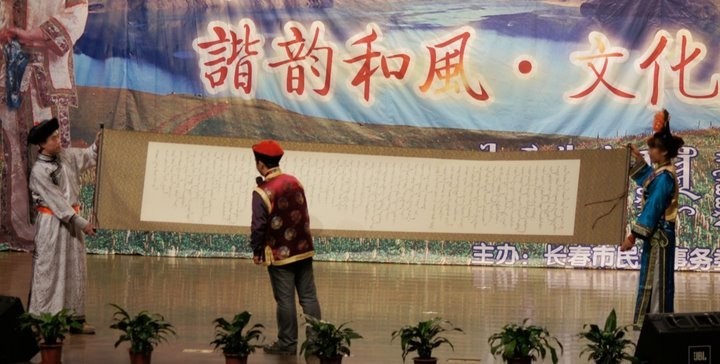
The qipao — tight-collared, side-slit, often embroidered — is the image tourists buy on silk scrolls. In daily life, you will see it only at weddings, cultural performances, or on the elderly woman who refuses to switch to polyester tracksuits. The male equivalent, the magua riding jacket with its horse-hoof cuffs, appears even less. What you will see instead are the practical clothes of the northeast: quilted cotton jackets in navy or charcoal, rubber boots for the spring mud, and the ubiquitous thermal underwear that makes winter survivable. The distinction surfaces in details. A Manchu tailor in Shenyang’s Xita district still cuts the collar higher on a winter coat, leaving room for a fur ruff. The buttons on a formal jacket are knotted frog closures, not plastic snaps. If you commission a piece, the tailor will ask which banner your family belongs to; the piping color — yellow, white, red, or blue — follows that answer. It is a quiet code, visible only to those who know to look at the seam.
Weddings: The Arrow, the Comb, and the Red Thread
A Manchu wedding in a county like Yitong or Huanren does not look like a hotel banquet in Beijing. The groom’s family arrives at the bride’s village before dawn with a roasted pig, two carp, and a bundle of sorghum stalks. The bride’s mother combs the bride’s hair three times — once for longevity, once for harmony, once for children — while singing a lullaby in a language the bride may not fully understand. The groom shoots a ceremonial arrow into a target set in the courtyard; hitting the center means the marriage will be “on target.” No one keeps score. The arrow is kept, bent tip and all, in a red cloth bundle under the marital bed. Later, the couple shares a bowl of “double happiness” noodles — two long strands pulled from the same dough — without biting them. Breaking the strand is bad luck. A foreign guest who slurps enthusiastically will be laughed at gently; the correct move is to lift the whole strand with chopsticks, let it coil in the spoon, and swallow in one motion. The bride’s uncle will then tie a red thread around the couple’s wrists. Do not cut it. It stays on until it falls off on its own, usually after the first lunar month.
Mistakes Newcomers Make
- Assuming every Manchu person practices shamanism. The household altar may hold a Buddhist statue, a Christian cross, or nothing but a photo of grandparents. The shamanic tradition — chanting, drumming, spirit journeys — survives in pockets like the villages around the Changbai Mountains, but it is not a universal identity badge.
- Asking “Are you Manchu?” as an opening line. It reads the same as asking someone their blood type. Wait for the context — a shared meal, a story about the family grave — before the label surfaces naturally.
- Photographing the ancestral tablet without permission. The wooden plaque inscribed with generations of names is not decor. If the family covers it with red cloth when you enter, put the camera away.
- Expecting a “traditional” performance in every autonomous county. Many towns stage shows for tour groups — drum dances, horseback archery demonstrations — but the real transmission happens in the kitchen, at the graveside, in the choice of a child’s middle name. The performance is for you. The life is for them.
- Confusing the Eight Banners with a tourist hierarchy. The banner system was a military and administrative structure. Today it functions as a genealogical map. A person who says “I am Bordered Yellow Banner” is telling you where their ancestors were registered, not claiming a title.
On the train back from Fengcheng, the landscape flattens into corn stubble and power lines. The passenger across the aisle pulls a vacuum-sealed packet of saqima from her bag, breaks off a sticky chunk, and offers it across the armrest. “My grandmother made these. She says the honey must be from the linden trees in the mountains, or the flavor doesn’t hold.” She does not say she is Manchu. She does not need to. The taste carries the banner color, the village name, the third-day ancestor rites, the uncut red thread. You take a piece. It sticks to your fingers, sweet and gritty with sesame. That is the knowledge that travels.