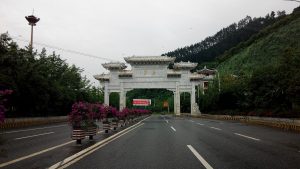
The minibus from Sihui rattles onto the Jingcheng Expressway just after dawn, the city’s ring roads falling away behind a haze of exhaust and morning mist. Two hours later the driver pulls off at a dusty lot beside a row of steamed-bun vendors, points at a faded blue sign, and shouts something that sounds like “Dongling.” You are in Zunhua, a county-level city tucked into the mountains northeast of Beijing, and the Eastern Qing Tombs are still a twenty-minute taxi ride up a winding valley road.
Getting there without a private car
No high-speed rail reaches Zunhua, so the bus from Beijing becomes the default artery for foreign visitors. The Sihui Long Distance Bus Station in Chaoyang District runs early departures — usually around seven in the morning — and the ride takes just over two hours if traffic cooperates. Buy a ticket at the counter with cash or a transportation card; the destination reads “遵化” in characters. Buses leave when full, not on a printed timetable, so arrive thirty minutes early and hover near the gate. Return buses line up near the tomb complex’s main parking area in the late afternoon, but the last one often pulls out before sunset. Miss it and you are negotiating a private hire back to the capital in the dark.
From the Zunhua bus station to the tombs, official taxis cluster at the forecourt. Drivers know the route by heart. Agree on a flat fare before the meter starts — usually the cost of a bowl of noodles plus a few yuan — and confirm the drop-off point is the main ticket hall, not the service area farther down the road. Ride-hailing apps work if you have a Chinese phone number, but signal drops in the valleys. A shared minivan sometimes waits near the station exit; locals pile in for a few yuan each, but the driver waits until every seat is taken.
First steps inside the Eastern Qing Tombs
The ticket hall sits at the foot of a broad stone avenue lined with ancient pines. Buy the through-ticket that covers the main burial chambers — Xiaoling for the Shunzhi Emperor, Jingling for Kangxi, Yuling for Qianlong, and Dingdongling for Empress Dowager Cixi. A shuttle bus runs the length of the valley, but the walk is flat, shaded, and only three kilometers end to end. Most visitors cluster at Cixi’s tomb for the marble carvings; walk ten minutes farther north and the crowds evaporate. Qianlong’s underground palace opens into a vaulted marble chamber where the air stays cool even in midsummer. I stood there alone one autumn afternoon, flashlight beam catching the faint red pigment on the stone coffins, hearing nothing but my own breath.
Guides in maroon vests linger near each entrance. Many are descendants of the Manchu tomb keepers from Dongling Manchu Ethnic Township, their families assigned to guard the site since the seventeenth century. They speak Mandarin with a northern lilt and a handful of English phrases memorized for tourists. Hire one at the main gate if you want the symbolism behind the stone animals, the drainage system, and the “spirit way” alignment. Negotiate the fee upfront — usually a few hundred yuan for a two-hour circuit — and ask them to skip the souvenir shops at the exit.
Eating in Zunhua town
Back in the county seat, lunch revolves around wheat and mutton. A typical table spreads with hand-rolled noodles in clear broth, sliced lamb scalded in a copper hot-pot, and a plate of “menzi” — mung-bean starch jelly cut into fingers, pan-fried until the edges lace brown, then doused in garlic vinegar, chili oil, and cilantro. The noodles should have a spring that snaps between chopsticks; the broth remembers every sheep bone that simmered overnight. Order by pointing at the picture menu on the wall or by saying “yangrou tangmian” for lamb soup noodles and “menzi” for the jelly. Portions are generous; one bowl feeds a hungry adult.
- Hand-rolled wheat noodles
- Mutton bones for broth
- Mung-bean starch (for menzi)
- Garlic, vinegar, chili oil, cilantro
- Pickled cabbage and radish on the side
To approximate menzi at home, whisk mung-bean starch with water until smooth, pour into a shallow tray, steam until set, chill, then cut into batons and fry in a hot wok with a slick of oil. The starch must be pure — cornstarch turns gluey. Restaurant versions arrive sizzling on a cast-iron plate; the sound tells you the crust is right.
Manchu township etiquette
Dongling Manchu Ethnic Township sits inside the tomb park boundaries. Villagers still wear traditional embroidered cuffs on market days, and the older generation speaks a few words of Manchu among themselves. If you wander into a courtyard home invited for tea, accept the bowl with both hands, sip, and leave a little at the bottom — draining it signals you want more, which obliges the host to refill endlessly. Photography inside homes requires a quiet nod of permission; point the lens at the ancestor tablet on the north wall only if the elder gestures toward it. Gifts of fruit or good cigarettes are received with a polite refusal first, then accepted on the second offer.
Market morning falls on the third, sixth, and ninth days of each lunar month. Stalls spill onto the lane with chestnuts, walnuts, dried persimmons, and hand-stitched insoles. Prices are not marked; the vendor names a figure, you counter half in jest, and you meet somewhere in the middle. Haggling is theater, not combat. Walk away smiling and the final price often follows you down the street.
Seasonal rhythms and practical traps
Spring brings apricot blossoms along the valley ridges; the tombs fill with Beijing weekenders during the Qingming holiday when families tend ancestral graves. Summer heat traps humidity in the stone chambers — carry water and a towel. Autumn turns the pines gold and the tourist flow thins to a trickle; this is the season for solitary descents into Qianlong’s vault. Winter closes the underground palaces when ice coats the stone stairs, but the above-ground halls stay open and the silence deepens.
Common missteps: assuming the last shuttle bus waits for stragglers (it departs on schedule), wearing sandals on the polished marble ramps (they turn slick as ice), and forgetting cash for the ticket window — mobile payment fails when the mountain signal dies. Toilets are squat-style at the main sites; carry tissue. English signage ends at the ticket hall; beyond that, stone tablets carry only Chinese and Manchu script. Photograph the map at the entrance before you start walking.
Leaving the valley
The return bus to Beijing queues beside the souvenir archway. Seats fill by mid-afternoon. If you linger for the last golden light on the spirit way, flag a taxi back to the Zunhua station and catch a later coach, or book a driver for the direct highway run. The road climbs out of the mountains, the pines recede, and the expressway lights of the capital appear on the horizon — proof that the empire’s edge is closer than the journey felt.