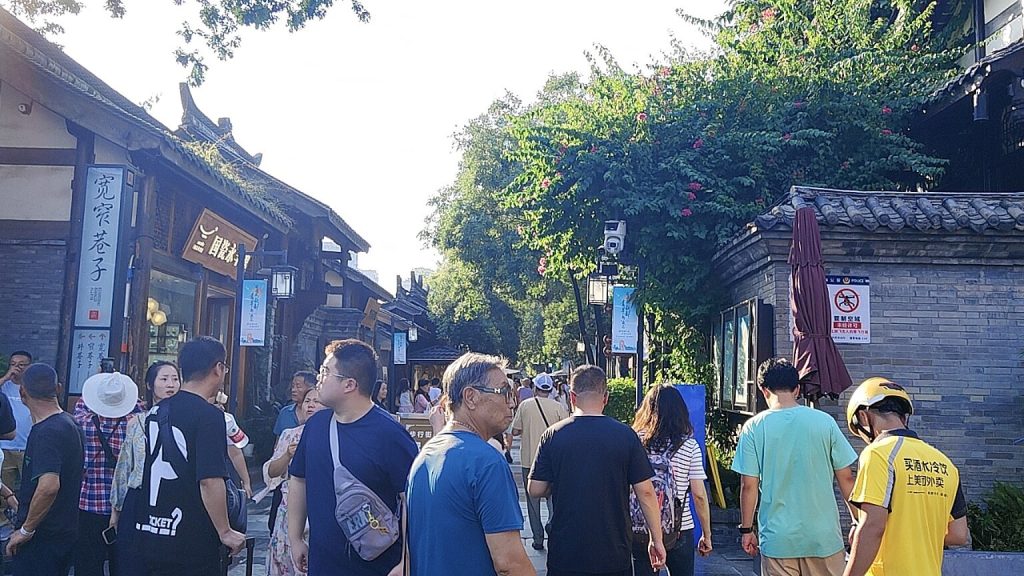
The first thing you notice, after the metro steps and the last grey of a late-December afternoon, is that Chengdu’s winter is wet rather than sharp. It sits on your sleeves. It makes the stone of the Wide and Narrow Alleys darker, and it makes the lanterns look closer than they are. Kuanzhai Xiangzi does not try to be a northern ice festival. It tries to be a neighbourhood of courtyards that has learned how to stay busy after dark.
This is an evening walk, not a day planner. For dates, tickets, and a whole-city sequence, use Chengdu late December and New Year planner. For a broader two-street weekend, Chengdu Jinli Kuanzhai November weekend still helps, and the autumn visit Chengdu Kuanzhai Alleys autumn visit remains in the archive. Tonight you only need a jacket, a charged phone, and an appetite for steam.
Arriving when the light has already gone
By late December the afternoon fails early. If you come at five, some shops are still opening their second breath of the day; if you come at seven, the lanes are a two-way river. Follow official signs for the entrance you actually use. Some courtyards or performances are ticketed; much of the walking street is simply a street. We will not invent a price or a closing time. If a staff member asks for a ticket, you either have one or you choose another doorway.
The alleys are easier if you pick a meeting point early — a named gate, a particular tree, a tea-house sign in Chinese saved in your notes. Phone signals are usually fine and then suddenly awkward when everyone in the lane stands still to film the same lantern. Offline maps and a screenshot matter more than pride (Amap and Baidu Maps setup).
Tea, damp coats, and a place to sit
A late-December evening here is improved by sitting. Chengdu still believes in tea houses, even when the courtyard is tourist-busy. Order simply, keep the table small, and let the damp air stay outside. If a house is full, do not hover over someone else’s gaiwan. Walk on; another doorway will be serving.
Food smells travel farther in the cold: chili, sesame, sugar, and hot oil. Pay the way the stall pays, which is usually a QR code (paying street vendors that only take a QR code). If your wallet is not ready, this is a frustrating street to troubleshoot, because the queue behind you is not a classroom. Have cash as a modest backup, then move.
You will hear more Mandarin and Sichuan than English, and also plenty of both. The point is not to perform belonging. The point is to keep your elbows in, and to let a wedding-photo couple finish their two minutes under a red lantern without walking through the frame.
Lights, crowds, and the difference from Jinli
Kuanzhai is a set of three main lanes with courtyards bitten into the sides. At night the wide alley carries more of the souvenir and photo energy; the narrower turns feel older only until the next neon menu appears. That mix is the honest texture. If you want a quieter courtyard, turn where the sound drops, and be ready to turn back when it is only a service passage.
Jinli, on another night, will feel like a different stage set. You do not need both on the same evening unless you enjoy moving between lights. One good lane, one sit-down tea or bowl, and a slow walk out is a complete late-December story.
Crowds thicken toward the official New Year holiday in early January, but even a midweek night in late December can be busy. Official security and bag checks, when they appear, are part of the evening, not an insult. Follow them and keep walking.
Leaving while the city is still kind
Do not wait until you are cold, low on battery, and unsure which gate leads to which metro exit. Official taxis and a working Didi account (Didi identity verification for foreign visitors) are useful if the last stretch looks long on wet pavement. The metro will still be the default for most visitors. Save the hotel’s Chinese name before you leave the lobby.
On the ride back, the alleys shrink to a smell of tea on your scarf and a few photos that came out more orange than your eyes remember. That is all right. Chengdu winter is not a postcard of snow. It is a damp evening that you can walk through, sit down in, and leave without finishing every shop.
Tomorrow you can be a planner again. Tonight it is enough that the stones were wet, the lanterns were patient, and the city let you pass.
Related Lovely China reading
For payments, start with Alipay and WeChat Pay hub and WeChat Pay vs Alipay for tourists. For trains, keep high-speed rail first-timers guide and 12306 passport signup for foreigners handy. City hubs: Beijing first-visit guide, Shanghai first-visit guide. Connectivity: roaming vs local SIM honest guide, pocket Wi-Fi vs eSIM for China, offline maps for foreigners. Bookmark China travel tools page.
Practical checklist
- Confirm official rules on the relevant government, park, airline, or bank page near your travel week
- Screenshot bookings, tickets, and QR codes while you still have stable Wi-Fi
- Save hotel and attraction names in Chinese characters in your phone notes
- Carry passport, a backup payment method, and a small cash float (why cash is still needed)
- Test one small mobile payment before you rely on wallets at a gate or taxi
- Keep the China travel tools page bookmarked for related Lovely China hubs
FAQ
Is this a day-by-day Chengdu planner?
No. It is an evening story with practical texture. For a late-December city plan, use the Chengdu late December and New Year planner.
Is Kuanzhai the same as Jinli?
No. They are different historic-street areas. Our November weekend guide covers both; this story stays in the Wide and Narrow Alleys after dark.
Do I need a ticket at night?
Some courtyards or performances may be ticketed; much of the lane is a walking street. We do not invent hours or prices. Read the signs at the entrance you use.
What should I wear on a late-December evening?
Chengdu winter is often damp and chilly rather than icy. A real jacket, non-slip shoes, and a charged phone for maps and QR payments are more useful than dressing for a northern snow scene.
Notes for late 2026 travellers
Late December 2026 and the New Year week into 2027 bring colder mornings, earlier sunsets, and holiday crowds in many city hubs. Pack real winter layers in the north, and leave extra time on weekends and around 1 January.
This article does not invent ticket prices, opening hours, processing times, consular fees, or official statistics. When a number matters, verify it on the official site, app screen, or ticket board near your travel week.
If an official rule page disagrees with this guide, follow the official page. Lovely China orients English-speaking travellers; we are not an immigration, banking, or medical authority.