The gardens had already taken the best of the light. What was left of the afternoon, on an early-December day in Suzhou, was a thin blue that would not last, and a cold that sat in the stone the way water sits in a canal. I walked toward Pingjiang Road because it was close, because I did not want another ticketed courtyard, and because the day had earned a slower close than a sprint back to the station.
A practical December day trip from Shanghai is written elsewhere (Suzhou early December day trip from Shanghai, and the year-round shape in Suzhou day trip from Shanghai). A November dusk on a Suzhou canal has its own story (November dusk Suzhou canal story). The Bund, in the same season, is a wider river and a louder shore (December evening on Shanghai’s Bund). This is only an evening: a coat, a narrow road, and the houses turning their lamps on one by one.
After the last garden door
I still had the smell of winter wood and still water in my scarf. The garden had been almost quiet—weekday, bare willows, a reflecting pool that gave back a pale sky and not much else. It had been enough. To add another famous name would have been a kind of greed the light would not support. Pingjiang Road, when you meet it at that hour, does not ask you to collect anything. It asks you to walk.
The stone pavement was damp without having just rained, the sort of damp that belongs to canals and to December. I was glad of thick soles and of gloves I could take off for a photograph and regret. People moved in the same direction without hurry: a student with a backpack, a couple sharing one pair of earphones, a vendor closing a shutter with a sound that was more wooden than metallic. Bicycles came from behind with a bell that was polite rather than urgent.
The white walls held the last of the day longer than the alleys deserved. Then they let it go.
The canal, and the first lamps
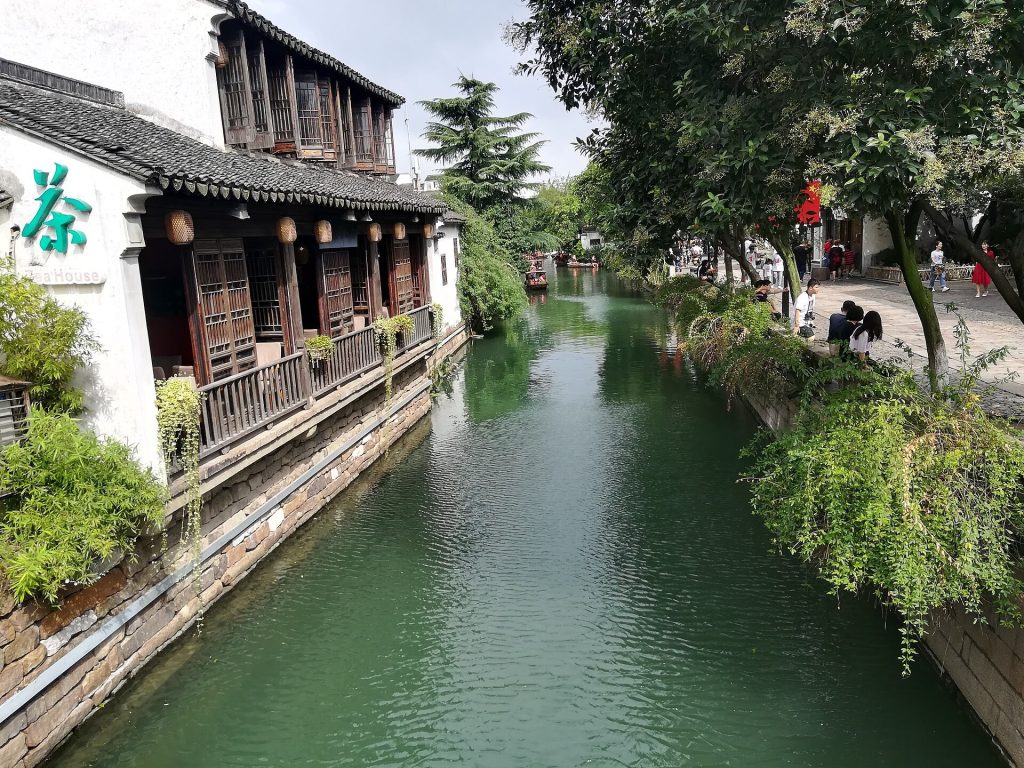
Pingjiang Road runs with the water, or the water runs with the road; from the pavement it is all one narrow thought. In early December the canal is not a summer postcard. It is dark, still, and exact. A boat, if there is one, moves as if it does not want to trouble the surface. Reflections of lanterns and window light appear earlier than you expect, because the sky has already given up.
I stopped on a small bridge and did not stay long. The cold there had an extra edge, the kind that rises from water. Below, a house showed a kitchen lamp, then a second room, then a figure passing behind glass. It is an ordinary thing, and on this road it feels like part of the architecture. You are not in a theme park. You are beside people who are cooking.
A teahouse door released a brief warm breath as someone came out—steam, leaves, and a sweetness I could not name. I did not have to go in for the evening to include it. Further on, a shop sold things I did not need, lit so carefully that the street seemed to borrow its colour. I bought nothing and did not feel that the walk had failed.
There were visitors, of course. Early December is not a secret. But the road was not performing at full volume. Conversations stayed close to the people who were having them. A loud group would have sounded wrong, and apparently knew it, or had already gone to dinner.
Hunger, stone, and the decision not to rush
Hunger arrived as a practical thought, not as a plan I had written in the morning. I chose a small room with a window on the lane, not because it was recommended in a book I would invent, but because it was there and there was a seat and the window showed the same wall I had been walking beside. I do not remember the dishes as a list. I remember the way my hands opened after the gloves came off, and the way the pane misted when the soup came, and the reluctance to go back out.
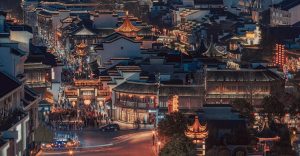
When I did go out, the road had completed its change. The last of the blue was gone. Lanterns and shop lights did the work, warmer than the air, doubled in the canal wherever the water was left alone. The stone felt more uneven in the dark, or I simply saw it less well. I walked more slowly, which was correct.
A cat occupied a doorstep as if it paid rent. Someone carried a pot plant indoors. On a side alley, too narrow for the main evening, the quiet was almost complete—just the canal, and a television somewhere behind a courtyard gate, and my own coat sleeve against a wall when I stepped aside.
I thought, briefly, of the November version of a night like this, when the air might have been kinder and the leaves not quite so finished. I did not prefer one to the other. This was simply earlier dark, a cleaner cold, and a day that had already had its garden.
The way back, without collecting the night
The temptation, on a handsome evening, is to keep walking until the road has nothing left to show, or to add a second neighbourhood because the map still has names. I turned back toward the metro and the idea of a train while the evening was still pleasant. A day trip that misses its return is not more authentic; it is only colder, and later.
On the way, the lamps seemed closer together than they had been an hour before, or I had grown used to them. The white walls were now a kind of paper lantern of their own, long and low. I did not take many more photographs. The phone battery was a practical concern in the cold, and the evening did not improve by being collected.
If you come, come already dressed for it. Come after a garden, not instead of sleeping, and not as a way to force the whole city into one dark. Let Pingjiang Road be a close of the day: canal air, a window of somebody else’s lamp, steam from a door, and stone that asks you to watch your step. Then leave, while the walk is still something you would repeat.
Related Lovely China reading
For payments, start with Alipay and WeChat Pay hub and WeChat Pay vs Alipay for tourists. For trains, keep high-speed rail first-timers guide and 12306 passport signup for foreigners handy. City hubs: Beijing first-visit guide, Shanghai first-visit guide. Connectivity: roaming vs local SIM honest guide, pocket Wi-Fi vs eSIM for China, offline maps for foreigners. Bookmark China travel tools page.
Practical checklist
- Confirm official rules on the relevant government, park, airline, or bank page near your travel week
- Screenshot bookings, tickets, and QR codes while you still have stable Wi-Fi
- Save hotel and attraction names in Chinese characters in your phone notes
- Carry passport, a backup payment method, and a small cash float (why cash is still needed)
- Test one small mobile payment before you rely on wallets at a gate or taxi
- Keep the China travel tools page page bookmarked for related Lovely China hubs
FAQ
Is this a garden-ticket or train-timetable guide?
No. It is a short travel story of an early-December evening on Pingjiang Road. Use the Suzhou early-December day-trip article and the generic Shanghai-to-Suzhou guide for logistics.
Will the road be as crowded as a summer night?
Not something we guarantee. This telling is of a quieter weekday-feeling evening in the cold, with earlier dark. Weekend nights can be busier. Dress for damp stone and leave time for your return.
What should I screenshot if I do walk there after a garden day?
Your return train or a realistic station plan, the garden’s official hours if you are still inside one late, and your hotel or evening pin in Chinese.
Notes for late 2026 travellers
November and early December bring cooler mornings, earlier sunsets, and comfortable walking weather across much of eastern and central China. Pack layers and leave extra time on clear weekends at popular sights.
This article does not invent ticket prices, opening hours, processing times, consular fees, or official statistics. When a number matters, verify it on the official site, app screen, or ticket board near your travel week.
If an official rule page disagrees with this guide, follow the official page. Lovely China orients English-speaking travellers; we are not an immigration, banking, or medical authority.