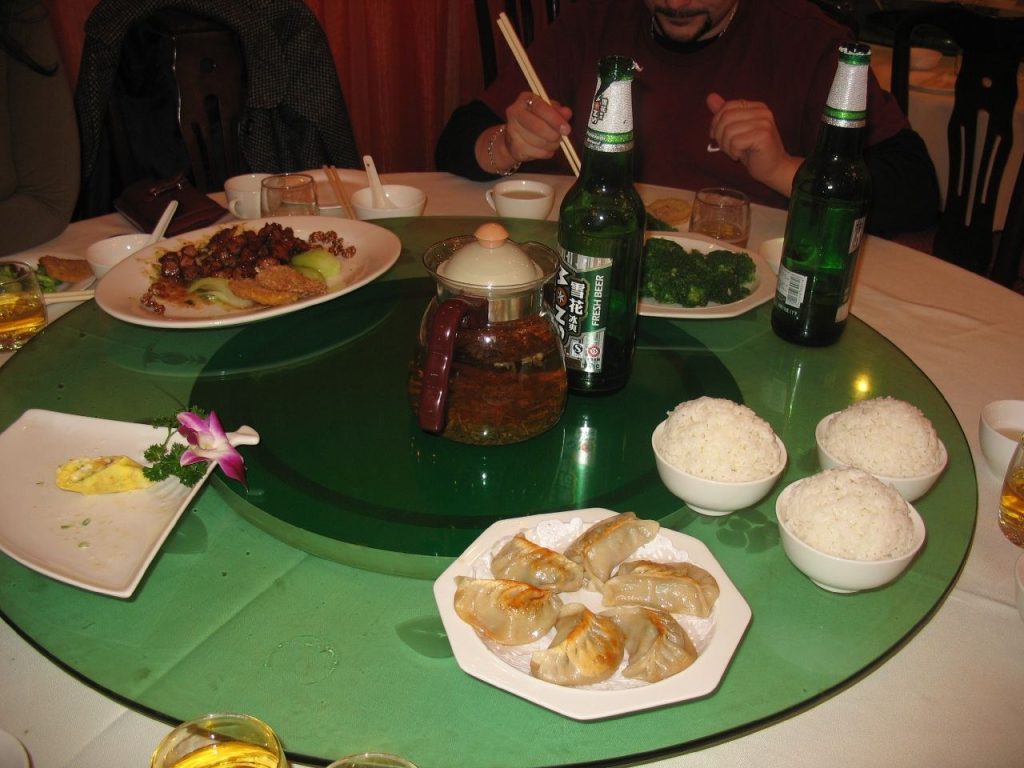
A lot of Chinese restaurant meals, especially with a group, are communal: dishes arrive in the centre, and people eat from shared plates rather than from a three-course stack of private mains. If the table is round, a lazy Susan—a revolving tray—often sits in the middle and does the reaching for you. This is a guide to that shared service: when to turn the tray, how to serve others, where bones go, and how the last piece is usually handled. It is not a second chopsticks-taboo article, and none of this is law.
Chopsticks habits live in chopsticks etiquette for foreigners. Seating at a more formal banquet is Chinese banquet seating etiquette. Tipping expectations are tipping in China for foreigners. If you are still in the queue outside, queue etiquette for foreigners applies before anyone sits down.
How a communal meal is supposed to feel
Dishes come out when they are ready, not in a fixed Western sequence. A vegetable may arrive before a fish; soup may appear in the middle. People take small amounts onto their own bowl or plate, eat, and go back. Rice or a staple often sits nearer to you or comes as individual bowls. The point is variety and pace, not finishing a private entree before the next course is “allowed.”
If you are a guest, you may be encouraged to eat first, or you may be asked to wait a moment until an elder or a host starts. Follow the table in front of you rather than a universal rule we would have to invent. A modest first serving is almost always kinder than loading your bowl as if the dish will not come around again. It will. You can take more later.
Turning the lazy Susan without making it a sport
Turn the tray slowly, with a warning glance, so a neighbour is not mid-lift with a pair of chopsticks or a ladle. If someone is serving, wait. If a heavy soup or a tall pot is on the wheel, turn even more gently. Do not spin it for fun, and do not reach across a moving plate.
Take food from the part of the dish that is closest to you after the tray has stopped, rather than stretching over someone else’s bowl. Serving spoons or communal chopsticks, when they are provided, are the tools for the shared plate; your personal chopsticks are for your own bowl. If there is no serving spoon, watch the local habit—some tables still use personal chopsticks for a clean dish, and some will fetch a spoon if you ask.
When you want a dish on the far side, rotate it to you or ask a neighbour with a word and a gesture. Standing up to spear something across the table is the move that makes a lazy Susan pointless.
Serving others, bones, and leftovers
In many groups, especially when older people or guests are present, someone will put a choice piece on someone else’s plate. If you are invited to serve an elder or a guest first, do it with a small, neat portion, not a pile. If someone serves you, a simple thank-you is enough; you are not required to perform a speech. If you do not eat a particular thing, say so early and briefly so that kindness does not land as a problem on your plate.
Bones, shells, and other inedibles usually go on a side plate, a saucer, or an appointed corner—not back into the shared dish, and not onto the tablecloth if a plate is there. If you are unsure, watch one cycle. Do not build a fortress of bones on a shared saucer that everyone else is still using for sauce.
The last piece on a popular plate can become a small courtesy dance. Some tables leave it; some offer it to a guest; some split it. Do not vacuum it up without a glance around. If it is offered to you, you may accept. If you want it and no one is moving, a short “may I?” is better than a silent lunge.
Leftovers are often packed if the table wants them. This is ordinary, not embarrassing. Follow the host if you are a guest. Payment at the end of a group meal is its own little choreography: one person may insist on paying; AA splitting appears in some friend groups and is less common at a formal host table. See WeChat Pay AA split bill and tipping in China for foreigners rather than inventing a rule. A polite offer to contribute is usually welcome; a fight over the bill that lasts longer than the dinner is not.
Formal rooms versus everyday tables
A workplace banquet or a family celebration may layer seating order and toast habits on top of all this (Chinese banquet seating etiquette). A lunch with friends may be looser, faster, and more practical. The shared grammar is still the same: small portions, a gentle hand on the tray, attention to elders and guests, and no mining of the last dumpling as if you were alone.
If you drop something, or turn the tray at the wrong time, a brief apology and a slower next move will do. People are not grading you against a statute. They are trying to eat. Soft courtesy, a modest bowl, and patience with dishes that arrive out of “course” order will carry a foreign guest through almost any lazy Susan in the room.
Related Lovely China reading
For payments, start with Alipay and WeChat Pay hub and WeChat Pay vs Alipay for tourists. For trains, keep high-speed rail first-timers guide and 12306 passport signup for foreigners handy. City hubs: Beijing first-visit guide, Shanghai first-visit guide. Connectivity: roaming vs local SIM honest guide, pocket Wi-Fi vs eSIM for China, offline maps for foreigners. Bookmark China travel tools page.
Practical checklist
- Confirm official rules on the relevant government, park, airline, or bank page near your travel week
- Screenshot bookings, tickets, and QR codes while you still have stable Wi-Fi
- Save hotel and attraction names in Chinese characters in your phone notes
- Carry passport, a backup payment method, and a small cash float (why cash is still needed)
- Test one small mobile payment before you rely on wallets at a gate or taxi
- Keep the China travel tools page page bookmarked for related Lovely China hubs
FAQ
Is it rude to turn the lazy Susan myself?
Not if you turn it slowly and wait when someone is serving or lifting food. Do not spin it, and do not reach across a moving dish. A glance at your neighbours is part of the move.
May I take the last piece on a shared plate?
Do not take it without a glance around. Some tables leave it, offer it to a guest, or split it. If it is offered to you, you may accept. A short “may I?” beats a silent lunge.
Do I have to recap all the chopsticks taboos here?
No. Use our chopsticks etiquette article for that. This page is about communal service: portions, the tray, serving others, bones, and paying after a group meal.
Notes for late 2026 travellers
November and early December bring cooler mornings, earlier sunsets, and comfortable walking weather across much of eastern and central China. Pack layers and leave extra time on clear weekends at popular sights.
This article does not invent ticket prices, opening hours, processing times, consular fees, or official statistics. When a number matters, verify it on the official site, app screen, or ticket board near your travel week.
If an official rule page disagrees with this guide, follow the official page. Lovely China orients English-speaking travellers; we are not an immigration, banking, or medical authority.