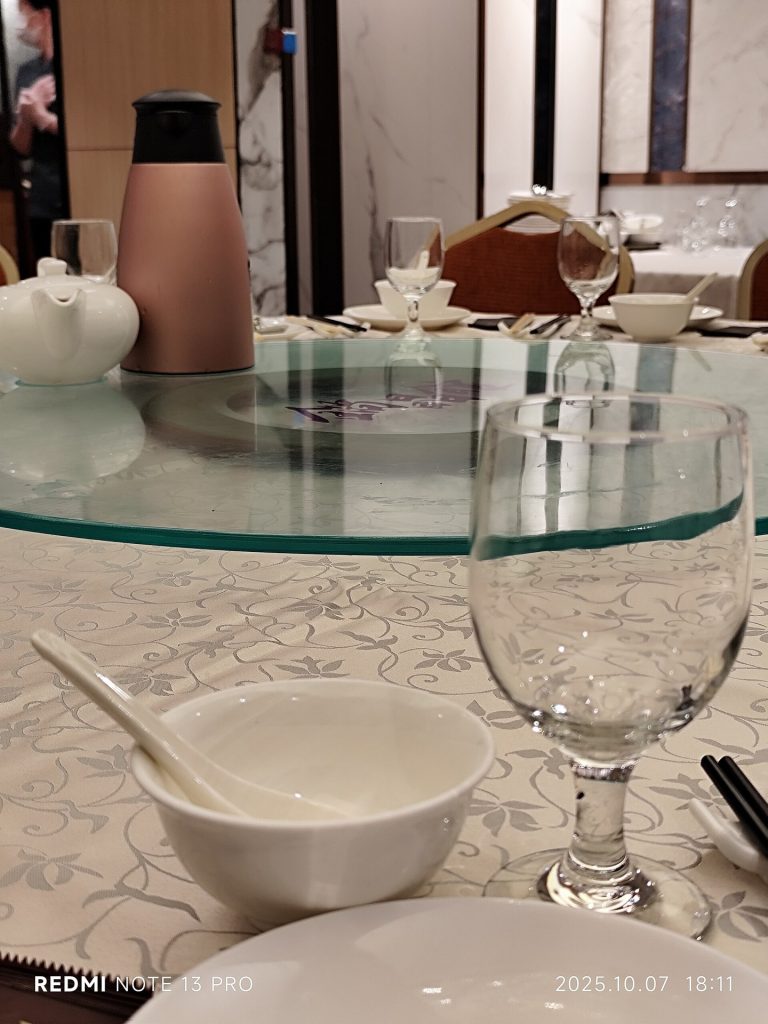
A Chinese banquet can feel choreographed even when everyone is friendly. Seating, toasting, and lazy-Susan timing communicate respect. Foreign guests are rarely expected to perform perfectly—but knowing a few defaults prevents accidental awkwardness.
This article focuses on seating and table flow. Gift-giving is a separate topic already covered elsewhere on Lovely China.
The seat of honour, simplified
At a round table, the seat facing the door—or the seat beside the host in the most central position—often signals honour. Hosts may guide you there. If someone ushers you toward a chair, take it rather than insisting on a “humble” corner that scrambles their plan. When unsure, wait to be seated.
Lazy Susan manners
Spin the turntable gently so dishes arrive facing elders or guests of honour without knocking chopsticks. Take small portions on the first pass; you can circulate again. Do not stop the Susan under your plate while delivering a long speech. Serving spoons, when provided, exist for a reason—use them for shared dishes.
Toasting without overdoing it
Hosts may toast guests; guests often return a toast later. You can sip rather than drain glasses if alcohol is a problem—communicate politely early. Soft drinks are acceptable substitutes in many modern settings when handled with grace. Never pressure others to drink.
Timing and arrival
Arrive on time or slightly early. Circling the block to be “fashionably late” can strand hosts who are waiting to seat the table. If traffic delays you, message your contact with a clear ETA.
Business versus family banquets
Business dinners may include seating maps and careful hierarchy. Family celebrations can be warmer and looser but still reserve key seats for elders. Follow the oldest cues in the room. Translation apps help with menu allergies (translation apps honest guide); payments afterwards may be QR-based (Alipay and WeChat Pay hub)—do not fight the host for the bill unless they clearly invite it.
Polite defaults for foreigners
- Wait to sit
- Taste before heavily seasoning shared food
- Keep phones off the table during toasts
- Thank the host once, sincerely, rather than performing endless compliments
- Mirror the pace of the table; do not race ahead of elders
November banquet season notes
Cooler months bring wedding and company dinner peaks. Dress one notch warmer than you would for a casual noodle lunch. Carry a small cash float in case of coat checks or last-minute taxis (why cash is still needed).
Related Lovely China reading
For payments and wallets, start with Alipay and WeChat Pay hub and WeChat Pay vs Alipay for tourists. For trains and long-distance moves, keep high-speed rail first-timers guide and 12306 passport signup for foreigners handy. For city orientation, the Beijing first-visit guide and Shanghai first-visit guide hubs remain useful even when your trip centres on another province. Bookmark China travel tools page so you can jump between logistics topics without searching from scratch on hotel Wi-Fi at midnight.
Practical checklist
- Confirm official rules on the relevant government, park, airline, or bank page near your travel week
- Screenshot bookings, tickets, and QR codes while you still have stable Wi-Fi
- Save hotel and attraction names in Chinese characters in your phone notes
- Carry passport, a backup payment method, and a small cash float (why cash is still needed)
- Test one small mobile payment before you rely on wallets at a gate or taxi
- Build time buffers for security lines, November weather, and bilingual navigation
- Prefer refundable holds until visas, trains, or park tickets are confirmed
- Keep the China travel tools page page bookmarked for related Lovely China hubs
How to verify information without panicking
English travel blogs lag policy changes. When something critical is at stake—entry permission, ticket validity, or whether a card works—use primary sources: embassy or VAC pages, National Immigration Administration notices, official park reservation platforms, airline apps, and the screens inside Chinese super-apps. Lovely China articles such as Alipay and WeChat Pay hub, high-speed rail first-timers guide, and essential apps for foreigners help you orient, but they are not substitutes for the live rule in front of you.
If two sources conflict, choose the stricter one until you can ask a human at the counter. That habit prevents most arguments that begin with “I read online that…” at gates.
FAQ
What if I sit in the wrong seat?
Hosts usually redirect kindly—move without drama.
Must I drink alcohol?
No. Polite refusal with a soft drink is widely understood when done early.
Who pays?
Often the host insists; follow their lead unless invited to contribute.
Are round tables mandatory?
Common for banquets, but hotels also use other layouts—follow the room.
Notes for late 2026 travellers
Late October and November bring cooler mornings, earlier sunsets, and comfortable train weather across much of eastern and central China. Pack layers, keep phone batteries warm outdoors, and leave extra time whenever a clear weekend coincides with popular sightseeing.
This article does not invent ticket prices, opening hours, processing times, consular fees, or official statistics. When a number matters, verify it on the official site, consulate page, app screen, or ticket board near your travel week.
Write key Chinese addresses into your phone notes before you leave Wi-Fi. Screenshot tickets and booking codes. Carry a small cash float even if you prefer wallets—see why cash is still needed. Reconfirm last-mile transport the evening before early starts.
If an official rule page disagrees with this guide, follow the official page. Lovely China orients English-speaking travellers; we are not an immigration, banking, or medical authority. Keep the China travel tools page bookmarked for other logistics hubs.
Traveller mindset
Move slowly through paperwork moments. A calm queue is cheaper than a missed train or a refused visa file. When language fails, show passport pages, booking screens, and maps with Chinese labels. Hotel front desks and station information booths are used to helping foreigners through routine steps.
Keep expectations honest: China is highly digital, but edge cases remain. Your job is not to memorise every exception—it is to carry backups (second card, cash, offline maps, written addresses) so one failure does not end the day. For everyday apps, start with essential apps for foreigners.