Public restrooms in China are ordinary infrastructure, not a character test. Some stalls are squat toilets, some are sit-down, many places now mix both, and a pocket pack of tissues solves the single most common surprise. This Lovely China guide offers practical, respectful advice for English-speaking travellers—without jokes that punch down, and without invented app rankings.
For queues in general, see queue etiquette foreigners. High-speed rail bathrooms are part of learning the train (high-speed rail first-timers guide). Keep China travel tools page bookmarked for the wider trip toolkit.
What you will actually see
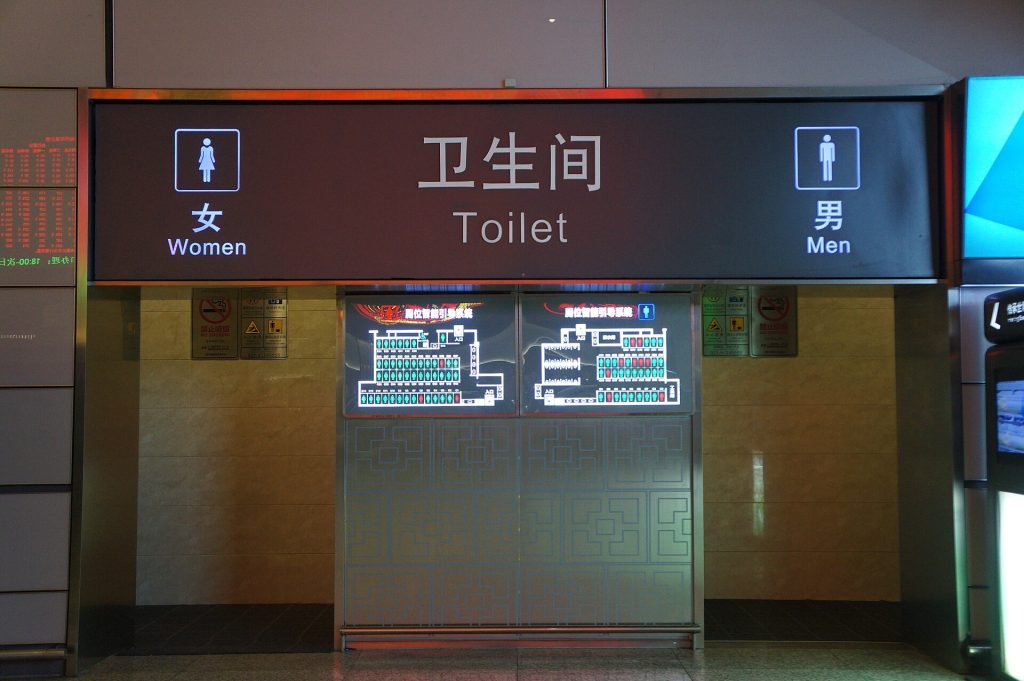
Newer airports, shopping malls, major metro stations, museums, and high-speed trains often provide clean, well-signed restrooms with at least some sit-down stalls. Older parks, side-street facilities, and busy long-distance bus stations may lean more on squat toilets and simpler fittings. Both can be perfectly usable. The door icons usually tell you which is which: a side view of a seated figure versus a squatting figure. Accessible or “barrier-free” stalls (无障碍) frequently include a sit-down toilet and grab bars—use them when you need them, and leave them free when you do not if a queue of travellers with reduced mobility is waiting.
If every remaining stall is a squat toilet and you have never used one, you can wait for a sit-down door, walk to a mall one metro stop away, or try the squat with the notes below. There is no prize for toughness.
Tissues, soap, and the small kit
Carry pocket tissues. Many restrooms do not stock paper in each stall, or the dispenser is empty by afternoon. A small packet in a jacket pocket is enough for a city day; refill from a convenience store when you think of it. Hand soap is common in newer places and missing in others, so a miniature sanitizer earns its space after a long park visit.
A few stalls will not have working locks. A companion can wait outside, or you can use a foot to hold the door as locals sometimes do. Again, this is ordinary problem-solving, not folklore.
Paper and the bin
In some older plumbing systems, signs ask you to place used toilet paper in a bin beside the toilet rather than flushing it. When that sign is present, follow it—the rule exists because the pipes cannot handle paper, not as a hospitality judgment. In newer malls, airports, and many trains, paper is flushable and the sign will say so or there will simply be no bin for that purpose. Read the stall in front of you instead of applying one national myth everywhere.
Leave the stall as decent as you found it. That is the entire etiquette.
How to use a squat toilet without drama
Face the door or face the fixture the way the foot grips on the porcelain suggest—there are usually raised treads. Keep clothing and bags off the floor if the floor is wet; a hook on the door, if present, is your friend. Squat as low as is comfortable, take your time, and stand up carefully. Flush with the pedal, button, or tank as marked. If there is no flush you understand, look for a bucket and scoop, or notify staff rather than leaving a problem for the next person.
You do not need special athletic ability. You do need shoes you can balance in. Smooth-soled heels are a poor match.
Where to look when you need one soon
Metro and railway stations, department stores, fast-food halls, museums, and temple visitor centers are the reliable backups. On a long street-food walk, duck into a mall when you pass one rather than waiting for a park restroom at the far end. High-speed trains have restrooms in each car or adjoining cars; they can queue after meal service, so go earlier (high-speed rail first-timers guide, train station security and luggage).
Map apps and some super-apps can hint at nearby toilets. Use whichever map you already run for navigation (Amap Baidu English mode, offline maps for foreigners). We will not rank toilet-finder apps or claim a crowd-sourced rating is authoritative. If an icon looks useful, treat it as a hint and still follow station signs.
Transit and accessibility notes
If you need a sit-down toilet predictably—mobility, recovery, travelling with small children who are not ready to squat—plan around malls, newer stations, and the accessible stall. Staff at museums and high-speed rail stations can often point you there if you show the 无障碍 characters or the International Symbol of Access.
Gendered rooms are the default in most places; family or accessible rooms appear more often in new transport hubs. Follow the signage rather than importing another country’s layout.
Tone worth keeping
People use these rooms the same way you do: between trains, after tea, during a long museum visit. A matter-of-fact kit (tissues, sanitizer, patience) beats a genre of travel writing that treats Chinese bathrooms as spectacle. If a facility is poorly kept, leave and find the mall. If it is well kept, that is also normal.
Pack the tissues, read the door icons, follow the paper sign in that stall, and use station or mall backups when you want more predictability. That is the whole skill.
Related Lovely China reading
For payments, start with Alipay and WeChat Pay hub and WeChat Pay vs Alipay for tourists. For trains, keep high-speed rail first-timers guide and 12306 passport signup for foreigners handy. City hubs: Beijing first-visit guide, Shanghai first-visit guide. Connectivity: roaming vs local SIM honest guide, pocket Wi-Fi vs eSIM for China, offline maps for foreigners. Bookmark China travel tools page.
Practical checklist
- Confirm official rules on the relevant government, park, airline, or bank page near your travel week
- Screenshot bookings, tickets, and QR codes while you still have stable Wi-Fi
- Save hotel and attraction names in Chinese characters in your phone notes
- Carry passport, a backup payment method, and a small cash float (why cash is still needed)
- Test one small mobile payment before you rely on wallets at a gate or taxi
- Keep the China travel tools page page bookmarked for related Lovely China hubs
FAQ
Do I always put paper in the bin?
Only when the stall asks you to. Older plumbing may not handle paper; newer malls, airports, and many trains expect you to flush it. Read the sign in front of you.
How do I find a sit-down toilet?
Look for door icons or an accessible/barrier-free stall. Malls, newer metro stations, and airports are the calm backups.
Which toilet-finder app is best?
We do not rank apps. Use the map you already navigate with and treat toilet icons as hints, then follow station signs.
Notes for late 2026 travellers
November and early December bring cooler mornings, earlier sunsets, and comfortable walking weather across much of eastern and central China. Pack layers and leave extra time on clear weekends at popular sights.
This article does not invent ticket prices, opening hours, processing times, consular fees, or official statistics. When a number matters, verify it on the official site, app screen, or ticket board near your travel week.
If an official rule page disagrees with this guide, follow the official page. Lovely China orients English-speaking travellers; we are not an immigration, banking, or medical authority.