You step onto Central Street after dark and the cold arrives as a fact, not a forecast. It sits in the fingers first, then in the space between scarf and chin. The stones of 中央大街 are never quite dry in late December; somewhere under the decorative lights there is a sheen you feel through the sole before you see it. You shorten your stride, the way everyone around you already has, and the street becomes a long, lit room without a ceiling.
This is not the autumn walk in Harbin Central Street autumn, when the facades could still be about European plaster in ordinary daylight. It is not a ticket guide to ice palaces; Harbin Ice and Snow World 2026–2027 and a late-December city planner exist for that. This is only an evening on the boulevard, after the shops have turned their windows into warm rectangles and the bakers have decided the night will be long.
A tram line or a crossing at the end of a block throws a smear of headlight across the cobbles. You wait, because ice and pride are a poor combination. A child in a padded suit slides a little and is lifted back by a gloved hand. Nobody treats this as drama. Harbin has been practising winter longer than you have been practising this coat.
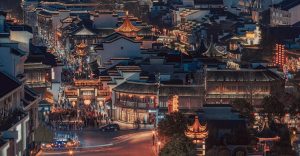
You walk without a shopping list. The facades—arches, pale stone, a curve of old commercial confidence—hold the lights the way a river holds a city. Russian-influenced architecture is part of the street’s ordinary vocabulary, not a costume put on for visitors, and at night it simply looks like a place that expected snow. A bakery window fogs from the inside. You do not need the name of the shop to understand the offer: heat, sugar, a place to stand still. If you go in, the glasses on your face will steam, and the coat that was barely enough outside will become too much in a dozen breaths. That, too, is the city’s rhythm. You peel a layer, you drink something hot, you go back to the dark.
Further along, music leaks from a doorway and is taken apart by wind. Street photographers work with numb hands. A couple takes a picture under an arch and immediately puts their phones away, because batteries die here the way conversation dies when you take a glove off too long. You keep your own phone inside the coat, close to the body, and you do not make a project of filming the entire street. The street is already doing the work.
If you have tickets for an ice park later, this walk is the preface, not the main clause. If you do not, it is still a complete evening: a slow out-and-back, a pause for food, a return to a hotel that will feel almost tropical when the door seals. The river is off to the side, wider and darker, and you can walk toward it if your clothing is honest. You can also not. Late December does not require you to collect every famous view in one night. Central Street will still be here in the morning, paler, with a different kind of foot traffic, and the ice in the joins of the stones will still be teaching the same short steps.
You turn back when your toes report in. The lights look warmer that way, which is a trick of relief and of walking toward food. Somewhere a speaker plays a half-familiar tune. You do not need to translate it. You have understood the only instruction the street keeps repeating: watch your feet, keep your hands warm, and let the city stay outside after dark, because this is what it was built to do.
A planner can tell you how to arrive and what to wear; a ticket page can tell you whether the ice grounds are open. The boulevard, on a late-December night, only asks that you walk it as if the ground might be glass, and that you leave before you are too proud to admit you are cold.
Ground-level reminders for this topic
Stay flexible when a counter, app screen, or staff instruction disagrees with a blog. Lovely China orients travellers; live official pages and bilingual signs win. Keep China travel tools page, essential apps for foreigners, and Alipay and WeChat Pay hub bookmarked so logistics stay boring while you focus on the angle of this guide: a short, grounded evening walk on Harbin’s Central Street (中央大街) in late December: ice underfoot, bakery light, Russian-influenced facades, and the feeling of a city built for winter, without inventing events or prices.
Related Lovely China reading
For payments, start with Alipay and WeChat Pay hub and WeChat Pay vs Alipay for tourists. For trains, keep high-speed rail first-timers guide and 12306 passport signup for foreigners handy. City hubs: Beijing first-visit guide, Shanghai first-visit guide. Connectivity: roaming vs local SIM honest guide, pocket Wi-Fi vs eSIM for China, offline maps for foreigners. Bookmark China travel tools page.
Practical checklist
- Confirm official rules on the relevant government, park, airline, or bank page near your travel week
- Screenshot bookings, tickets, and QR codes while you still have stable Wi-Fi
- Save hotel and attraction names in Chinese characters in your phone notes
- Carry passport, a backup payment method, and a small cash float (why cash is still needed)
- Test one small mobile payment before you rely on wallets at a gate or taxi
- Keep the China travel tools page page bookmarked for related Lovely China hubs
FAQ
Is this stories advice official?
No. Lovely China orients travellers. Verify live rules on official pages, apps, and counters near your travel week.
Will every city behave the same?
No. Airports, stations, parks, and markets differ. Use local signage and staff instructions when they conflict with a general guide.
What should I screenshot before I lose Wi-Fi?
Bookings, tickets, hotel Chinese address, pickup pins, and payment success screens.
Notes for late 2026 travellers
Late December 2026 and the New Year week into 2027 bring colder mornings, earlier sunsets, and holiday crowds in many city hubs. Pack real winter layers in the north, and leave extra time on weekends and around 1 January.
This article does not invent ticket prices, opening hours, processing times, consular fees, or official statistics. When a number matters, verify it on the official site, app screen, or ticket board near your travel week.
If an official rule page disagrees with this guide, follow the official page. Lovely China orients English-speaking travellers; we are not an immigration, banking, or medical authority.