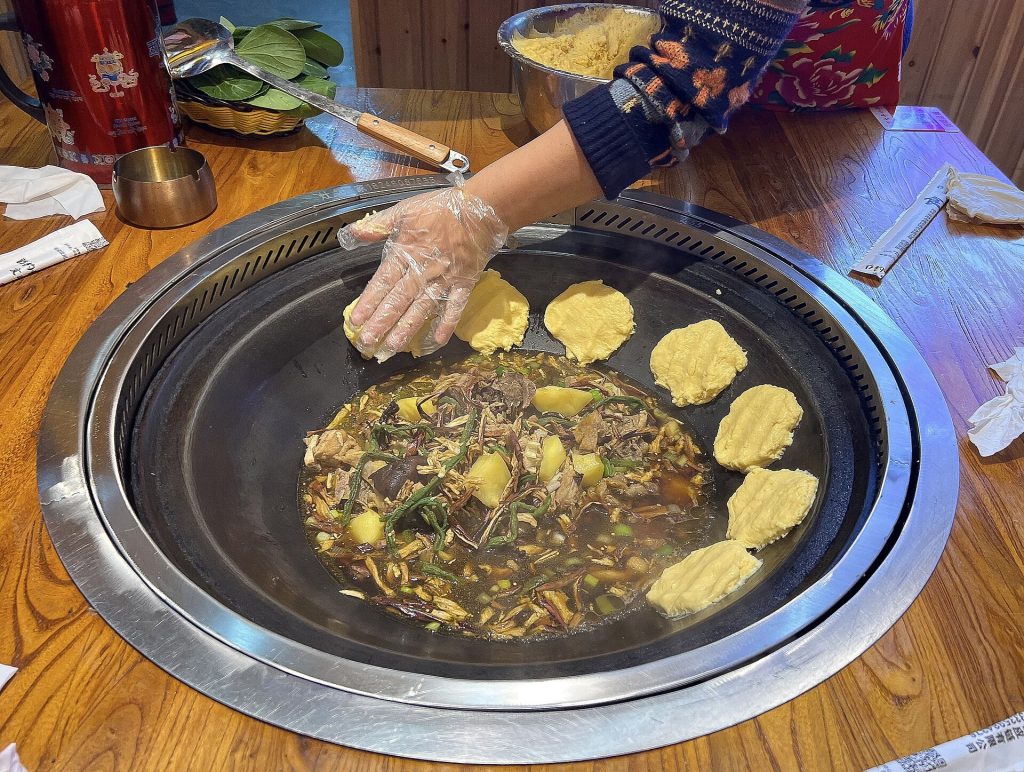
猪肉炖粉条 (zhūròu dùn fěntiáo) is a Northeast China winter pot: pork stewed until it gives, and wide, translucent potato-starch vermicelli that drink the broth. It is home-style Dongbei food, the sort of dish that appears on a lazy Susan in a family restaurant when the windows are steamed. It is not Sichuan hotpot, and it is not a plate of fried noodles. If you are in Harbin, Changchun, Shenyang, or a Dongbei kitchen in another city in December, this is one of the names worth recognizing on a menu.
We will not invent prices, a single official recipe, or a restaurant ranking. how to order from a Chinese menu helps when you cannot read the characters; shared dishes and lazy Susan etiquette helps when the pot is in the middle of the table.
What arrives, and how it differs from hotpot
The usual picture is a deep pot or large bowl: pieces of pork (often belly or ribs, sometimes with bone), long or wide fentiao (potato-starch vermicelli, sometimes called glass noodles or sweet-potato noodles in English menus), and often cabbage, bean knots, or other winter vegetables that have cooked in the same liquor. The flavour is savoury, sometimes lightly sweet from the meat and soy, usually not the chilli-numb heat of a Chengdu pot. It can be oily. It is filling.
A Sichuan or Chongqing hotpot, or Beijing shuan yang rou (Chengdu hotpot first-timers, Beijing mutton hotpot first-timers), is a boiling stock you dip bites into at the table. 猪肉炖粉条 is already stewed when it arrives. You serve from the pot; you do not wait for raw meat to cook on your chopsticks, and you should not treat the vermicelli as a side you ignore. The noodles are the point as much as the pork. They are slippery. Use a spoon as well as chopsticks, and do not be shy about that.
Recipes vary by kitchen: more soy, more scallion or ginger, sometimes tomato, sometimes a darker, longer stew. “Dongbei cuisine” is a region, not a chain. If you need a mild pot, say so; if you want less oil, ask, and accept that the dish may still be rich.
How to order and share
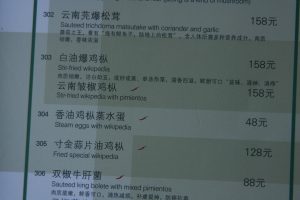
On a Chinese menu look for 猪肉炖粉条, sometimes shortened, sometimes listed under 东北菜. If the menu is only photographs, look for a stew with pale wide noodles and pork, not a clear soup with thin vermicelli, and not a dry stir-fry. Point, or show the characters from a note. For a table of two, one pot plus a lighter vegetable or cold dish is often enough; the vermicelli expands as it sits. For a larger table, it is a shared main, not a personal bowl, unless the restaurant serves individual portions.
Allergies and taboos: this is pork. If someone at the table does not eat pork, order something else for the group centre. Starch noodles may be listed as 粉条 or 土豆粉; if you cannot eat that starch, ask clearly. We will not invent a gluten-free guarantee; soy sauce and kitchen practice vary. Vegetarians should not try to “just eat the noodles” from a pork stew; order a vegetable dish instead (vegetarian or vegan in Chinese restaurants).
When the pot arrives, stir gently so noodles do not sit in a solid block. Serve others a little first if you are following common shared-table courtesy (shared dishes and lazy Susan etiquette, chopsticks etiquette). The broth is part of the eating; spoon it over rice if rice is on the table, or drink it from a soup spoon. Leftover fentiao will keep soaking liquid and become even heavier. That is normal, not a defect.
Where it fits a winter trip
This is comfort food after a cold walk, which is why it sits well on a Harbin evening or any northern night. It is not a spicy challenge and not a street snack you eat in a queue. If the restaurant offers a clay pot or a larger 铁锅 style, it is still the same idea: meat, noodles, time. Pay as you would in any restaurant, with a wallet or card that already works, and do not expect an English explanation of every cut.
If you like this pot, you may also meet other Dongbei stews and dumplings on the same menu. Order one rich stew, not three, unless the table is large. Official recipes do not exist here—only kitchens and seasons. Eat it hot, watch the slippery noodles, and let it be a winter dish rather than a photograph you delay until it sets.
Related Lovely China reading
For payments, start with Alipay and WeChat Pay hub and WeChat Pay vs Alipay for tourists. For trains, keep high-speed rail first-timers guide and 12306 passport signup for foreigners handy. City hubs: Beijing first-visit guide, Shanghai first-visit guide. Connectivity: roaming vs local SIM honest guide, pocket Wi-Fi vs eSIM for China, offline maps for foreigners. Bookmark China travel tools page.
Practical checklist
- Confirm official rules on the relevant government, park, airline, or bank page near your travel week
- Screenshot bookings, tickets, and QR codes while you still have stable Wi-Fi
- Save hotel and attraction names in Chinese characters in your phone notes
- Carry passport, a backup payment method, and a small cash float (why cash is still needed)
- Test one small mobile payment before you rely on wallets at a gate or taxi
- Keep the China travel tools page page bookmarked for related Lovely China hubs
FAQ
Is this food advice official?
No. Lovely China orients travellers. Verify live rules on official pages, apps, and counters near your travel week.
Will every city behave the same?
No. Airports, stations, parks, and markets differ. Use local signage and staff instructions when they conflict with a general guide.
What should I screenshot before I lose Wi-Fi?
Bookings, tickets, hotel Chinese address, pickup pins, and payment success screens.
Notes for late 2026 travellers
Late December 2026 and the New Year week into 2027 bring colder mornings, earlier sunsets, and holiday crowds in many city hubs. Pack real winter layers in the north, and leave extra time on weekends and around 1 January.
This article does not invent ticket prices, opening hours, processing times, consular fees, or official statistics. When a number matters, verify it on the official site, app screen, or ticket board near your travel week.
If an official rule page disagrees with this guide, follow the official page. Lovely China orients English-speaking travellers; we are not an immigration, banking, or medical authority.