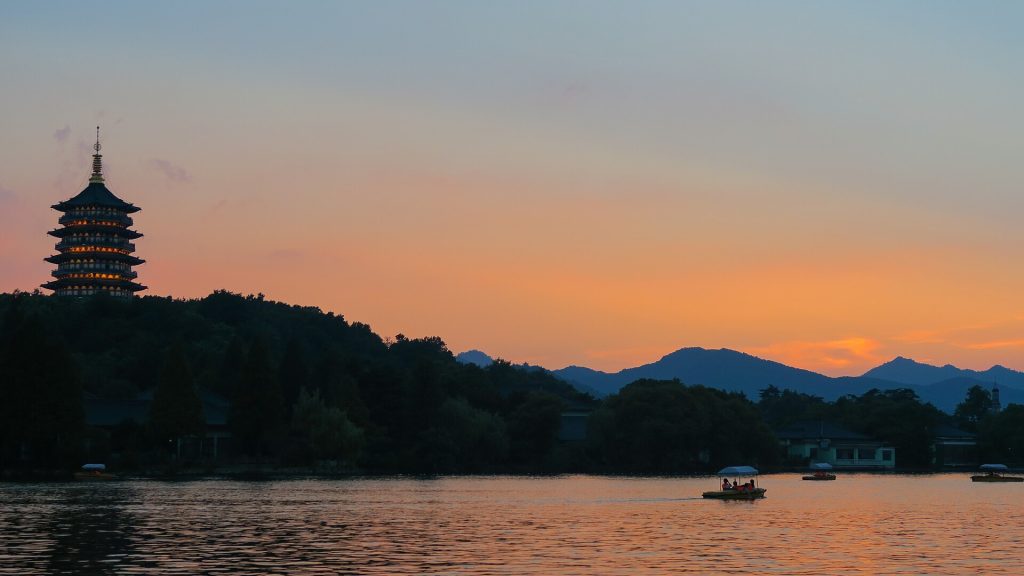
The light goes early at West Lake in late December. You notice it not as a statistic but as a change in the colour of the water: the surface turns from pale silver to a darker pewter while the causeway lamps are still coming on, one by one, as if someone were walking ahead of you with a switch. The willows have given up their summer curtain. Their branches hang in thin lines, and the wind moves them without much sound.
This is a short walk, not a timetable. For tickets, boats, and a daylight plan, use Hangzhou West Lake early December and Hangzhou first-visit guide. For a November dusk, there is already another story. This one belongs to the last days of the year, when the air is damp and the stone holds the cold through your soles.
The path you actually take
You leave the metro or a bus stop while there is still a leftover smear of daylight in the west, enough to see the outline of a pagoda or a hill without photographing it yet. The first minutes are practical. You zip the coat you almost left in the hotel because Shanghai had felt milder at noon. Hangzhou’s lake wind is narrower and more precise. It comes along the water and finds the gap at your throat.
A few people are still on the causeway. Not nobody, and not a festival. A couple in dark coats. A man with a supermarket bag. Someone taking a picture of the lamps in the water and then putting the phone away because their fingers hurt. A vendor may still be packing up; we will not invent a menu or a price. If a stall is open, the smell is more likely sweet potato or something fried than a summer lotus tea. You can walk past it. The lake does not require a purchase.
The water is close to the path. In summer you might have watched boats stitch across it. In late December the surface is often emptier, or the boats that remain look farther away than they are. Official winter hours, if any boats are running at all, are a question for the official page on a different morning. This evening you do not need the water to perform. It only has to hold the lights.
What winter does to the famous views
Broken Bridge and the long causeways are names you already know if you have read a Hangzhou guide. In this season they are less of a postcard and more of a route: stone, damp, a railing, a place to turn back when your hands have had enough. The famous silhouettes are still there. They look quieter, which is not the same as empty. Weekends and New Year week can thicken the path again; a weekday evening in late December is the hour this story is telling.
You stop once, not ten times. The opposite shore is a band of low buildings and darker hills. A teahouse window, if you pass one, is a rectangle of warmer colour. You can go in if it is open and you want to feel your fingers. You can also keep walking and let the idea of tea be enough. Chinese teahouse order and etiquette exists for a proper order on another afternoon.
The way back
The dark arrives while you are still mid-lake, which is the point of starting before it is fully night and the point of not walking “just one more bridge.” You turn around with the lamps now brighter than the sky. The city noise returns in pieces: a scooter, a snatch of conversation, the metro sign. You check the time because last trains in a Chinese city are a real limit, not a poetic one, and you have a hotel name in Chinese in your notes.
Your coat smells faintly of cold air when you take it off in the lobby. Dinner can be simple. The lake does not need you to summarise it. In the morning, if the sky is clear, you can walk a shorter loop in daylight and notice how ordinary the same stones look without the pewter water. If it rains, you can stay inside and be glad you already had the evening.
This is not a claim that West Lake in winter is secret. It is only a record of one late-December hour, when the year is almost over and the path is wet and the lights come on in time for you to find your way back.
Ground-level reminders for this topic
Stay flexible when a counter, app screen, or staff instruction disagrees with a blog. Lovely China orients travellers; live official pages and bilingual signs win. Keep China travel tools page, essential apps for foreigners, and Alipay and WeChat Pay hub bookmarked so logistics stay boring while you focus on the angle of this guide: a short travel story of a late-December evening walk at West Lake in Hangzhou: earlier dark, damp cold, lights along the causeway, and a quieter winter pace, not a ticket-and-hours guide.
Related Lovely China reading
For payments, start with Alipay and WeChat Pay hub and WeChat Pay vs Alipay for tourists. For trains, keep high-speed rail first-timers guide and 12306 passport signup for foreigners handy. City hubs: Beijing first-visit guide, Shanghai first-visit guide. Connectivity: roaming vs local SIM honest guide, pocket Wi-Fi vs eSIM for China, offline maps for foreigners. Bookmark China travel tools page.
Practical checklist
- Confirm official rules on the relevant government, park, airline, or bank page near your travel week
- Screenshot bookings, tickets, and QR codes while you still have stable Wi-Fi
- Save hotel and attraction names in Chinese characters in your phone notes
- Carry passport, a backup payment method, and a small cash float (why cash is still needed)
- Test one small mobile payment before you rely on wallets at a gate or taxi
- Keep the China travel tools page page bookmarked for related Lovely China hubs
FAQ
Is this a ticket or boat-hours guide?
No. It is a short travel story of a late-December evening walk. Use the early-December West Lake guide and the Hangzhou first-visit guide for logistics.
Is this the same as the November dusk West Lake story?
No. That sibling is a November evening. This telling is later in the year: earlier dark, colder stone, and a winter causeway.
What should I screenshot if I walk there after dusk?
A realistic metro or return plan, the hotel name in Chinese, and official boat or park notices only if you still intend to use a ticketed service.
Notes for late 2026 travellers
Late December 2026 and the New Year week into 2027 bring colder mornings, earlier sunsets, and holiday crowds in many city hubs. Pack real winter layers in the north, and leave extra time on weekends and around 1 January.
This article does not invent ticket prices, opening hours, processing times, consular fees, or official statistics. When a number matters, verify it on the official site, app screen, or ticket board near your travel week.
If an official rule page disagrees with this guide, follow the official page. Lovely China orients English-speaking travellers; we are not an immigration, banking, or medical authority.