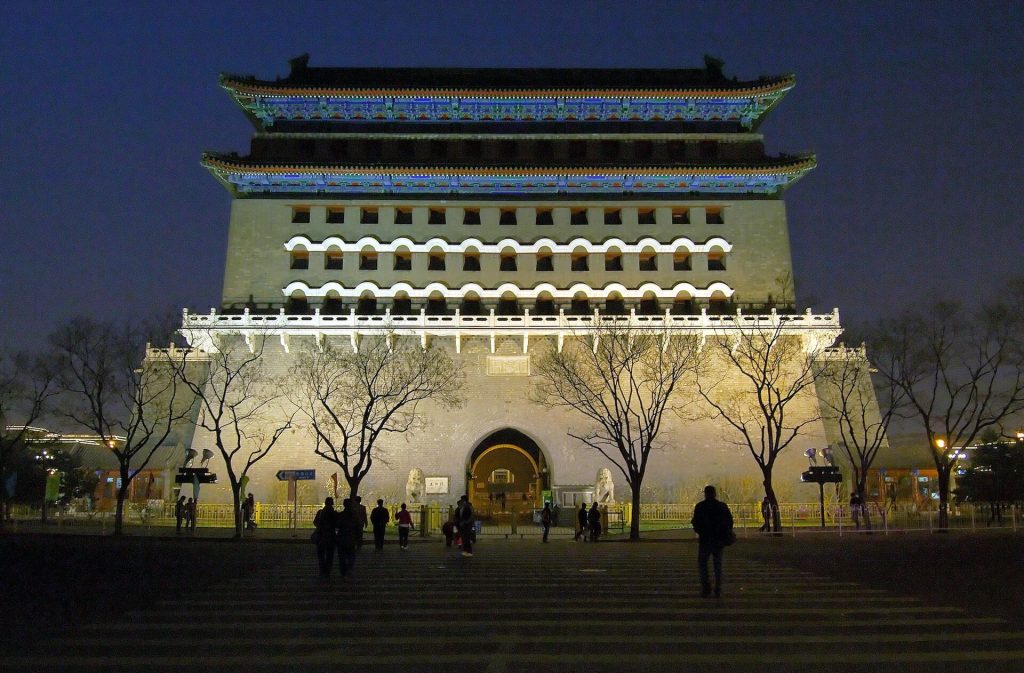
The light goes early in late December, and Qianmen Street starts to glow before dinner feels reasonable. You come up from the metro, or you walk south from the larger square, and the pedestrian street is already a corridor of shopfronts, coats, and breath you can see. The city-gate tower sits at the north end like a dark shoulder against a pale, cold sky. This is not a ticket guide, and it is not a hutong morning or a Shichahai dusk; those stories already have their own pages (a November morning in a Beijing hutong, a November evening in a Beijing hutong, November evening Beijing Shichahai story). It is an evening on this one street, and on the turn into Dashilar, when the year is almost over.
The cold is honest. It comes up through the soles first, then the fingers if you keep stopping to photograph a window. People walk a little faster than they do in October, then slow down anyway because the street is full. A vendor’s window throws a square of warm light onto the paving. Somewhere a kitchen is doing something with duck fat and sweet sauce; you do not need a reservation name or a price to know what Beijing smells like on a winter evening.
The path you actually take
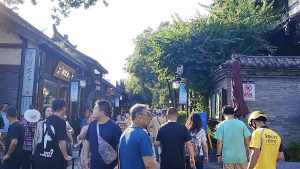
You stay on the main pedestrian street longer than you meant to, because the first block is a spectacle and because turning away feels like leaving a theatre before the interval. The shops are a mix of old signs and new glass. You do not have to buy anything. You look at the way the lights hang, at a child in a hood, at a couple sharing a skewer they will finish before they reach the next crossing.
Dashilar waits to the west, narrower, with its own pull of lanterns and low frontages. The turn is the moment the wide tourist street becomes a lane again. A late-December evening here is less about a famous façade than about the way sound changes: less open sky, more voices against wood and brick, a bicycle bell that should not surprise you and still does. If a courtyard door is open, you do not treat it as a set. You keep walking.
You will see the gate tower again when you look back. It is heavier in winter dusk than in a summer noon photograph. The square beyond it is windier. You can walk toward that wind for a minute and then decide that the street you already have is enough. This is not the evening to invent a flag-raising or a ticketed gallery after dark. The street is the event, and it does not need a programme.
What winter does to the scene
Earlier dark is the real seasonal fact. By the hour when you might still be in a park in September, the lights here are already doing most of the work. Faces look warmer under them than they feel. A thin damp in the air can sit on scarves. If it has snowed, even a little, the paving becomes a careful kind of walk and the street photographers appear as if they had been waiting for the first pale scuff on the ground. If it has not snowed, the cold is still enough.
You hear more languages than you expected, and more Beijing conversation than the souvenir windows suggest. Someone is trying to keep a phone battery alive in an inner pocket, which is a winter problem, not a story problem. You pass a family standing exactly in the middle of the flow to take a group picture, and you step around them because that, too, is part of the street.
There may be a tourist tram rail in the middle of Qianmen Street. If a car is running that evening, it cuts the crowd like a slow, lit animal; if it is not, the rails are just part of the paving. We will not invent a timetable. You watch what is actually moving.
A tray of roast chestnuts, if one is actually there that night, is a small heat you can hold for a minute and then you walk on. You do not need a price, and you do not need a stall name. You need your hands to feel like they belong to you again.
The way back
At some point the cold wins, which is a kind of mercy. You choose a metro entrance you already marked, or you walk to a signed taxi rank rather than a dark kerb. You might eat first, in a room that is too bright and exactly warm enough, and then come out for one more look at the gate before you go underground. You might not. A late-December evening does not have to be long to be complete.
The city planner in Beijing late December and New Year planner can tell you how to spend the daylight. Christmas-week lights in a more general sense live in Christmas and December holiday lights. Tonight is only this corridor, this cold, this earlier dark, and the smaller street that branches off it. No invented festival name is required. You go back with the smell of the kitchen still in your scarf, and with the feeling that the year, in this city, is being walked out under ordinary shop lights.
Related Lovely China reading
For payments, start with Alipay and WeChat Pay hub and WeChat Pay vs Alipay for tourists. For trains, keep high-speed rail first-timers guide and 12306 passport signup for foreigners handy. City hubs: Beijing first-visit guide, Shanghai first-visit guide. Connectivity: roaming vs local SIM honest guide, pocket Wi-Fi vs eSIM for China, offline maps for foreigners. Bookmark China travel tools page.
Practical checklist
- Confirm official rules on the relevant government, park, airline, or bank page near your travel week
- Screenshot bookings, tickets, and QR codes while you still have stable Wi-Fi
- Save hotel and attraction names in Chinese characters in your phone notes
- Carry passport, a backup payment method, and a small cash float (why cash is still needed)
- Test one small mobile payment before you rely on wallets at a gate or taxi
- Keep the China travel tools page page bookmarked for related Lovely China hubs
FAQ
Is this a ticket guide to Qianmen or Tiananmen?
No. It is a late-December evening story about the pedestrian street and the turn toward Dashilar. For a daylight city plan, use the Beijing late-December planner. We do not sell or invent tickets.
Will there be a special winter festival on the street?
We do not invent event names, fireworks, or official shows. The lights, the cold, and the crowd are the scene. If a municipal notice that week describes an event, follow that notice.
How is this different from the hutong and Shichahai stories?
Those walks sit in other neighbourhoods and other months. This piece stays on Qianmen Street and Dashilar on a late-December evening, when dark comes early and the gate tower sits against a cold sky.
How do I get back when I am cold?
Use a metro entrance you already marked, or a signed official taxi rank. A short, warm evening is a complete walk; you do not have to stay until the street empties.
Notes for late 2026 travellers
Late December 2026 and the New Year week into 2027 bring colder mornings, earlier sunsets, and holiday crowds in many city hubs. Pack real winter layers in the north, and leave extra time on weekends and around 1 January.
This article does not invent ticket prices, opening hours, processing times, consular fees, or official statistics. When a number matters, verify it on the official site, app screen, or ticket board near your travel week.
If an official rule page disagrees with this guide, follow the official page. Lovely China orients English-speaking travellers; we are not an immigration, banking, or medical authority.