Why the Dazu Rock Carvings are worth a day from Chongqing
The Dazu Rock Carvings (大足石刻) in Chongqing’s Dazu District are one of China’s great Buddhist art sites and, for many foreign visitors, the biggest surprise of a southwest China trip. Thousands of figures, many still showing original paint, are carved into sandstone cliffs. Buddhist, Taoist and Confucian themes appear side by side, along with very human scenes of family life, farming and moral lessons. UNESCO inscribed the site on the World Heritage List in 1999, describing carvings dating from the 9th to the 13th century.
Dazu sees far fewer international visitors than the Longmen or Mogao grottoes, but domestic crowds during national holidays can be heavy. That is why the week after Golden Week is such a good time to go. This guide is written on 6 October 2026, day six of the National Day holiday (1–7 October). From 8 October crowds usually drop sharply, although Saturday 10 October 2026 is a makeup workday, so the weekend of 10–11 October behaves like a short weekend rather than a free one.
If you are comparing grotto sites around China, see our guides to Luoyang’s Longmen Grottoes in autumn, Datong’s Yungang Grottoes and Dunhuang’s Mogao Caves.
Baodingshan vs Beishan: which to see
UNESCO’s listing covers five main sites. Most visitors focus on the two that are best set up for visitors.
Baodingshan (宝顶山): the must-see
Baodingshan is the large, theatrical site, carved mainly in the Southern Song dynasty under the monk Zhao Zhifeng. Its centrepiece is Great Buddha Bend (大佛湾), a horseshoe-shaped valley lined with huge carved scenes. Highlights include:
- The Thousand-Armed Guanyin (千手观音), a dense gilded fan of arms and hands, restored in a long conservation project completed in 2015
- The Reclining Buddha (the Buddha’s parinirvana), a huge half-figure that seems to disappear into the rock
- The Wheel of Reincarnation, held in the jaws of a fierce figure
- The parental-kindness scenes, a sequence about the sacrifices of parents that many visitors find moving
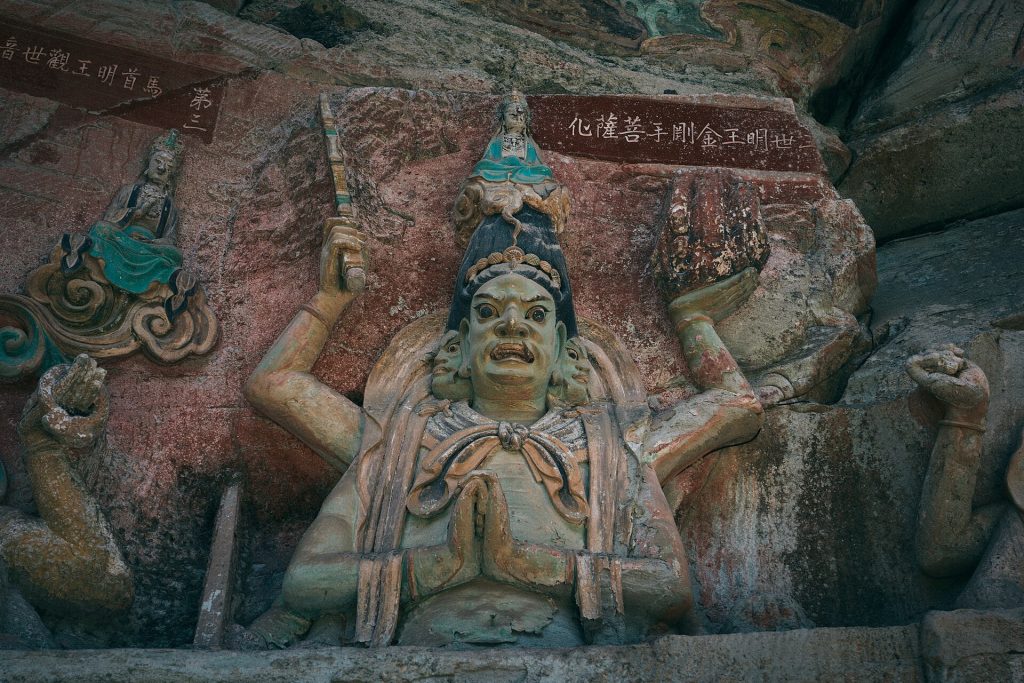
- Painted guardian and Wisdom King figures (like the cover photo), plus the attached Shengshou Temple (圣寿寺)
If you only have time for one site, choose Baodingshan.
Beishan (北山): earlier, quieter, more delicate
Beishan, close to Dazu’s urban area, was begun in the late Tang dynasty and continued through the Five Dynasties and Song. Its niches are smaller and finer: graceful bodhisattvas, detailed robes and jewellery. It is calmer than Baodingshan and suits visitors who like to look slowly. The official site also lists a Beishan night tour; check the official channel for the current schedule.
Tickets and passports
According to the official Dazu Rock Carvings website (dzskyjy.cn):
- Entry is by real-name ticket or valid original ID, with face recognition at the gate.
- A Baodingshan ticket includes free entry to the Museum of Dazu Rock Carvings.
- The museum is closed on Mondays, except on statutory holidays.
- Separate Baodingshan, Beishan and combined tickets exist, with peak and off-season prices, plus optional shuttle buses and a digital film.
Check the official website or the “大足石刻” WeChat account for current prices, time slots and opening hours rather than relying on blog screenshots. Recent visitor guides report that online booking and self-service machines are linked to Chinese ID cards, so passport holders often buy at the staffed counter in the visitor centre. Carry your original passport, not a photocopy. For real-name booking in general, see our attraction reservations guide.
Getting there from Chongqing
Dazu lies west of central Chongqing, toward Chengdu.
- High-speed rail: Trains on the Chengdu–Chongqing corridor stop at Dazu South (大足南). From the station, take a taxi or ride-hailing car to Baodingshan or Beishan. Check 12306 for current timetables and book return tickets early on Sundays.
- Coach: Long-distance buses run from Chongqing to Dazu; then use local transport to the sites. Check current departures at the bus station.
- Private driver: The easiest option if you want both sites in one day, because Baodingshan and Beishan are some distance apart and are not walkable from each other.
Arriving by air? Our Chongqing Jiangbei airport arrival guide covers the first steps. For ride-hailing, see Didi for foreign visitors.
A calm after-Golden-Week day plan
1. Early train or car from Chongqing. Aim to reach Baodingshan’s visitor centre in the morning.
2. Buy tickets with your passport, then take the shuttle or walk to Great Buddha Bend.
3. Two to three hours at Baodingshan. Walk the horseshoe slowly, visit Shengshou Temple, and add the museum if it is not a Monday.
4. Lunch in Dazu. Chongqing food is spicy by default; learn to say bú yào là (不要辣, no chilli) or see our mild Chongqing hotpot tips.
5. Afternoon at Beishan for one to one and a half hours, or rest and stay for the night tour if it is running.
6. Return to Chongqing, or continue toward Chengdu by train.
Ticket sales and last entry at Baodingshan close well before sunset, according to recent visitor reports, so do not leave it until the afternoon.
Weather and what to bring in October and November
Autumn in the Chongqing area is usually mild, often grey and misty, with occasional drizzle. Steps and stone paths can be wet.
- Non-slip shoes and a light rain jacket or umbrella
- A light layer for cool mornings
- Water and a snack (food outside main entrances can be limited)
- Mobile payments set up beforehand (Alipay and WeChat Pay guide)
Photography and etiquette
- Follow the posted photo rules. Flash and tripods are commonly restricted to protect painted surfaces; obey signs and staff.
- Do not touch the carvings or lean on railings close to the rock.
- Keep voices low near shrines and at Shengshou Temple, which is an active place of worship.
- Do not block narrow walkways for long photo sessions; step aside for groups.
- Drones are not appropriate at heritage sites unless explicitly permitted.
Understanding what you are looking at
One reason Dazu feels different from northern grottoes is its mix of teachings. Alongside Buddhist scenes, carvings in the wider Dazu group reflect Taoist and Confucian ideas, such as filial piety, moral cause and effect, and everyday virtue. Many scenes include inscriptions explaining the lesson. An audio guide or a short guided tour helps a lot; ask at the visitor centre what is available in English on the day.
Combining Dazu with a wider trip
Dazu fits neatly between Chongqing and Chengdu. A classic plan: two days in Chongqing (Hongyadong at night, Ciqikou old town), one day at Dazu, then on to Chengdu and perhaps the Leshan Giant Buddha. For the post-holiday travel picture, read our returning after Golden Week guide.
FAQ
Is the Dazu Rock Carvings worth visiting after Golden Week?
Yes. Weekdays from 8 October are usually much calmer than the 1–7 October holiday, which makes it easier to see Baodingshan’s narrow walkways properly.
How long do I need at Dazu?
About two to three hours for Baodingshan and one to one and a half hours for Beishan. With transfers, plan a full day for both.
Can foreigners book Dazu tickets online?
Systems often require a Chinese ID. Passport holders can buy at the staffed visitor-centre counter. Bring your original passport.
Is the museum open every day?
The official site says the Museum of Dazu Rock Carvings is closed on Mondays, except on statutory holidays.
Baodingshan or Beishan if I only have half a day?
Baodingshan. It is the larger, more dramatic site and includes the Thousand-Armed Guanyin.
Lovely China was founded in 2025 to help English-speaking travellers and expats plan calmer, deeper trips in China. Spotted an outdated detail? Email [email protected].
Cover photo: JL Cogburn / Wikimedia Commons (CC BY-SA 2.0). A painted Wisdom King figure at Baodingshan, Dazu Rock Carvings.