Hangzhou Pian’er Chuan Noodles: The Ultimate First-Timer’s Guide
Hangzhou is world-famous for its misty West Lake, lush tea plantations, and rich cultural heritage, but for food lovers, the city’s culinary soul is best found in a steaming bowl of noodles. Among the pantheon of local delicacies, none holds a more revered place than Pian’er Chuan (片儿川).
If you are visiting Hangzhou for the first time, diving into a bowl of Pian’er Chuan is an essential cultural rite of passage. This deceptively simple noodle soup represents the pinnacle of Jiangnan comfort food: harmonious, unpretentious, deeply flavorful, and steeped in local history.
—
What is Pian’er Chuan? (Anatomy of a Classic Bowl)
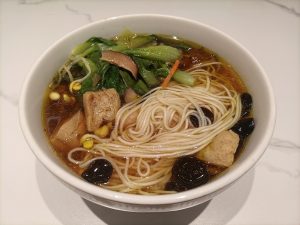
At first glance, Pian’er Chuan might look like a humble, rustic bowl of soup noodles. However, every element is meticulously calculated to deliver maximum flavor and texture.
The Noodles ($Mian$): Traditionally, Jiangnan-style alkaline noodles or wide, thin wheat noodles are used. They must be cooked to a precise al dente* bite—not too mushy, yet tender enough to soak up the savory broth.
The Broth ($Tang$): The foundation is a clear, yet intensely savory soup, usually simmered with pork bones and chicken. It is light on the palate but rich in umami*.
* The Topping ($Jiao Tou$): This is where Pian’er Chuan gets its distinct identity. The signature topping consists of three core ingredients:
1. Sliced Preserved Mustard Greens ($Xue Cai$): Fermented mustard greens that provide a sharp, savory, and slightly salty punch, cutting through the richness of the pork.
2. Lean Pork Slices: Thinly sliced pork that is velveted and flash-cooked to remain tender.
3. Bamboo Shoots ($Sun Gan$ or fresh bamboo shoots): Depending on the season, crisp bamboo shoots add an earthy sweetness and a satisfying crunch.
The name Pian’er Chuan itself is a localized Hangzhou slang term. “Pian” refers to the sliced ingredients (the pork and bamboo shoots), and “Chuan” is a phonetic play on local dialect describing how the ingredients are tossed and cooked together quickly in the wok with the broth.
—
The History and Cultural Significance
The origins of Pian’er Chuan trace back over a century to the late Qing Dynasty. It was popularized by Kui Yuan Guan (奎元馆), a historic noodle restaurant established in 1867 on Hefang Street in Hangzhou. Originally a modest eatery catering to scholars traveling to Hangzhou for imperial examinations, Kui Yuan Guan needed quick, nourishing, and affordable meals that could sustain hungry minds.
Legend has it that the chef combined leftover preserved greens, bamboo shoots, and pork slices with fresh noodles, creating a quick-cooking, deeply comforting dish that instantly won over locals and travelers alike. Over the decades, Pian’er Chuan transitioned from street food to an intangible cultural heritage dish of Zhejiang province. Today, it is recognized as one of the top noodles of China, celebrated for its perfect balance of salt, acid, umami, and texture.
—
Where to Eat Authentic Pian’er Chuan in Hangzhou
Finding a great bowl of Pian’er Chuan in Hangzhou is an adventure in itself. You can find everything from century-old institutions to tiny neighborhood mom-and-pop shops. Here are the top spots every first-timer should visit:
1. Kui Yuan Guan (奎元馆)
* The Vibe: Historic, bustling, and steeped in tradition.
Why Go: As the birthplace of Pian’er Chuan, visiting this landmark is a must for history buffs. While commercialized, their classic bowl remains a reliable benchmark for traditional flavors. (Tip: Try their upgraded version topped with river shrimp or fried eel if you want a feast).*
* Locations: Multiple branches, but the flagship is near Jiefang Road.
2. Ju Ying Mian Guan (菊英面馆)
* The Vibe: Legendary, cramped, and fiercely authentic neighborhood institution.
Why Go: Ju Ying is famous among locals for its uncompromising commitment to old-school preparation. The soup is oilier and richer, and the Xue Cai* is intensely fragrant. Be prepared to wait in line during peak lunch hours, as seating is extremely limited.
* Location: 120 Zhongshan South Road.
3. Zhiwei Guan (知味观)
* The Vibe: A time-honored culinary complex offering both casual noodle counters and formal dining.
* Why Go: If you want a clean, comfortable environment to try Pian’er Chuan alongside other Hangzhou snacks like Xiao Long Bao and Wontons, Zhiwei Guan is an ideal, tourist-friendly starting point.
* Location: Near the lakeside on Yan’an Road.
—
Step-by-Step Guide for First-Timers: How to Order Like a Local
Ordering noodles in a traditional Chinese noodle shop can be intimidating if you do not speak Mandarin or know the local customs. Follow this step-by-step framework to navigate your first experience smoothly:
1. Arrive Early or Off-Peak: Famous noodle shops like Ju Ying or Kui Yuan Guan get slammed between 11:30 AM and 1:00 PM. Aim for 11:00 AM or 2:00 PM to secure a table without a stressful wait.
2. Know the Ordering System: In most local spots, you walk up to the cash register first, place your order, and pay. You will receive a plastic token or paper receipt. Take this to the noodle collection window or hand it to a server at your table.
3. Customize Your Preferences:
Noodle texture: If you prefer firmer noodles, you can try saying “Ying mian”* (硬面).
Broth adjustments: Traditional bowls come with standard oil and salt. If you prefer a lighter bowl, you can request “Qing dan”* (清淡 – lighter flavor).
4. Add Condiments Wisely: Most tables feature chili oil, vinegar, and white pepper. Taste your broth first before adding anything. A dash of white pepper powder can elevate the pork and bamboo flavors remarkably.
5. Clear Your Table (Etiquette): In bustling, fast-paced neighborhood shops, it is customary to clear your bowl or make space quickly once you finish so the next hungry diner can sit down.
—
Frequently Asked Questions (FAQ)
Is Pian’er Chuan spicy?
No, traditional Pian’er Chuan is not spicy at all. The flavor profile relies on the savory umami of pork bone broth, the saltiness and acidity of preserved mustard greens, and the natural sweetness of bamboo shoots. If you want heat, you can add house-made chili oil from the table condiments.
Can I get a vegetarian version of Pian’er Chuan?
Traditionally, Pian’er Chuan is flavored with pork slices and pork bone broth, so it is not vegetarian. However, because it is made-to-order in many local kitchens, you can politely ask the chef to omit the pork (“Bu yao rou”), leaving just the preserved greens, bamboo shoots, and noodles in a vegetable or soy-based broth, though strict vegetarians should note that cross-contamination in busy woks is common.
How much does a bowl of Pian’er Chuan cost?
Prices vary depending on the establishment. At a local neighborhood noodle house, a standard bowl costs between 15 to 25 RMB (approx. $2.50 to $3.50 USD). At historic heritage restaurants or if you add luxury toppings like river shrimp, prices can range from 35 to 60+ RMB.
—
Explore More Hangzhou Culinary Adventures
Your journey through Hangzhou’s food scene doesn’t stop at noodles! To plan the ultimate gastronomic itinerary, check out these related guides:
* Hangzhou West Lake Food Guide: What to Eat Near the Water (Internal Link Placeholder)
* Dongpo Pork: The History Behind Hangzhou’s Most Famous Braised Dish (Internal Link Placeholder)
* Longjing Tea Village: A Tea Lover’s Day Trip from Hangzhou (Internal Link Placeholder)