<!–
title: When My Language Partner Brought His Entire Family to Coffee
slug: language-partner-entire-family-coffee
category: Stories
focus: language exchange china story
meta: When my language partner brought his entire family to coffee — a one-hour exchange that became a three-hour interview and a wider welcome.
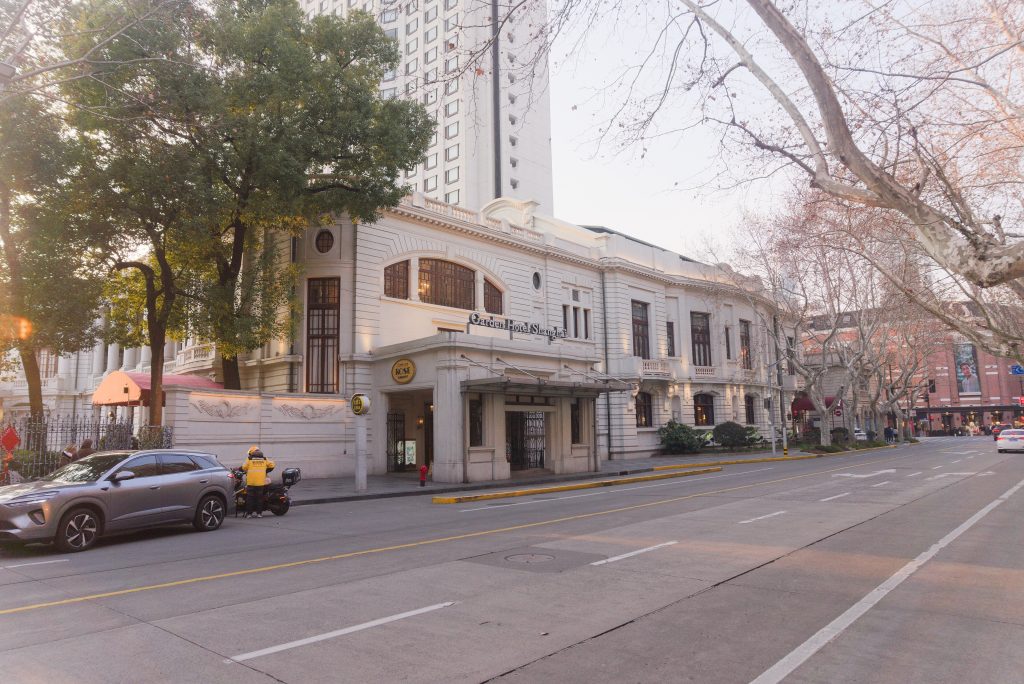
cover_alt: Cafe interior seating at a Shanghai hotel garden cafe
cover_credit: Photo: 4084470 0.smil / Wikimedia Commons (CC BY 4.0)
word_count: 1448
–>
The calendar invite that understated the guest list
My language exchange was supposed to be sixty minutes of coffee and corrected tones. He messaged: “Okay if my cousin joins?” I typed yes, imagining one cousin. The cafe door then admitted a small parade: cousin, cousin’s girlfriend, parents “nearby shopping,” and an aunt who had opinions about pastries. Suddenly our verb drills had an audience.
I panicked politely. Then I remembered that hospitality sometimes arrives as overcrowding with love.
From language swap to family interview
Questions came in relays. Where was I born? Did I eat spicy food? Was Chinese harder than I expected? Did my city have subways? The aunt asked if I was married with the directness of someone who considers privacy a Western hobby. I answered with humour and incomplete details. My language partner translated the jokes that worked and buried the ones that did not — a true friend.
We ordered more cakes because cake is a ceasefire.
What I learned that textbooks skip
Families evaluate foreigners through care metrics: Do you refuse food twice then accept? Do you pour tea for elders first? Do you check your phone too often? I poured tea. I put the phone face down. I accepted a second pastry under soft coercion. Somewhere in that choreography, my tones improved because stakes feel real when elders lean in.
If you want cafe logistics in a big city afternoon, pair this memory with ordinary tools like Alipay setup — the bill splitting alone was a language lesson.
How my partner survived his own relatives
He mouthed sorry once. I mouthed it’s okay. Later he explained that declining the family tag-along would have cost him more face at home than my surprise cost me in public. That trade made sense once I stopped centering my syllabus. Language partners are whole people with kinship weather systems.
Boundaries that still keep warmth
- Agree on time extensions explicitly; three hours should be a choice, not an ambush every week.
- Signal fatigue with gratitude: “Today was wonderful; next time maybe just us two for grammar.”
- Keep sensitive topics light unless you truly want the debate.
- Pay sometimes; being forever paid-for can feel like being forever temporary.
- If festival season packs cafes — Mid-Autumn week especially — book or arrive early (alone Mid-Autumn walk for the opposite mood).
The goodbye that included leftovers
The aunt boxed uneaten cake for me with authoritative folds. The parents shook my hand as if concluding a minor summit. My partner walked me to the metro and apologized again. I told him the truth: I had practiced more real Mandarin in one afternoon than in three tidy one-on-one sessions.
Why I still say yes carefully — and sometimes yes widely
Not every lesson should become a family forum. But once in a while, the “interview” is the curriculum: how affection crowds a table, how curiosity can be blunt and kind at once, how a language exists to carry you into rooms you did not schedule. I went home over-caffeinated, over-caked, and newly fluent in the idea that fluency includes surviving love with an audience.
A closing note for fellow travelers
Stories like this one are not blueprints you must copy move for move. They are permission slips: to wake early, to refuse a drink kindly, to follow a smell, to ask for help at a gate, to treat a wrong ticket as a door. China will offer you bigger monuments than any single evening can hold. Keep at least one evening for the human-scale scene — a knock, a queue, a skewer, a translated line on a hospital page.
If you are sequencing festival travel around Mid-Autumn 2026 (25–27 September) and Golden Week (1–7 October), keep the calendar guides handy and leave slack in your plans. Slack is where the soft stories enter. Pack patience, a working payment app, and the humility to be corrected by strangers who mean well. Then write your own version when you get home — not for performance, for memory.
Field notes you can reuse next month
Travel days often fail in the boring places: dead phone batteries, unpaid metro gates, hotel counters that need a passport photo page ready, and holiday calendars that quietly insert makeup workdays. Before you chase the next memorable stranger, spend ten minutes on foundations. Set up Alipay and WeChat Pay for foreign visitors. Skim Golden Week 2026 vs Mid-Autumn so September and October do not blur into one expensive blur. If your route crosses a long national holiday, National Day Golden Week 2026 travel plan helps you expect crowds without resenting them.
Carry a light layer even when noon feels warm; evenings on water, hills, plazas, and overnight buses cool faster than city apps admit. Screenshot Chinese addresses for drivers. Tell one friend where you are going. Eat something small before you join a long queue so hunger does not make you sharp with people who are also tired. None of this is glamorous. All of it protects the soft moments — the grandma’s knock, the plaza gap in the dance circle, the ferry hand that lifts your bag — from being ruined by preventable friction.
When the story ends, write three lines in your phone: where you stood, what you smelled, what you would thank a stranger for. That tiny ritual turns a trip into something you can hand to your future self. Monuments will still be there next year. The exact sentence a retired couple said on a leaf-season bus will not. Keep the sentence.
A closing note for fellow travelers
Stories like this one are not blueprints you must copy move for move. They are permission slips: to wake early, to refuse a drink kindly, to follow a smell, to ask for help at a gate, to treat a wrong ticket as a door. China will offer you bigger monuments than any single evening can hold. Keep at least one evening for the human-scale scene — a knock, a queue, a skewer, a translated line on a hospital page.
If you are sequencing festival travel around Mid-Autumn 2026 (25–27 September) and Golden Week (1–7 October), keep the calendar guides handy and leave slack in your plans. Slack is where the soft stories enter. Pack patience, a working payment app, and the humility to be corrected by strangers who mean well. Then write your own version when you get home — not for performance, for memory.
Field notes you can reuse next month
Travel days often fail in the boring places: dead phone batteries, unpaid metro gates, hotel counters that need a passport photo page ready, and holiday calendars that quietly insert makeup workdays. Before you chase the next memorable stranger, spend ten minutes on foundations. Set up Alipay and WeChat Pay for foreign visitors. Skim Golden Week 2026 vs Mid-Autumn so September and October do not blur into one expensive blur. If your route crosses a long national holiday, National Day Golden Week 2026 travel plan helps you expect crowds without resenting them.
Carry a light layer even when noon feels warm; evenings on water, hills, plazas, and overnight buses cool faster than city apps admit. Screenshot Chinese addresses for drivers. Tell one friend where you are going. Eat something small before you join a long queue so hunger does not make you sharp with people who are also tired. None of this is glamorous. All of it protects the soft moments — the grandma’s knock, the plaza gap in the dance circle, the ferry hand that lifts your bag — from being ruined by preventable friction.
When the story ends, write three lines in your phone: where you stood, what you smelled, what you would thank a stranger for. That tiny ritual turns a trip into something you can hand to your future self. Monuments will still be there next year. The exact sentence a retired couple said on a leaf-season bus will not. Keep the sentence.


