The wok sits heavy on the burner, its seasoned iron blackened by decades of oil and fire. I drop in a slab of pork belly, skin side down, and the fat hits the metal with a sharp, angry hiss. Smoke curls up, carrying the scent of caramelizing sugar and star anise. This is the sound of a Sunday afternoon in my Shanghai neighbor’s kitchen, the sound that pulled me away from takeout menus and into the slow, sticky alchemy of hongshao rou. The first time I tried this alone, I rushed the sugar. It burned black in seconds, turning the potential for amber gloss into a bitter, acrid crust I had to scrape into the bin. The second time, I skimped on the shaoxing wine. The meat stayed tough, tasting only of salt and soy. The third time — when I let the sugar melt slow, when I browned the pork until the edges curled like old letters, when I walked away for two hours and let the braise do its quiet work — the chopsticks slid through the fat with zero resistance. That is the dish: patience rewarded with a spoonful of glossy, dark sauce over steamed rice.
What Arrives on the Table
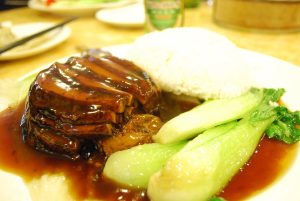
A proper hongshao rou arrives in a clay pot or a deep ceramic bowl, the lid lifted to release a cloud of steam scented with soy, rock sugar, and five-spice. The pork sits in thick, mahogany lacquer — cubes roughly two centimeters square, skin intact, fat layers distinct but softened into something that trembles when the bowl is nudged. The color should be a deep, reddish-brown, not black, not pale soy-sauce tan. Beside it, a mound of plain white rice waits, grains separate and hot. There are usually a few peeled hard-boiled eggs floating in the sauce, their whites stained tea-brown, and maybe chunks of daikon radish that have absorbed the braise until they taste richer than the meat. You pick up a cube with chopsticks; it holds its shape but yields instantly, the skin offering a slight chew before the fat collapses on the tongue. Sweet hits first, then salt, then the warm hum of star anise and cinnamon lingering at the back of the throat. It is not spicy. It is not greasy in the way fried food is greasy. It is condensed, concentrated, the kind of dish that makes you stop talking.
How It Should Taste and Look
The hallmark is the “tang” — that specific glossy sheen that comes from rock sugar melted slow and reduced hard. The sauce clings to the meat in a sticky veil; it does not pool watery at the bottom. Fat is key: you want three distinct layers — skin, fat, lean — and the fat must render until translucent, not rubbery. The lean meat stays moist, infused with the braise, never dry or stringy. Aromatics — ginger slices, scallion knots, star anise, a stick of cassia bark, maybe a dried chili or two — leave their ghost in the liquid but are usually fished out before serving. The flavor profile sits in a narrow lane: savory-sweet with a faint bitter edge from the caramel, rounded by the alcohol of shaoxing wine evaporated to essence. If it tastes only of soy sauce, the sugar was too little or the reduction too short. If it cloyingly sweet, the sugar won. Balance is the only metric that matters.
A Home Method That Works
I cook this in a heavy Dutch oven or a thick-bottomed wok with a lid. The steps below are what I do after three years of trial, error, and texts to my neighbor at 6 p.m. on a Sunday.
Prep the pork: Cut 800 g pork belly (skin on) into 3 cm cubes. Place in a pot, cover with cold water, add a few ginger slices and a splash of shaoxing wine. Bring to a boil, skim the grey foam for two minutes, then drain and rinse the cubes under hot water. Pat dry — this removes the blood that clouds the sauce.
Caramelize the sugar: Wipe the pot dry. Add 2 tablespoons oil and 60 g rock sugar (or granulated white sugar in a pinch). Medium-low heat. Stir constantly with a wooden spatula. The sugar melts, bubbles large, then small, turns pale amber. The second it hits a deep copper color — about 30 seconds after the small bubbles — kill the heat. Do not walk away.
Coat the pork: Immediately dump the blanched pork into the hot caramel. Toss fast to coat every piece. The sugar will seize and harden on the meat; that is fine. It will melt again in the braise.
Build the braise: Add 3 tablespoons light soy sauce, 1 tablespoon dark soy sauce (for color), 3 tablespoons shaoxing wine, 3 slices ginger, 2 scallion knots, 2 star anise, 1 small stick cassia bark, 1 dried chili (optional), and enough hot water to just cover the pork — about 500 ml.
Simmer low and slow: Bring to a boil, then drop to the lowest bubble. Cover. Walk away for 90 minutes. Check once at the 60-minute mark; if the liquid has dropped below the meat, add a splash of hot water.
Reduce the sauce: Uncover. Turn heat to medium-high. The liquid should be thin. Boil it down, stirring gently, until it thickens to a syrup that coats a spoon — 10 to 15 minutes. Taste. A pinch of salt only if needed. Add peeled hard-boiled eggs or daikon chunks in the last 20 minutes of the braise if using.
Rest: Kill the heat. Let sit 15 minutes. The sauce settles into the meat. Scoop into a serving bowl. Spoon every drop of that gloss over the top.
Ordering It in a Restaurant
In a Shanghainese or Zhejiang-style restaurant, look for “hongshao rou” (红烧肉) or “dongpo rou” (东坡肉) on the menu — the latter is often the same cut, sometimes whole, sliced tableside. Avoid places that list it under “spicy” or “Sichuan” sections; those versions swap the sweet-savory balance for doubanjiang and chilies. A good sign: the dish arrives in a small clay pot with a lid, still bubbling. Ask the server, “Tang duo ma?” (Is there lots of sauce/gloss?). They know the question. If they hesitate, order something else. Price varies wildly — a modest family spot might charge 48 yuan for a generous portion; a hotel restaurant triple that. Portion size is usually enough for two people with rice and a vegetable. Order a plate of qing chao kong xin cai (stir-fried water spinach with garlic) to cut the richness. Eat the pork first, while the fat is hot and the gloss is alive. Cold hongshao rou congeals into something you need to reheat to love again.
Mistakes Beginners Make
Skipping the blanch. The grey foam is blood and impurities. Leave it, and your sauce turns cloudy, the flavor muddy.
Burning the sugar. Caramel goes from perfect to carbon in seconds. Use medium-low, watch the bubble size, pull the pan off heat the instant it hits copper. If it smells bitter, start over — there is no fixing burnt sugar.
Using only light soy sauce. Dark soy gives the red-brown depth. Without it, the pork looks pale, anemic, like it missed the sun.
Boiling, not simmering. A hard boil shreds the meat fibers, turns fat to rubber. You want one lazy bubble breaking the surface every few seconds.
Adding cold water mid-braise. Thermal shock tightens the meat. Hot water only. Keep a kettle going.
Rushing the reduction. The final 15 minutes create the gloss. Walk away too early and you have soup. Stir too hard and you break the cubes. Patience, again.
Throwing out the fat. That rendered lard in the pot? Spoon it over rice. Mix it with a dash of vinegar and chili oil. It is the cook’s reward.