The minibus engine strained as we climbed the switchbacks above Dujiangyan, the air thickening with pine and damp earth. By the time the driver braked at the Front Mountain ticket gate, the valley had disappeared into a white ceiling of cloud. A group of retirees in matching windbreakers was already sorting themselves into a cable‑car queue, while a lone monk in gray robes adjusted his satchel and started up the stone steps on foot. I shouldered my daypack and followed the monk.
Choosing Your Mountain Face
Mount Qingcheng splits cleanly into two personalities. Front Mountain (前山) packs the Taoist heavyweights — Jianfu Palace, Tianshi Cave, Shangqing Palace — into a compact corridor that can be walked in half a day if you ride the cable car up and down. Back Mountain (后山) trades temples for silence: wide fire‑roads, bamboo groves, and a handful of forgotten shrines where the only sound is wind in the canopy. Most first‑timers do Front Mountain in the morning, grab a bowl of liangfen at the base, then decide whether their knees have another four hours for the back side.
Front Mountain: The Temple Circuit
Start early, before the tour buses unload at nine. From the main gate, a paved path climbs past Jianfu Palace (建福宫), its courtyard scented with sandalwood incense. Ten minutes further, the trail narrows to flagstones worn smooth by centuries of pilgrims. Tianshi Cave (天师洞) sits halfway up — a low hall built around a natural grotto where Zhang Daoling is said to have refined elixir. The statue inside is recent, but the bronze censer at the threshold dates to the Ming. Visitors toss coins into the grate; locals press foreheads to the cold stone.
Another twenty minutes of stairs brings you to Shangqing Palace (上清宫), perched on a knife‑edge ridge. On a clear day the Min River glints far below. Today the view was pure gauze. I shared a thermos of hot barley tea with a Sichuan University student who comes here every autumn to “breathe the old air.” We watched a priest in a patched robe sweep fallen needles from the courtyard, his broom moving in slow, deliberate arcs.
- Cable car up: ¥90 one way, ¥160 round trip; runs 08:00–17:00 in high season.
- Walking time gate to Shangqing: 2.5 hours at a steady pace, 3.5 if you pause at every hall.
- Footwear: Trail runners with grip; the stone gets slick after rain.
- Water: Fill bottles at the gate — vendors on the mountain charge triple.
Back Mountain: The Long Quiet
Take the shuttle from the Front Mountain parking lot to Baiyun Cableway lower station (白云索道), then ride up to the Back Mountain trailhead. From there a broad gravel road — once a firebreak — rolls west toward Laojun Pavilion (老君阁). The first kilometer is popular with weekend families; after the turnoff for Yuecheng Lake (月城湖) the crowds thin. I walked three hours and saw two other hikers, a red‑billed leiothrix, and a shed snakeskin curled on a mossy step.
The pavilion itself is a reconstruction, but the platform offers the park’s widest panorama: layered ridges fading into Sichuan haze. Pack a sandwich. There is no vendor up here, only a stone trough fed by a spring that tastes of iron and cold rock. Descend the same way or continue the loop down to Taian Ancient Town (泰安古镇) for a late lunch of smoked tofu and rice wine — add two hours and arrange a ride back from Taian.
- Shuttle bus: ¥20 each way, leaves every 30 minutes from the main lot.
- Baiyun cable car: ¥70 one way; saves 400 meters of elevation gain.
- Loop distance: 14 km if you exit at Taian; 10 km out‑and‑back to Laojun Pavilion.
- Phone signal: Spotty past Yuecheng Lake; download offline maps beforehand.
Dujiangyan Irrigation System: Engineering as Pilgrimage
Two kilometers downstream from the mountain gates, the Min River splits around a man‑made island. The Fish Mouth Levee (鱼嘴) divides the flow; the Flying Sand Weir (飞沙堰) spills excess silt; the Bottle‑Neck Channel (宝瓶口) meters water into the Chengdu Plain. No cement, no steel — just stacked bamboo cages filled with stone, a design that has adjusted itself every flood season for more than two millennia.
Walk the Anlan Suspension Bridge (安澜索桥) at mid‑morning when the sun hits the rapids. The cables sway; the planks clatter. Downstream, a crew in rubber boots repairs a section of the outer weir, stacking limestone blocks by hand while a foreman shouts measurements in Sichuan dialect. This is not a museum piece — it still irrigates 700,000 hectares of rice and wheat. Stand on the bridge long enough and you feel the vibration of the current in your soles, the same rhythm that has fed the basin since the Warring States period.
- Entry ticket: ¥80 (includes both mountain and irrigation sites if bought as a combo).
- Best light for photos: Late autumn mornings, low angle through the gorge.
- Guided walk: Free volunteer guides in red vests gather at the bridge at 10:00 and 14:00; they speak Mandarin and basic English.
- Footwear again: Wet stone on the bridge deck — skip leather soles.
Eating, Sleeping, and Getting There
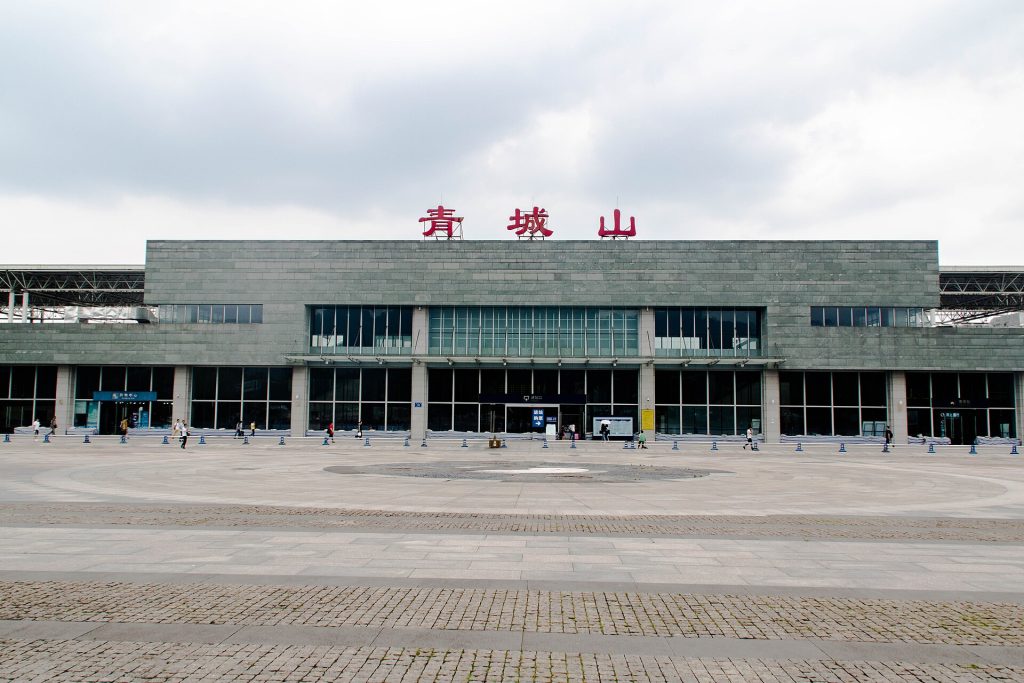
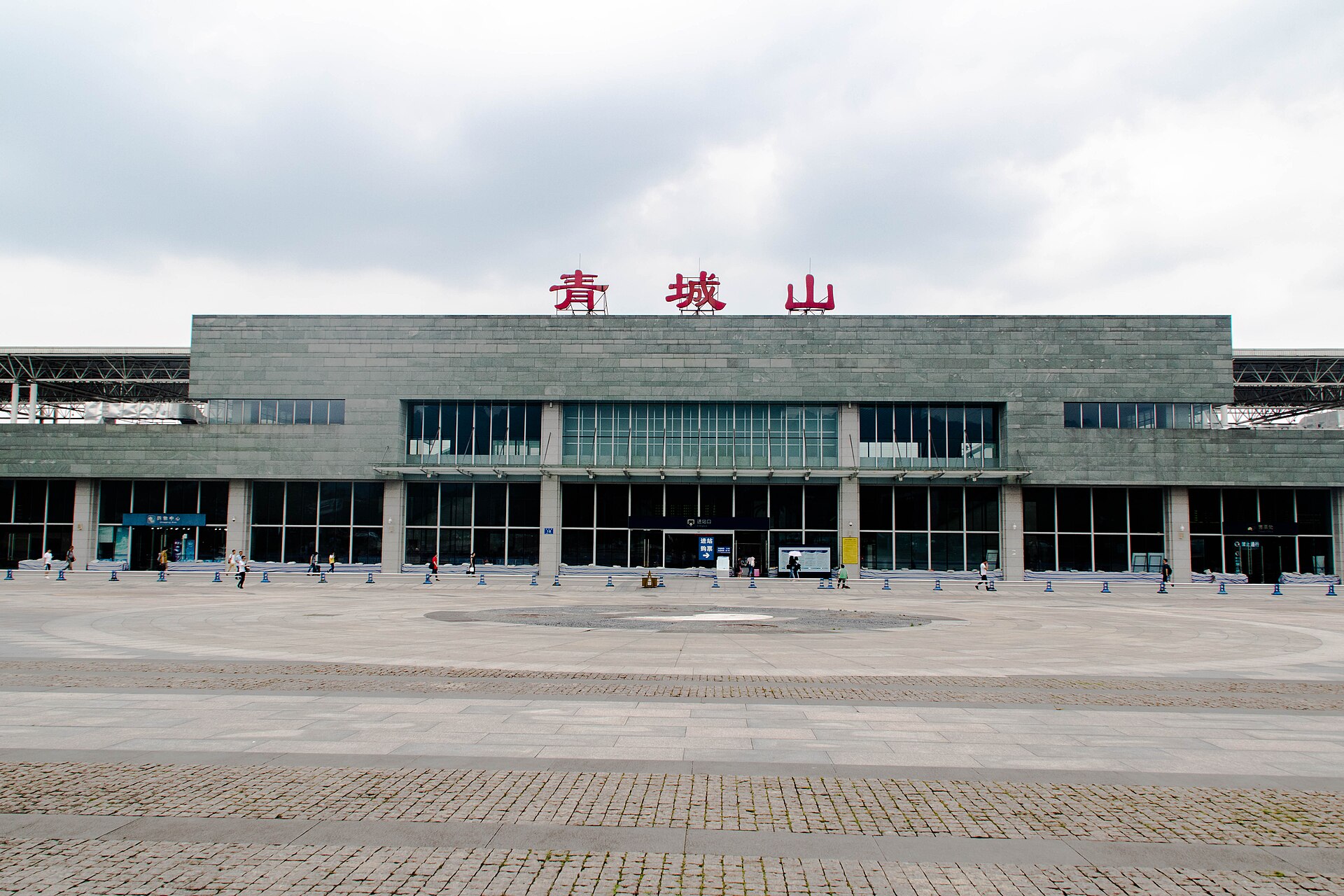
Dujiangyan city sits at the mountain’s feet, thirty minutes by high‑speed train from Chengdu East. Trains run every half hour; the station is a five‑minute taxi ride from the park’s main entrance. I stayed in a courtyard guesthouse near the South Bridge (南桥) — tiled roof, shared courtyard, hot water that actually lasts through a shower. The owner, a woman who once taught middle‑school physics, wakes at five to steam mantou for guests heading up the mountain before dawn.
Dinner is simple: mapo tofu with mountain pepper, stir‑fried celtuce stems, a bowl of rice, and a pot of jasmine tea. No menu — she cooks what the market delivered that morning. After the meal, neighbors gather at a fold‑out table to play dou dizhu, cards slapping the bamboo surface. They invited me to join. I lost three rounds, then wandered back to the guesthouse under a sky thick with stars, the mountain a dark bulk against the horizon.
- Train from Chengdu: 30 minutes, ¥15 second class; buy on the 12306 app or at the station.
- Taxi from Dujiangyan station to park gate: ¥20–25, five minutes.
- Guesthouse price range: ¥180–350 for a private room with bathroom in off‑season; doubles on Golden Week.
- Cash: Small vendors and the guesthouse prefer WeChat/Alipay, but keep ¥200 in small notes for mountain stalls.
What Trips People Up
First, underestimating the stairs. Front Mountain looks gentle on the map; the reality is 3,000 uneven steps between gate and summit. Knees that feel fine at breakfast ache by noon. Second, trusting the cable car as a time saver — queues can swallow an hour each way during holiday weeks. Third, skipping the irrigation system because “it’s just a dam.” The weir is alive; watching the repair crew is as close to the mountain’s heartbeat as you’ll get. Fourth, arriving at the park at ten in the morning during the spring tea harvest. The narrow road from town backs up for kilometers. Leave Chengdu on the 07:00 train, or stay the night before.
Last autumn I met a couple from Chengdu who had driven up for the day. They spent four hours in traffic, forty minutes in the cable‑car line, and twenty minutes at Shangqing Palace before turning around. “Next time we sleep here,” the husband said. He was right. The mountain reveals itself to the ones who stay past the last bus.