Stepping off a long-haul flight into Guangzhou Baiyun International Airport (CAN) as a first-time foreign visitor can feel overwhelming, but modern terminal updates and clear bilingual signage make the journey into China’s southern commercial hub straightforward. With ongoing terminal adjustments in play, your transfer experience relies heavily on knowing which terminal you land in, how to handle digital payments, and selecting the right ground transit without relying on outdated guides.
Terminal Orientation Mindset
Your airport transfer starts well before you clear baggage claim. Following recent structural shifts, international flights primarily land at Terminal 2 (T2) or the newer Terminal 3 (T3). Terminal 1 has closed for long-term modernization, meaning older maps or guidebooks referencing Airport South metro station or T1 arrivals are obsolete.
Check Your Booking: Look closely at your final flight confirmation or airline notice to verify whether you arrive at T2 or T3.
The Inter-Terminal Link: Free 24-hour shuttle buses connect T2 and T3 for smooth passenger transfers if you need to reposition between them.
Luggage Carts and Wi-Fi: Free luggage carts are readily available past customs. Before leaving the restricted zone, connect to the airport’s free Wi-Fi network using your passport at a verification kiosk, or rely on roaming data if you prepared an airport SIM kiosk guide ahead of time.
Metro Links and Airport Express Options
For speed, cost-effectiveness, and immunity to surface traffic, rail transit is usually the top choice for travellers heading into central districts like Tianhe or Yuexiu.
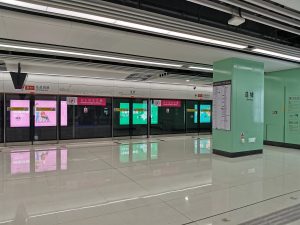
Terminal 2 Metro Access: T2 features direct access to Airport North station on Metro Line 3 located on the basement level (B1). Line 3 runs directly toward major downtown nodes like Guangzhou East Railway Station and Tiyu Xilu. For deeper navigation tips, review the Guangzhou metro first-timers guide.
Terminal 3 Public Transit Route: T3 does not have a direct subterranean metro station. Instead, passengers take a dedicated shuttle bus or local connection to Gaozeng station to join Line 3 or Line 9, or utilize the intercity rail links connecting from Baiyun Airport East.
Ticketing and Payment: While single-journey token machines accept cash or digital methods, many international travellers prefer generating a transit QR code through the Guangzhou Metro mini-program inside Alipay or WeChat. Read up on tourist metro cards vs mobile pay to decide which option suits your comfort level, and make sure your Alipay and WeChat Pay hub setup is complete before your flight.
Buses, Taxis, and Ride-Hailing Pickups
If you are traveling with heavy luggage, arriving late in a November evening when temperatures drop and trains wind down, or heading directly to a hotel door, surface transport is often more practical.
Airport Express Coaches: Long-distance and express buses depart from designated zones outside the transport centres at T2 and T3. They offer large undercarriage storage for bulky bags and run routes toward major hotel clusters in Yuexiu and Tianhe.
Licensed Taxis: Follow the official overhead signs to the authorized taxi queue. Official taxis run on meters with regulated daytime and nighttime rates. Never accept rides from individuals soliciting inside the terminal halls.
DiDi Ride-Hailing: If you prefer app-based booking, rideshare pickups are restricted to specific geofenced parking lots—such as Lot P8 at T2 and Lot P12 at T3. Securing a ride requires a data connection and a linked payment platform. Consult Didi ride-hailing for foreigners for step-by-step app integration.
Essential First-Timer Checklist
[ ] Verify Terminal: Double-check your arrival terminal (T2 or T3) right before departure, as schedules and ground setups adjust.
[ ] Prepare Hotel Details: Have your hotel’s name and address written out clearly in Chinese characters. Taxi drivers and local app dispatchers rarely rely on English addresses.
[ ] Payment Readiness: Ensure your mobile payment apps are active with a working international credit card attached, alongside some physical Chinese Yuan cash for absolute emergencies.
[ ] Official Verification: Cross-check current operating hours and fare notices on official Guangzhou Baiyun International Airport or Guangzhou Metro portals close to your travel week.
FAQ
Which terminal at Guangzhou Baiyun Airport handles international arrivals?
International flights primarily land at Terminal 2 (T2) or Terminal 3 (T3), depending on your specific airline. Terminal 1 is closed for renovations. Always verify your operating carrier’s terminal designation on your ticket confirmation prior to departure.
How do I get from the airport to downtown Guangzhou using the metro?
If you arrive at Terminal 2, you can walk directly to Airport North station on Metro Line 3 on level B1. If you arrive at Terminal 3, you will take a short connecting shuttle or bus to reach the broader metro network. Verify route maps and destination boards on the platform before boarding.
Can I pay for my airport transport using a foreign credit card?
Direct tap-to-pay with foreign contactless credit cards is not universally supported across all ticket machines and turnstiles. Setting up digital payment mini-programs within Alipay or WeChat before you travel provides the smoothest transaction experience for metro rides and transit codes.
Where should I go to catch a DiDi ride-hailing car?
Ride-hailing services operate out of dedicated, geofenced parking zones rather than curbside arrivals. If you are exiting from Terminal 2, head to parking lot P8; for Terminal 3, proceed to parking lot P12 following the airport’s ground transportation signs.
Related Lovely China reading
For payments, start with Alipay and WeChat Pay hub and WeChat Pay vs Alipay for tourists. For trains, keep high-speed rail first-timers guide and 12306 passport signup for foreigners handy. City hubs: Beijing first-visit guide, Shanghai first-visit guide. Connectivity: roaming vs local SIM honest guide, pocket Wi-Fi vs eSIM for China, offline maps for foreigners. Bookmark China travel tools page.
Practical checklist
- Confirm official rules on the relevant government, park, airline, or bank page near your travel week
- Screenshot bookings, tickets, and QR codes while you still have stable Wi-Fi
- Save hotel and attraction names in Chinese characters in your phone notes
- Carry passport, a backup payment method, and a small cash float (why cash is still needed)
- Test one small mobile payment before you rely on wallets at a gate or taxi
- Keep the China travel tools page page bookmarked for related Lovely China hubs
FAQ
Is this travel advice official?
No. Lovely China orients travellers. Verify live rules on official pages, apps, and counters near your travel week.
Will every city behave the same?
No. Airports, stations, parks, and markets differ. Use local signage and staff instructions when they conflict with a general guide.
What should I screenshot before I lose Wi-Fi?
Bookings, tickets, hotel Chinese address, pickup pins, and payment success screens.
Notes for late 2026 travellers
November and early December bring cooler mornings, earlier sunsets, and comfortable walking weather across much of eastern and central China. Pack layers and leave extra time on clear weekends at popular sights.
This article does not invent ticket prices, opening hours, processing times, consular fees, or official statistics. When a number matters, verify it on the official site, app screen, or ticket board near your travel week.
If an official rule page disagrees with this guide, follow the official page. Lovely China orients English-speaking travellers; we are not an immigration, banking, or medical authority.