The first short ride that makes a Chinese city feel closer
Your first shared bike ride in a Chinese city is rarely about fitness. It is about shrinking a confusing kilometre between metro exit and alley breakfast, or between riverside path and hotel door. Bright frames cluster near subway mouths, office towers, and campus gates. Once you unlock one calmly, neighbourhoods stop feeling like corridors you can only walk or taxi through.
This is a practical first-ride story for foreign visitors and new arrivals: which apps and deposits to expect, how parking rules work, how traffic actually behaves beside you, and how to keep the first trip short enough to stay fun. It is not a claim that every city uses the same brand or that every street is bike-perfect. It is a calm pattern you can reuse.
Before you rely on phones outdoors, sort connectivity with China SIM/eSIM for foreign visitors. For payments inside the same apps, keep Alipay and WeChat Pay for foreign visitors ready. When distances or weather win, Didi for foreign visitors remains the backup.
What “shared bike” means on the ground
Dockless bikes with rules
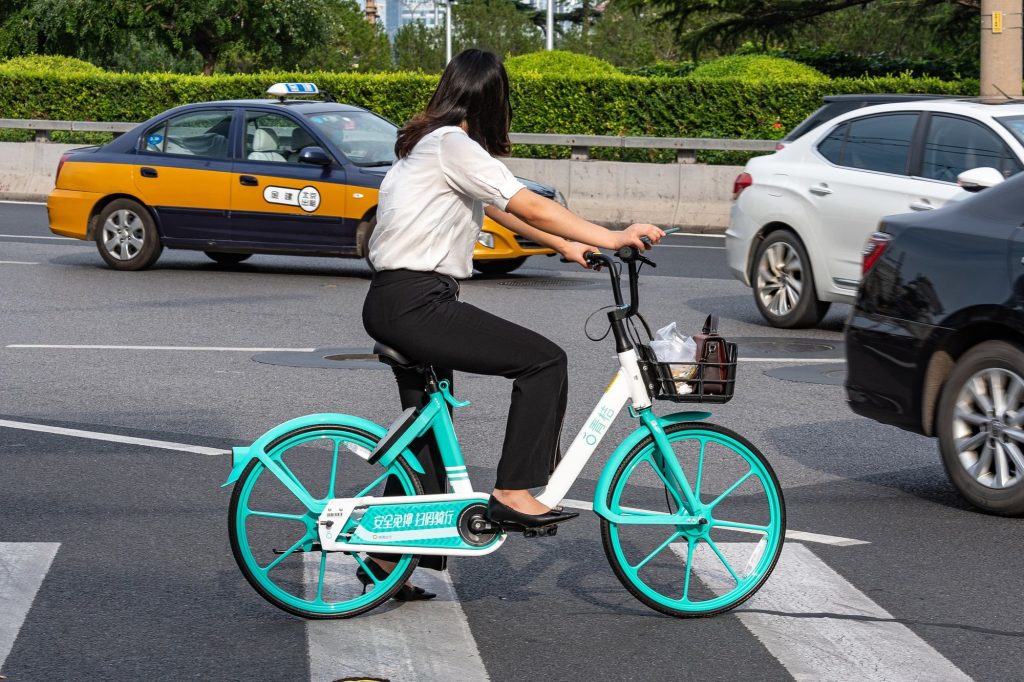
Most city shared bikes in China look free-floating: unlock by scanning a code, ride, lock when finished. In practice, cities and operators add parking zones, painted boxes, roadside racks, and no-parking stretches. Your app map usually shows where ending a ride is allowed. Ending outside a zone can mean extra fees, repeated lock prompts, or a bike that refuses to close the trip cleanly.
Brands change; the habit stays
You may see Meituan-linked bikes, Hello-linked bikes, DiDi/Qingju greens, or local variants depending on the city and year. Do not memorise every logo before day one. Memorise the habit: scan, ride in a bike lane when available, park in a marked zone, lock, confirm the trip ended.
Helmets and local requirements
Some cities and operators push helmet prompts or provide helmets on certain bikes. If the app or the bike instructs you to wear one, do it. If no helmet is available and you feel unsafe in traffic, skip the ride and walk or take a bus. Pride is a bad reason to enter a six-lane turn.
Apps, deposits, and the five minutes before you pedal
Account setup while you still have Wi‑Fi
Do this in your hotel or apartment, not in the rain beside a locked wheel:
1. Install the bike brand’s app or open the bike mini-program inside WeChat/Alipay if that is how locals in your city unlock.
2. Complete real-name style verification if asked — foreign ID flows vary; follow in-app instructions carefully.
3. Add a working payment method.
4. Read the deposit / credit / ride-pass screen without tapping through blindly.
Some systems use deposits; some use credit scores or ride packages; some charge per minute after unlock. Exact numbers change, so this guide does not invent prices. Your calm job is to understand whether money is held, how trips bill, and how to end a ride.
Permission and map hygiene
Allow location access while riding. Screenshot the customer-service entry in the app. Note what “report broken bike” looks like before you need it with sweaty hands.
Choose a tame first bike
Skip bikes with twisted baskets, flat-looking tires, screaming chains, or frames knocked into the gutter. Walk thirty seconds to a better cluster. Your first ride should teach city movement, not mechanical patience.
Unlock, adjust, and leave the sidewalk cluster
The unlock moment
Point your camera at the QR code. Wait for the unlock confirmation. Lift the rear lock or follow the on-screen lock instruction for that model. If the wheel stays locked, do not force it — cancel and choose another bike.
Seat height and brakes
Stand beside the bike and set the seat so your feet can touch the ground. Squeeze both brakes before you enter traffic. Ring the bell once to learn where it is. These ten seconds prevent the classic first-timer wobble into a pedestrian stream.
Leaving the pile
Shared bike piles form at metro exits. Push out of the cluster before mounting if space is tight. Look for a painted bike lane or the quietest parallel street. Do not dramatise a left turn across turning cars on minute one.
Traffic habits that keep first rides short and safe
Think “predictable,” not “fast”
Chinese city cycling beside cars, e-bikes, and scooters rewards predictability:
- Stay right in the bike lane when one exists
- Expect e-bikes to overtake closely
- Slow before every driveway and right-turn mouth
- Assume a car may not yield even when you are legally in a bike lane
You are not racing couriers. You are borrowing a public object for a neighbourhood hop.
Signals and crossings
Stop at red lights even if two e-bikes slip through. First rides are when habits form. At wide crossings, walking the bike on a crosswalk is allowed dignity, not failure.
Night and rain
Night rides need working lights; if the bike is dark and streets are poorly lit, skip it. Light rain makes metal surfaces and painted lanes slick. Heavy rain is a Didi day.
Parking docks, painted boxes, and ending the trip
Read the map before you feel done
When you are one or two minutes from your destination, open the parking layer. Aim for a blue/green allowed zone rather than the exact shop door if the door sits in a red no-parking strip. Walking the last forty metres is normal.
Lock and confirm
Park upright in the zone, lock as instructed, and wait for the app to confirm trip end and fee. If the trip does not close, stay with the bike and use in-app help rather than walking away hoping it resolves. Abandoned “maybe locked” bikes create billing headaches.
Do not block ramps and gates
Even inside an allowed zone, avoid doorways, tactile paving, bus doors, and accessibility ramps. Local fines and public frustration are real; courtesy is part of riding.
A first-ride story you can copy
Here is a calm template many newcomers use on day two or three in a city:
1. After breakfast, walk to the nearest metro-exit bike cluster.
2. Unlock a healthy bike and ride five to ten minutes along a riverside path or quiet secondary road.
3. Park in a marked zone near a cafe or park gate.
4. End the trip fully.
5. Walk, take photos, breathe.
6. Unlock a second bike only if you still feel steady — or walk back and call the first ride a win.
That short loop teaches unlock, traffic noise, and parking without trapping you far from home. Save ambitious cross-city rides for later.
Mid-Autumn and Golden Week timing notes for 2026
Festival weeks change street energy. Mid-Autumn Festival falls on Friday 25 September 2026 (holiday ~25–27 September), with a makeup workday on Sunday 20 September. Golden Week runs roughly 1–7 October, with a makeup workday on Saturday 10 October. Near scenic night-walk areas, bike clusters can thin out or park zones fill with festival crowds. On those evenings, walking may be kinder than circling for a legal parking box.
If your trip straddles both holidays, Golden Week 2026 vs Mid-Autumn helps you decide which nights to keep car-free and slow.
When not to ride
Skip shared bikes when:
- You are unsure about payment or ID verification
- You feel jet-lag dizzy
- The only available bikes are damaged
- You would need a multi-lane left turn you do not understand
- You are carrying fragile luggage that needs two hands
A metro ride or taxi is not a defeat. Shared bikes are a tool, not a test of belonging.
Troubleshooting without panic
- Unlock fails: try another bike; check network; restart the mini-program.
- Bike locks mid-ride: move to the roadside safely and contact in-app support; do not leave it in a live lane.
- Cannot end trip: stay in a parking zone, follow end-ride prompts, photograph the bike ID number.
- Unexpected fee prompt: screenshot before paying disputes; use official support channels rather than street “helpers.”
Keep your voice steady. Most first-ride problems are account or parking-zone issues, not personal failures.
What the first ride changes
After one successful short loop, maps make more sense. Alley breakfasts feel nearer. Evening river paths feel usable. You also learn the city’s soft edges: where bike lanes vanish, where e-bikes dominate, where parks invite coasting.
That is the real story. Not a heroic forty-kilometre day, but a quiet five-to-ten-minute hop that turns “I can only get there somehow” into “I can get there myself.” Keep the first ride short, legal, and daylight-bright. The second ride will already feel like ordinary life in a Chinese city — which is exactly the point.