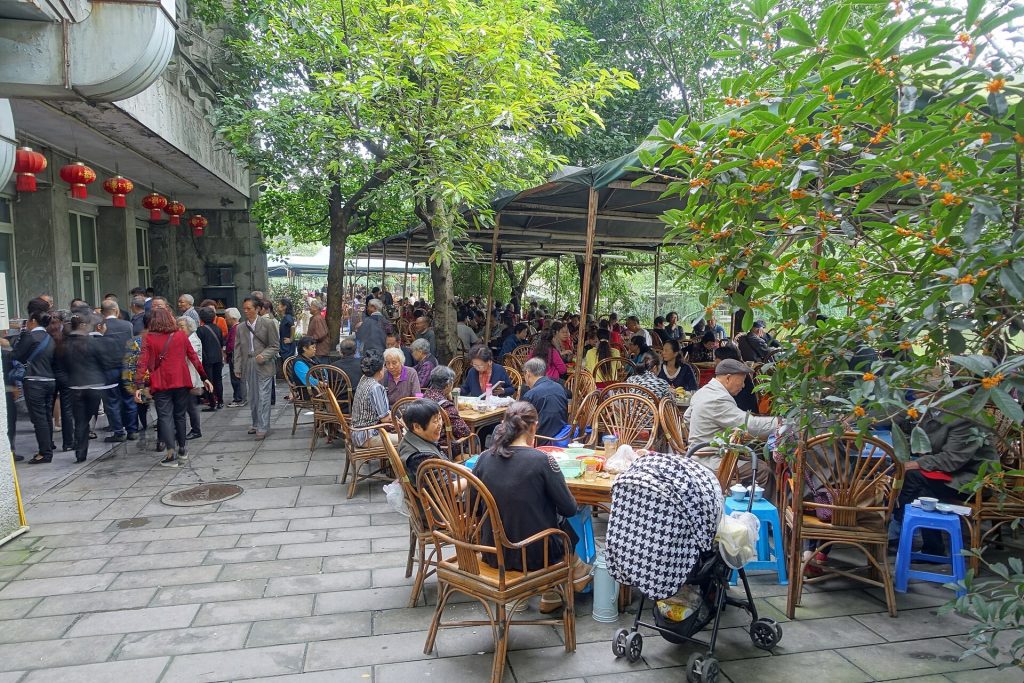
The first cool week of November in Chengdu does not announce itself with drama. It arrives as a softer edge on the air, a slower hand on the thermos, a preference for seats that catch pale sun through a courtyard tree. In a neighbourhood teahouse—not a staged tourist set, just a room that has hosted mornings longer than your itinerary—the day begins before your phone finishes its first map load.
You push the curtain or door, and warmth meets you in layers: wet tea scent, sesame oil from somewhere out back, a faint sweetness that might be steamed buns two doors down. Bamboo chairs scrape. A towel hangs over a seat like a reserved claim. Nobody rushes you to order as if you were a transaction.
Covered cups and patient water
The gaiwan or the glass with a lid is less a prop than a method. Leaves open in heat. Water is topped up without ceremony. You learn, by watching, that drinking is not a race to the bottom of a cup but a conversation with the same leaves across refills. Bitterness softens; aroma shifts. Time stretches to match.
A server moves with the economy of someone who has done this since before ride-hail icons existed. You point, you smile, you manage a few words, or you show a translation screen from translation apps honest guide without turning the table into a classroom. Payment will come later—QR likely, cash sometimes—habits you already practised for Chengdu days in Chengdu first-visit guide and Alipay and WeChat Pay hub.
Mahjong as percussion, not soundtrack for sale
From a side room or a nearby table, tiles click in bursts. The sound is local weather: present, uninterested in your content calendar. Nobody asks you to film it. If you do lift a camera, you keep faces out unless invited. The ethics are the same as temple courtyards and hutong mornings—people are not extras in your November story.
An older patron folds a newspaper the way others fold maps. Someone’s portable radio murmurs a talk show. A birdcage hangs in a sunnier teahouse elsewhere in the city; here, the bird is optional mythology. What you get instead is steam writing temporary calligraphy under the lid when you tilt it.
Autumn light on enamel and bamboo
November light in Chengdu can be shy—thin cloud, sudden gold, then soft again. It finds the rim of a cup, the worn shine on chopsticks, the dust motes above a charcoal-dark table. Outside, electric bikes tick past. Inside, your itinerary loses a few sharp corners. The panda base can wait thirty quiet minutes; the hotpot booking will still exist after one more refill.
You think of other slow Chinese mornings you have read about—the canal hush in November morning on a Suzhou canal—and notice how Chengdu’s version is thicker with conversation, less watery, more kettle. Both are real. Neither needs a fake quote from a named stranger to feel true.
Leaving without conquering the room
When you finally stand, legs remember the low chair. You nod. You do not declare the teahouse “discovered.” You simply step back into a city that will feed you chili and soft rabbits of memory all week. Carry the pace to the next queue: temple incense, train security, wallet QR—whatever China travel tools page had you worrying about at 2 a.m. on hotel Wi-Fi.
November will end. The leaves in someone else’s gaiwan will be new. The click of tiles will continue without you. That is the gift of a teahouse morning: it reminds a traveller that China is not only gates and tickets, but rooms where time is poured and poured again.
Related Lovely China reading
For payments and wallets, start with Alipay and WeChat Pay hub and WeChat Pay vs Alipay for tourists. For trains and long-distance moves, keep high-speed rail first-timers guide and 12306 passport signup for foreigners handy. For city orientation, the Beijing first-visit guide, Shanghai first-visit guide, and Chengdu first-visit guide hubs remain useful even when your trip centres on another province. Connectivity backups live in roaming vs local SIM honest guide, SIM vs eSIM carriers compare, pocket Wi-Fi vs eSIM for China, and offline maps for foreigners. Bookmark China travel tools page so you can jump between logistics topics without searching from scratch on hotel Wi-Fi at midnight.
Practical checklist
- Confirm official rules on the relevant government, park, airline, or bank page near your travel week
- Screenshot bookings, tickets, and QR codes while you still have stable Wi-Fi
- Save hotel and attraction names in Chinese characters in your phone notes
- Carry passport, a backup payment method, and a small cash float (why cash is still needed)
- Test one small mobile payment before you rely on wallets at a gate or taxi
- Build time buffers for security lines, November weather, and bilingual navigation
- Prefer refundable holds until visas, trains, or park tickets are confirmed
- Keep the China travel tools page page bookmarked for related Lovely China hubs
How to verify information without panicking
English travel blogs lag policy changes. When something critical is at stake—entry permission, ticket validity, or whether a card works—use primary sources: embassy or VAC pages, National Immigration Administration notices, official park reservation platforms, airline apps, and the screens inside Chinese super-apps. Lovely China articles such as Alipay and WeChat Pay hub, high-speed rail first-timers guide, and essential apps for foreigners help you orient, but they are not substitutes for the live rule in front of you.
If two sources conflict, choose the stricter one until you can ask a human at the counter. That habit prevents most arguments that begin with “I read online that…” at gates.
FAQ
Is this a specific named teahouse advertisement?
No—it is a composite travel narrative grounded in common Chengdu teahouse textures.
Do I need to speak Chinese to visit?
Basic pointing and translation apps help; patience matters more than fluency.
Are teahouses tourist-only spaces?
Many neighbourhood teahouses primarily serve locals; be a respectful guest.
What else should I read for Chengdu logistics?
Start with the Chengdu first-visit hub and practical payment guides.
Notes for late 2026 travellers
Late October and November bring cooler mornings, earlier sunsets, and comfortable train weather across much of eastern and central China. Pack layers, keep phone batteries warm outdoors, and leave extra time whenever a clear weekend coincides with popular sightseeing.
This article does not invent ticket prices, opening hours, processing times, consular fees, or official statistics. When a number matters, verify it on the official site, consulate page, app screen, or ticket board near your travel week.
Write key Chinese addresses into your phone notes before you leave Wi-Fi. Screenshot tickets and booking codes. Carry a small cash float even if you prefer wallets—see why cash is still needed. Reconfirm last-mile transport the evening before early starts.
If an official rule page disagrees with this guide, follow the official page. Lovely China orients English-speaking travellers; we are not an immigration, banking, or medical authority. Keep the China travel tools page bookmarked for other logistics hubs.
Traveller mindset
Move slowly through paperwork moments. A calm queue is cheaper than a missed train or a refused visa file. When language fails, show passport pages, booking screens, and maps with Chinese labels. Hotel front desks and station information booths are used to helping foreigners through routine steps.
Keep expectations honest: China is highly digital, but edge cases remain. Your job is not to memorise every exception—it is to carry backups (second card, cash, offline maps, written addresses) so one failure does not end the day. For everyday apps, start with essential apps for foreigners.