As we head into late October and November 2026, traveling to China requires a highly specific digital payment strategy. You already know that scanning QR codes is the undisputed king of commerce here. From high-end malls in Shanghai to vegetable markets in rural Sichuan, the smartphone has replaced the wallet. But what happens when the QR code won’t scan, the app demands a secondary SMS verification code you can’t receive, or your phone battery simply dies while you’re navigating the crisp autumn streets of Beijing?
You need cash.
While the country has aggressively shifted toward a cashless society over the last decade, the People’s Bank of China (PBOC) mandates that merchants must still accept physical RMB (Renminbi). Following a series of regulatory crackdowns in recent years to ensure the country remains accessible to international tourists and the elderly, cash is officially protected by law. However, for foreign visitors relying on Visa, Mastercard, or AMEX, getting that cash out of a Chinese ATM isn’t always as simple as sliding your card into the nearest machine.
Here is the practical, no-nonsense 2026 guide to finding ATMs that work, navigating foreign withdrawal fees, avoiding digital pitfalls, and keeping physical backup money in your wallet.
Why You Still Need Cash in 2026
If you’ve read up on [Alipay and WeChat Pay for Foreign Visitors in China 2026], you know that 95% of your transactions will happen seamlessly on your smartphone. However, that remaining 5% can make or break your day. Cash remains your ultimate fail-safe for several highly specific scenarios:
Connectivity Dead Zones: Even with China’s impressive 5G infrastructure, if you find yourself deep in a rural area, hiking a remote section of the Great Wall, or experiencing sudden network drops, mobile payments will fail. Ensure you have a solid connection from the start by checking out [China SIM and eSIM for Foreign Visitors in 2026], but always carry a physical backup.
Phone Battery Issues: It happens to the best of us. After a long 12-hour day of taking photos, running translation apps, utilizing map routing, and scanning codes, your battery will drain. A dead phone in China means you cannot hail a ride, buy a subway ticket, or pay for a meal.
Small Independent Vendors & Risk Control Limits: Some street food carts, remote market stalls, or independent drivers might only have a personal, unverified QR code. Occasionally, when a foreign-linked credit card attempts to pay a personal (non-merchant) account, the app’s automated fraud detection blocks the transaction. Cash solves this instantly.
Subway Ticket Machines: While major cities allow you to scan your phone at the turnstile, some older automated ticketing machines in tier-2 and tier-3 cities only accept domestic mobile payment networks or physical cash.
Deposit Requirements: Though increasingly rare, physical cash deposits are occasionally still required at certain small boutique hotels, equipment rental shops (like bicycle rentals in tourist parks), or locker facilities.
Which ATMs Actually Accept Foreign Cards?
China’s domestic banking system runs on the UnionPay network. Your foreign Visa, Mastercard, AMEX, or Discover card is an “outsider” to this ecosystem. Even if an ATM displays a fading Visa or Mastercard sticker on the plastic casing, it does not guarantee a successful withdrawal. You will need to adopt a “verify-it-yourself” mindset locally, as branch policies and individual machine network connections frequently change.
That said, traveler reports in 2026 consistently point to the “Big Four” Chinese state-owned banks as your most reliable bets:
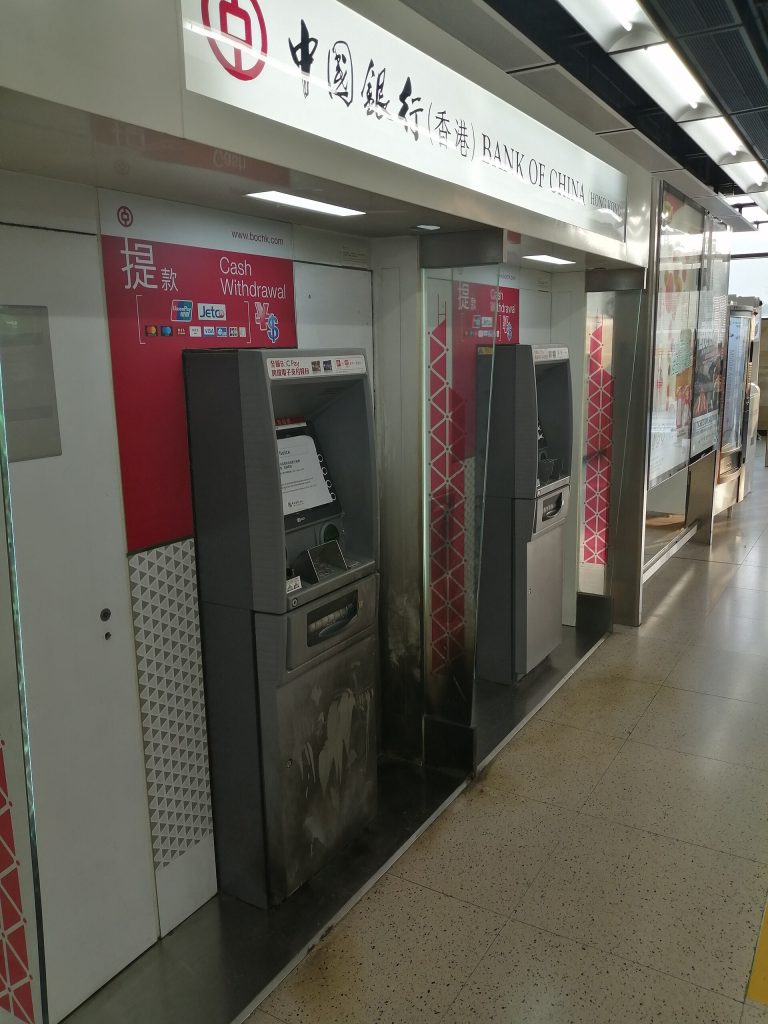
Bank of China (BOC): Historically and currently the most reliable bank for foreign cards. If you see their distinct red logo, this should be your first attempt. Their machines are deliberately programmed to interface with international networks.
Industrial and Commercial Bank of China (ICBC): Highly successful with international Visa and Mastercards, and they boast the largest network of physical ATMs in the country.
China Construction Bank (CCB): A solid backup option, though success rates with foreign AMEX and Discover cards vary by province.
Agricultural Bank of China (ABC): Hit or miss for foreign cards, but widely available in smaller towns and rural counties where BOC or ICBC might be absent.
Tier 1 City Alternatives: If you are in Shanghai, Beijing, Guangzhou, or Shenzhen, you can also look for international bank branches such as HSBC, Standard Chartered, or Citibank. Their ATMs are guaranteed to accept foreign cards seamlessly.
The Airport Pro-Tip: Airport ATMs are specifically configured to handle international arrivals. Your best strategy is to withdraw 500 to 1,500 RMB from a Bank of China or ICBC ATM in the arrivals hall before you even step outside to get a taxi.
Step-by-Step: Navigating a Chinese ATM Interface
Walking up to an ATM in a foreign country can be intimidating, especially when the default screen is entirely in Mandarin. Here is exactly what to expect and how to navigate the common pitfalls of a Chinese ATM:
Language Selection: As soon as you insert your foreign card, most Big Four bank ATMs will automatically detect an international chip and offer an English language option. If it doesn’t, look for a button labeled “English” or “语言” (Language) in the corner of the screen.
The 6-Digit PIN Dilemma: Chinese bank cards universally use 6-digit PINs. Your Western debit card likely has a 4-digit PIN. When the ATM prompts you for a 6-digit PIN, do not panic and do not add zeros to the end of your number. Simply type your standard 4-digit PIN and press the green “Enter” or “Confirm” (确认) button. The machine will process it normally.
Account Selection: You will typically be asked to choose between “Checking,” “Savings,” or “Credit.” Choose “Checking” for a standard debit card withdrawal.
The DCC Trap (Dynamic Currency Conversion): This is the most critical step. The ATM may display a screen offering to “lock in” your exchange rate, showing you the exact cost in your home currency (e.g., USD, GBP, EUR). Always decline this. This is called Dynamic Currency Conversion, and the exchange rate offered by the ATM operator is notoriously terrible, often hiding a 5% to 8% markup. Always choose “Withdraw in Local Currency” or “Continue Without Conversion.” Let your home bank handle the math; you will get the mid-market exchange rate.
Taking Your Cash: Chinese ATMs dispense cash first, and then ask if you want to perform another transaction or return your card. Do not walk away with your cash and leave your card in the slot.
UnionPay vs. Foreign Cards: The Reality
The core friction with ATMs in China stems from backend network compatibility. Because the domestic financial ecosystem relies on UnionPay, many standard ATMs simply lack the international routing protocols to securely ping your bank in London, Sydney, or New York.
If you have a home bank card that runs on the UnionPay network (which is increasingly common in parts of Asia, and available through certain Western financial apps), your ATM success rate approaches 100%. If you’re relying entirely on a foreign Visa or Mastercard, you are subject to that specific machine’s international routing connection at that exact moment. For more on navigating this network gap digitally, see our guide on [UnionPay QR and Foreign Cards in China 2026: When It Works and How to Set Up].
The Honest Truth About Withdrawal Fees
Let’s talk about fees without inventing numbers, because exact amounts fluctuate based on currency markets, local bank policies, and your home financial institution. When you withdraw cash in China using a foreign card, you face a two-front fee battle:
The Chinese Bank Fee: The ATM operator will almost always charge a flat access fee for using an international card (typically between 15 and 30 RMB). This will be clearly displayed on the screen before you confirm the withdrawal.
Your Home Bank Fee: Your domestic bank may charge an out-of-network ATM fee (often $3 to $5 USD) plus a foreign transaction fee (usually 1% to 3% of the total withdrawal amount).
How to minimize this:
Try to make fewer, larger withdrawals rather than multiple small ones to cut down on the flat access fees. Chinese ATMs generally have a per-transaction limit of 2,500 to 3,000 RMB for foreign cards. If you need more, you will have to perform a second transaction.
Furthermore, the savvy traveler in 2026 uses a bank card explicitly designed for international travel. Accounts from Charles Schwab, Fidelity, Monzo, Revolut, or Wise are famous for dropping foreign transaction surcharges entirely and, in some cases, refunding all global ATM access fees at the end of the month.
Practical Tips for Your 2026 Trip
Break Your Hundreds: Chinese ATMs exclusively dispense 100 RMB notes (the red bills featuring Mao Zedong). Because the country is so heavily digitized, many small vendors simply do not carry enough physical change for a 100 RMB note if you’re only buying a 5 RMB bottle of water. Break your large bills at convenience stores (like FamilyMart, Lawson, or 7-Eleven) or large supermarkets where they have high cash turnover.
Inform Your Bank: Always put a travel notice on your home bank cards before flying to China. A sudden withdrawal attempt in Guangzhou will almost certainly trigger an automated fraud freeze if your bank algorithm thinks you are still sitting in Chicago.
What to Do If the ATM Eats Your Card: If a machine swallows your card (usually due to a timeout error or a flagged fraud alert), do not leave the area. If the bank is open, walk inside immediately with your passport and ask for a manager. They can open the machine and retrieve it. If it is after hours, look for the emergency phone number printed on the ATM, note the machine ID number, and return when the branch opens.
Always Carry 200 RMB: Make it a daily habit to fold 200 RMB (two red bills) and tuck it behind your phone case or in an inner bag pocket. It’s enough to get you a taxi ride back to your hotel, buy a meal, or purchase a subway ticket if your digital payment methods temporarily fail.
Having physical cash in China in 2026 isn’t about rejecting the digital revolution—it’s about traveling with peace of mind. Get your RMB at the airport, break it into smaller bills, and enjoy the rest of your trip knowing you’re covered no matter what the technology does.
Frequently Asked Questions (FAQ)
Can I use contactless (NFC) or Apple Pay at Chinese ATMs?
While many Chinese ATMs are equipped with NFC readers, these are almost exclusively programmed to read domestic UnionPay contactless cards or Chinese mobile wallets. Do not rely on tapping your foreign phone or card to get cash; you must insert the physical chip card into the machine.
What is the maximum amount of cash I can withdraw in a single day?
This depends entirely on your home bank’s daily ATM withdrawal limit. However, the Chinese ATM itself will typically cap a single transaction at 2,500 or 3,000 RMB. If your home bank allows you to withdraw the equivalent of $1,000 USD per day, you will just have to perform multiple back-to-back 3,000 RMB transactions at the Chinese ATM to reach that limit.
Can I just exchange my home currency for RMB at a local Chinese bank branch instead of using an ATM?
Yes, but it is highly inefficient. Exchanging foreign cash at a Chinese bank branch requires a passport, filling out complex customs and currency exchange forms, and often waiting in line for over an hour. Using an ATM is drastically faster and usually offers a better exchange rate.
Will I encounter counterfeit money when receiving change?
Counterfeit currency was a major issue in China in the early 2010s, which is partly what drove the rapid adoption of digital payments. Today, the risk is incredibly low. ATMs dispense pristine, verified bills. When receiving change, you may notice vendors briefly rubbing the collar of Mao Zedong on the bill (it has a distinct textured feel) to check authenticity, but as a tourist in 2026, it is not something you need to actively worry about.
I forgot my physical debit card. Can I get cash out using Alipay or WeChat Pay?
If your Alipay or WeChat Pay is linked to a foreign credit card, you cannot use those apps to withdraw physical cash or transfer money to a Chinese bank account to withdraw cash. The foreign card integration is strictly for merchant payments only. You must have a physical ATM card to access physical currency.
Related Lovely China guides
- Alipay and WeChat Pay for Foreign Visitors in China 2026
- How to Use Amap (Gaode Maps) in China as a Foreigner: 2026 English Guide
- China SIM and eSIM for Foreign Visitors in 2026
FAQ
Is this guide current for late 2026?
It reflects commonly reported practice as of October 2026. Always re-check official sources before you travel, because rules, ticket platforms and seasons change.
Where can I verify details?
Use the official website, WeChat account or ticket platform named for this topic. For payments and maps, see Lovely China’s practical visitor guides linked above.
What if my situation is unusual?
Ask your hotel, airline, park ticket office or embassy/consulate for case-specific advice rather than relying only on a blog post.