The minibus shuddered to a halt on a hairpin bend above the Jinsha River. Below, the water cut a brown slash through the gorge, and across the valley a cluster of grey-tiled roofs clung to a terrace of barley stubble. An old woman in a blue apron and a black felt hat appeared at the edge of the path, a bamboo basket strapped to her back. She didn’t wave. She just adjusted the strap, turned, and walked uphill toward the village, the rhythm of her steps matching the creak of the bus door closing behind me. That was my first glimpse of Baidi, a Nakhi settlement where the road ends and the footpaths begin.
Village Rhythms and the Shape of a Day
Life in a Nakhi village follows the altitude. In the valley floor around Lijiang Old Town, the day starts with the clatter of wok spatulas in breakfast stalls — rice noodles in beef broth, pickled mustard greens, a dollop of chili oil. Higher up, in places like Baisha or Yuhu, the morning begins earlier. You hear the thud of a mortar and pestle grinding corn for baba flatbreads before the roosters finish their first round. Women carry water in tin pails balanced on a shoulder pole; men split firewood with a short-handled axe, the blade biting into pine logs stacked against the courtyard wall.
The courtyard house — sanfang yizhaobi, three wings and a screen wall — is the center of gravity. The main room faces south to catch the winter sun. The screen wall blocks wind and, tradition says, evil spirits. Inside, the hearth sits on the right. A tripod iron pot hangs from a chain. Above it, the blackened rafters hold strings of drying chilies, garlic braids, and cured pork belly wrapped in straw. The family eats sitting on low stools around a square table. There is no separate dining room. The kitchen is the living room.
Market Days and the Caravan Memory
Every fifth day, the village lane widens into a market. Traders arrive before dawn in three-wheeled trucks loaded with sacks of walnuts, baskets of matsutake mushrooms in season, and bundles of firewood. The Nakhi have traded across these mountains for centuries — tea bricks south to Tibet, horses north to the Sichuan basin, salt and iron tools moving both ways. The old caravan routes are now paved highways, but the market logic hasn’t changed. You still bargain by holding fingers under a cloth: three fingers for thirty yuan, a twist of the wrist for a counter-offer. No one shouts. The transaction finishes with a nod and a handful of cash passed palm-down.
If you walk the old stone slabs of Shuhe or Baisha early enough, before the tour buses unload, you can still see the grooves worn by mule hooves. Some elders keep a brass bell from a lead mule hung on the lintel. They polish it once a year before the Spring Festival. It’s not a decoration. It’s a receipt for a life spent on the trail.
Dongba Script: Reading the World in Pictures
The Nakhi are the only people in the world who still use a living pictographic writing system. Dongba script looks like stick figures dancing across handmade paper — a triangle for mountain, a wavy line for river, a tiny human shape with raised arms for “pray.” But each glyph can carry multiple meanings depending on context. A picture of a bird might mean “bird,” “fly,” “message,” or “soul” depending on the color of the ink and the stroke order.
I sat with He Xuewen, a dongba (ritual specialist) in his eighties, in his courtyard in Baisha. He unrolled a manuscript the length of my arm. The paper was thick, fibrous, made from the bark of the wikstroemia shrub. He read right to left, top to bottom, chanting in a nasal register that vibrated in the chest. The text was a funeral ritual: guiding the soul past the nine black hills, across the bridge of hair, into the ancestor realm. He didn’t translate. He said the script remembers what the mouth forgets.
Young Nakhi now learn the script in weekend classes at the Dongba Culture Museum in Lijiang. Some study it like Latin — academic, detached. Others apprentice to a dongba for years, memorizing thousands of glyphs, learning to mix ink from pine soot and ox gall, to cut the bamboo pen at the exact angle. The difference shows in the hand. A student’s strokes hesitate. A master’s line flows without lifting the pen.
Music That Survived the Bonfire
Nakhi ancient music — dongjing — arrived with Taoist priests from the central plains during the Ming dynasty. It settled into the temples and never left. The instruments are relics: sugudu (a fretless lute with a snakeskin soundboard), hulusi (gourd flute), pipa with silk strings, bronze chime stones hung on a wooden frame. The repertoire includes pieces with titles like “Wind Entering the Pines” and “Three Variations on the Plum Blossom.” The notation uses gongche characters — an old Chinese solfège — written in vertical columns.
During the Cultural Revolution, the Red Guards burned scores and smashed instruments. Musicians buried their sugudu in the garden, hid chime stones under the pigsty. After 1978, they dug them up. The silk strings had rotted. They restrung with nylon fishing line. The first public performance in decades happened in a drafty hall in Dayan. The oldest player, a former carpenter named Xuan Ke, conducted with a chopstick. He was ninety-two when I saw him lead the orchestra in 2018. His hands shook, but the downbeat was exact.
Today, the Dayan Ancient Music Association performs nightly in a restored courtyard hall near the Black Dragon Pool. The audience is half tourists, half locals. The program notes are in English and Chinese. But when the hulusi takes the melody — a thin, reedy line that bends like smoke — the room quiets. No one checks their phone. The music doesn’t ask for attention. It assumes it.
Festivals: Fire, Water, and the Turning Year
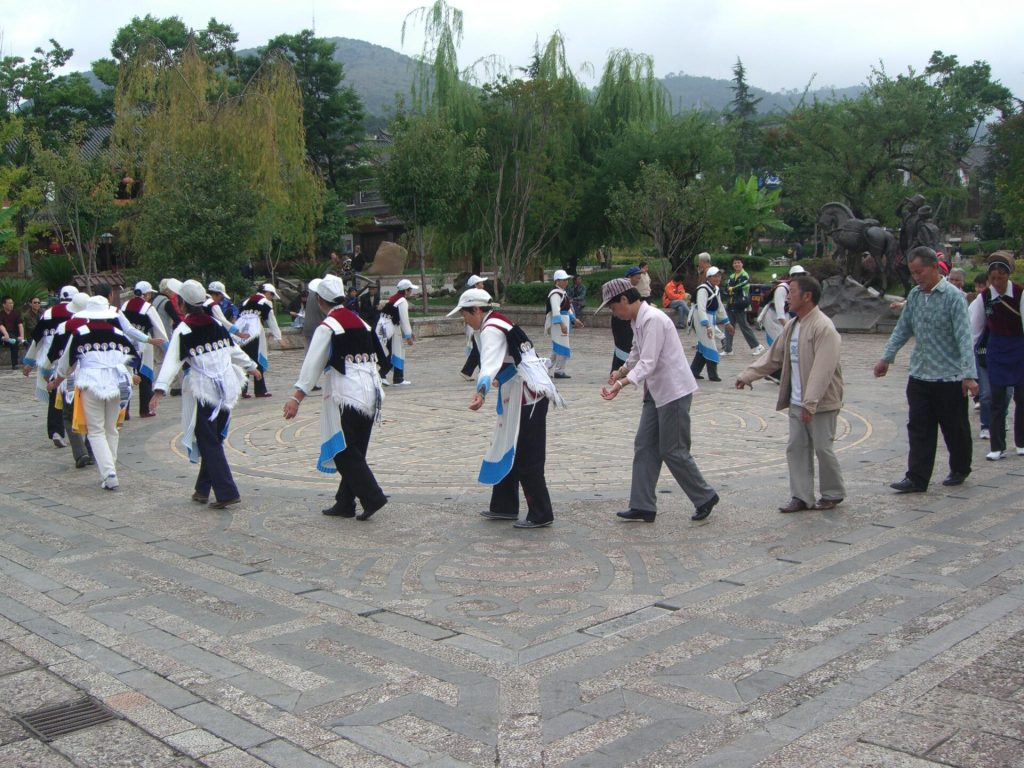
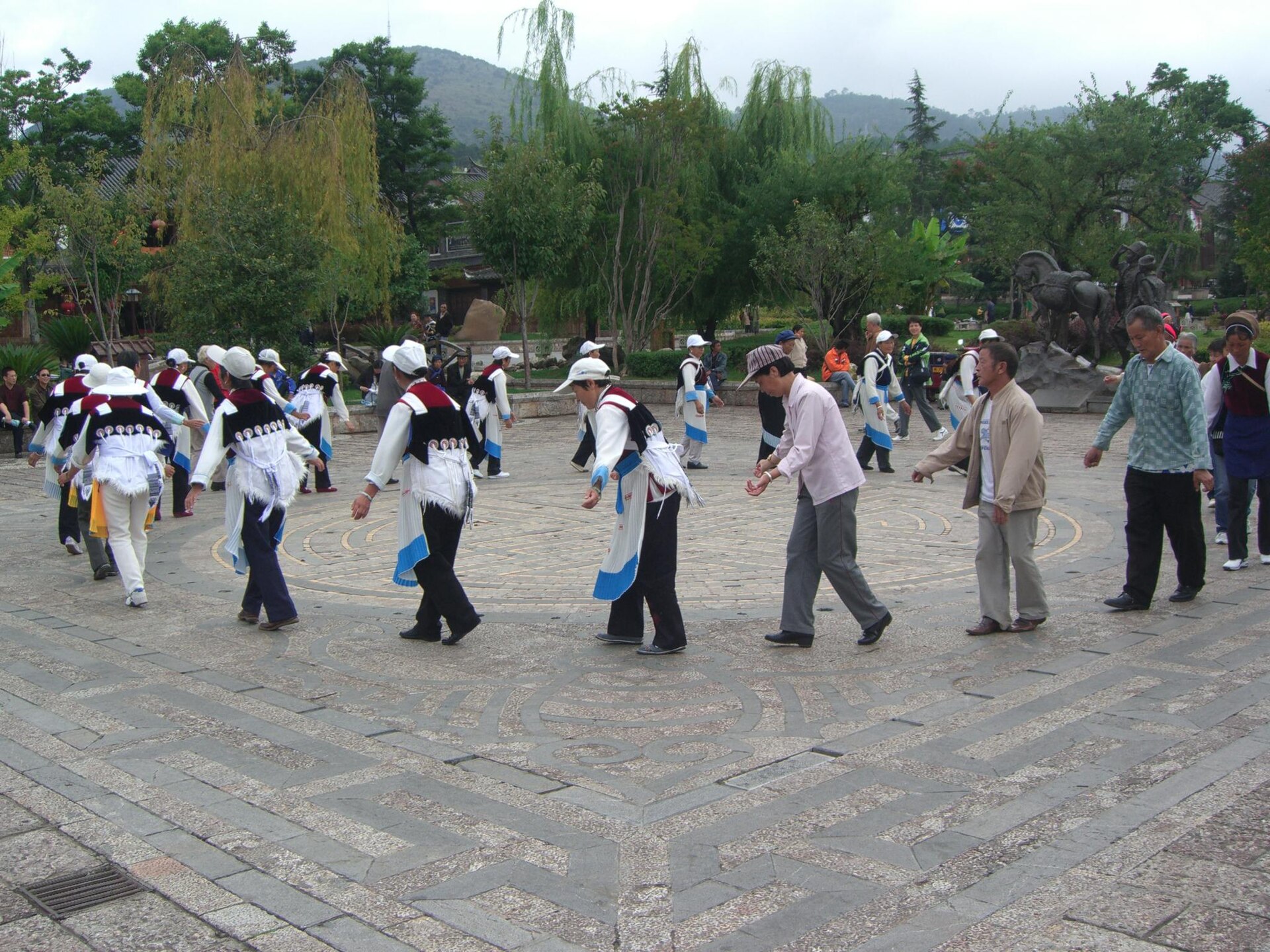
The Nakhi calendar runs on lunar months, but the festivals anchor to the agricultural cycle. The Torch Festival falls on the twenty-fourth day of the sixth lunar month — high summer, when the corn tassels and the mosquitoes thicken. In every village square, a pine trunk is erected, wrapped in straw, soaked in pine resin. At dusk, a dongba lights it with a flaming arrow. The fire roars. Men and women circle it, dancing the guozhuang — linked arms, stamping steps, voices rising in a call-and-response that has no written lyrics. The song changes every year. Someone improvises a verse about the harvest, a neighbor’s new baby, a dispute over irrigation water. The fire carries the words to the sky.
Two weeks later comes the Sanduo Festival, honoring the mountain god Sanduo, the Nakhi protector. Pilgrims climb Jade Dragon Snow Mountain’s southern slope to the Beiyue Temple. They carry white roosters, barley wine, and bundles of juniper branches. The path is steep, switchbacking through rhododendron thickets. At the temple, the dongba chants the Sanduo Jing, a text that lists every peak, spring, and sacred stone in the territory. The roosters are released, not slaughtered. They scatter into the forest. The wine is poured on the altar stone. The juniper smoke rises straight up — a good omen.
What Newcomers Get Wrong
Visitors often treat Nakhi culture as a performance. They pose with the stone lions at the Mu Palace gate. They buy “Dongba script” T-shirts printed with random glyphs that mean nothing. They ask a dongba to write their name — but the script doesn’t work like an alphabet. You can’t spell “Jennifer.” You can only write the concepts: “white,” “wave,” “virtue,” “arrive.” A real dongba will refuse, or write a blessing instead.
Another mistake: assuming all Nakhi are the same. The Mosuo, officially grouped with the Nakhi, live around Lugu Lake, fifty kilometers north. They follow a matrilineal system — “walking marriage,” where partners visit at night but live with their mothers. The Nakhi of Lijiang are patrilineal, Confucian-influenced, with ancestral tablets in the main hall. They share a language root and the Dongba religion, but the daily logic differs. Don’t ask a Nakhi man in Baisha about “the kingdom of women.” He’ll laugh, but the joke wears thin.
And don’t expect a homestay to be a guesthouse. If a family invites you to stay, you sleep on the kang — the heated brick bed — under the same quilts as the grandparents. You eat what they eat: corn porridge, fermented bean paste, wild greens gathered that morning. You wash from a basin. The toilet is a shed at the garden’s edge. They won’t charge you. If you leave money on the pillow, they’ll chase you down the path to return it. Hospitality isn’t a transaction. It’s the old caravan code: the traveler shares the fire, the host shares the roof.
Walking the Old Paths
The best way to understand the Nakhi is to walk. Not the paved loop around Black Dragon Pool. Take the high trail from Yuhu Village to the foot of Jade Dragon Snow Mountain. It climbs through oak forest, past a spring where a stone basin catches water drop by drop. An old woman fills her thermos there every morning. She’ll offer you a sip. The water tastes of iron and cold stone.
Further up, the trail crosses a scree slope. Cairns mark the way — three stones stacked, no mortar. Each passerby adds a pebble. The pile grows. It’s not a trail marker. It’s a prayer. The mountain watches. The Nakhi know this. They don’t conquer the peak. They visit it, leave a stone, and go back down to the barley field, the hearth, the manuscript waiting on the desk.