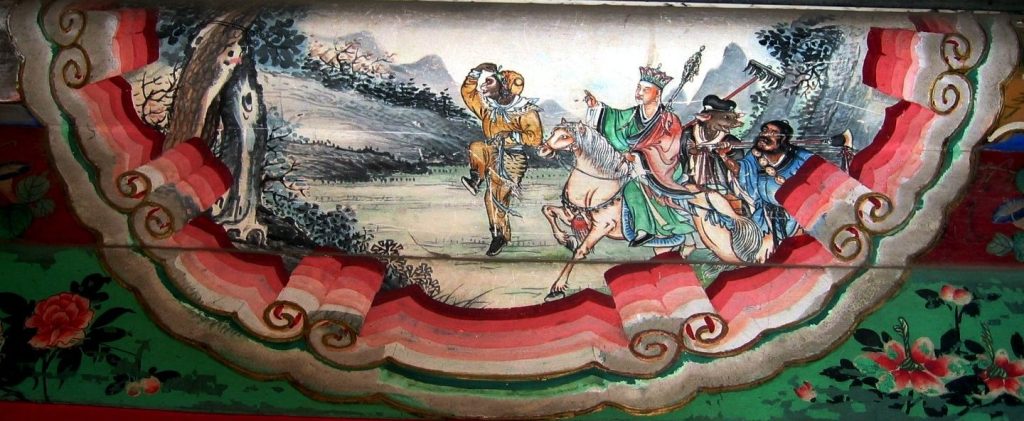
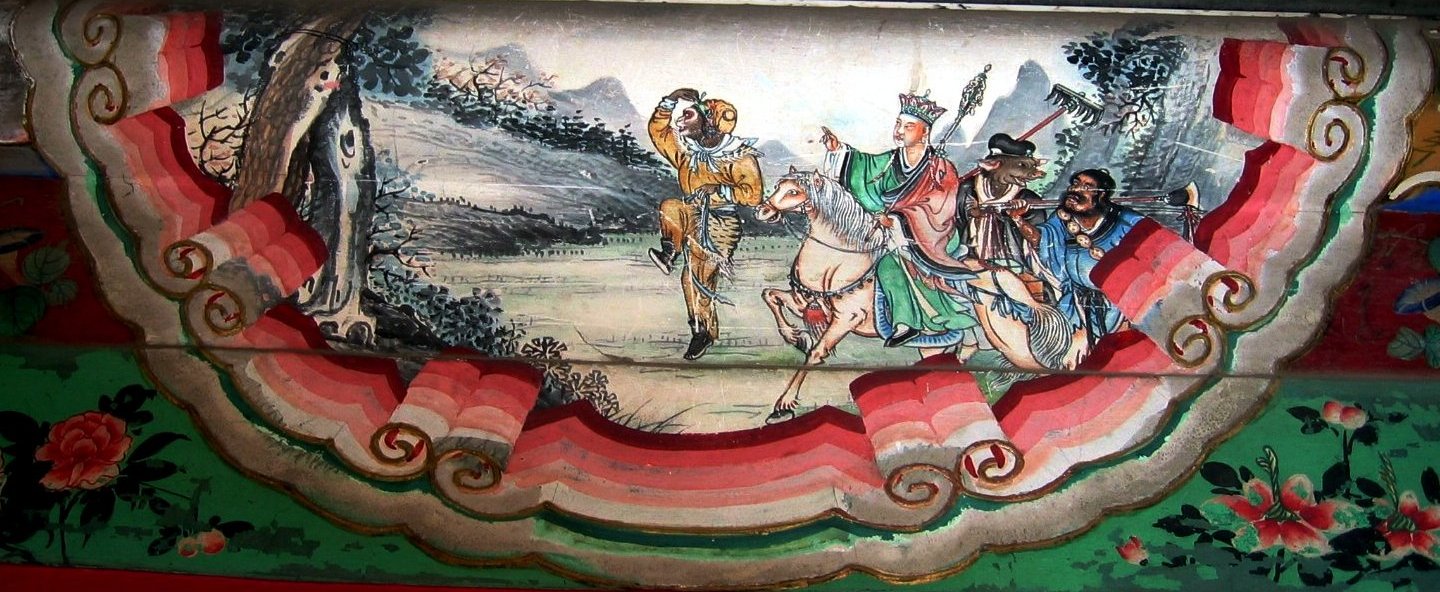
The minibus rattles over a washboard stretch of the G312, heat shimmer rising off the asphalt in vertical columns. Through the dusty window, the Flaming Mountains unfold — not red, exactly, but a bruised purple-brown that shifts to ochre as the sun climbs. No flames lick the ridges, yet the name fits: the ground radiates a dry, pressing weight that seeps through boot soles. Ahead, a hand-painted sign points toward the Bezeklik Thousand Buddha Caves, its Uyghur and Chinese characters bleached by decades of ultraviolet assault. This is where the Monkey King supposedly borrowed the palm-leaf fan, where Tripitaka’s horse stumbled on gravel that burns bare feet in July. The legend feels close enough to touch, baked into the sandstone itself.
Following the Pilgrim’s Dust
Xuanzang passed through Turpan in the autumn of the year of the Wood Horse, the seventh century by Western reckoning. His own record, Records of the Western Regions, describes a kingdom called Gaochang where the king welcomed him with snow stored in underground ice cellars — a detail that sounds like fantasy until you visit the karez shafts still flowing beneath the oasis. The novel Journey to the West turns this historical footnote into an inferno: eighty-one leagues of fire, the Mountain of Flames that no rain can quench. Sun Wukong flies to the Kunlun peaks, borrows Princess Iron Fan’s banana-leaf fan, and extinguishes the blaze with three sweeps. Locals will tell you the fan landed in the Grape Valley, turning the heat into the sweetness of raisins. The story lives in the irrigation ditches, the drying racks, the way an old farmer wipes sweat from his neck and grins when you ask about the Monkey King.
Reading the Rock Faces at Bezeklik
The caves sit in a gorge where the Mutou Valley cuts into the range. Of the original eighty-three grottoes, fifty-seven survive; German, Russian, and Japanese expeditions stripped the finest murals a century ago, leaving blank rectangles where bodhisattvas once gazed. What remains rewards patience. In Cave 20, a Uyghur donor prince kneels beside his wife, their faces rendered with the delicate shading of Tang brushwork. Cave 33 holds a rare depiction of the Parinirvana — the Buddha reclining on a lion couch, disciples weeping in styles that blend Indian, Persian, and Chinese linework. Bring a headlamp; the motion-sensor lights fail half the time. Sit on the gravel floor and trace the lapis lazuli blue that somehow survived the desert wind. No plaque explains the pigment trade route that brought that color from Afghanistan. You have to imagine the caravans yourself.
Grape Valley: Where the Fan Fell
Ten kilometers southeast, the valley floor drops into green. Vineyards drape over adobe walls, fed by karez channels that run underground for kilometers before surfacing here. In the eighth lunar month, the air thickens with the scent of fermenting sugar. Families spread Thompson Seedless on paper trays between the rows, turning them with wooden paddles every afternoon. A woman named Aygul invites me under her grape arbor. She serves tea in a bowl with a floating jujube, then produces a plate of naan still warm from the tonur clay oven. “The Monkey King cooled this place,” she says, tearing the bread. “Otherwise the grapes would cook on the vine.” Her grandson runs past chasing a kite shaped like a centipede — seventy segments of red silk on a bamboo frame. The kite dips toward the vines, rises, dips again. No tourists here, only the extended clan gathering for the harvest.
Gaochang and Jiaohe: Two Cities, One Silence
The ancient capitals bracket the oasis. Gaochang sprawls on the desert fringe, its mud-brick walls eroded into soft mounds. A donkey cart waits at the south gate; the driver, Abdul, charges twenty yuan for a circuit. We pass the monastery where Xuanzang lectured for a month, its foundation stones still aligned to the cardinal points. Jiaohe, thirty kilometers west, perches on a willow-leaf plateau between two riverbeds. No walls needed — the cliffs are defense enough. Streets follow a grid still visible from the viewing platform: residential quarter, temple district, government offices, stupa courtyard. At dusk, the site empties. I stay until the guard whistles. The last light strikes the central avenue’s poplar stumps, planted by Tang garrison soldiers. Their roots drank from the same karez that waters Aygul’s vines. The connection feels deliberate, as if the city planners knew someone would stand here centuries later, tracing water’s invisible map.
Night Market Lessons
Turpan’s night market sets up on Laocheng Road after the fifth call to prayer. Smoke from lamb kebabs carries cumin, chili, and the particular char of poplar wood. I queue for samsa — mutton and onion baked in tandoor-clung dough — and watch a Han tourist bargain aggressively over a jade pendant. The vendor, a woman with gold-capped teeth, lets him win the last five yuan, then switches to Uyghur to tell her neighbor: “He thinks he’s clever. The stone is glass.” She catches my eye, smiles. “You? You listen.” She presses a extra kebab into my paper wrapper. “Eat. The fire mountain cools at night. Tomorrow it wakes hungry.” The meat is fatty, the bread crust blackened in spots. Best meal of the journey. Locals eat standing, wiping fingers on napkins, arguing football, switching languages mid-sentence. No one photographs their food. The ritual is consumption, not documentation.
What the Guidebooks Omit
They don’t mention the sand that finds every zipper, every lens crevice, the space between toes. They skip the midday hours when the museum locks its doors and the only shade is a convenience store awning selling warm beer. They won’t tell you that the “Flaming Mountain” scenic area charges for a thermometer photo prop — a giant red mercury tube beside a concrete monkey statue — while the real thermals rise unseen beyond the fence. They omit the call to prayer echoing off the Jiaohe cliffs at dawn, the way it vibrates in the chest. Or the night a sandstorm scours the grape valley, stripping leaves, and the next morning the vines stand bare as bones yet the karez still flows, cold and steady. The story isn’t in the caves or the ruins or even the novel. It’s in the irrigation engineer who wakes at third watch to clear a blocked shaft. The grandmother teaching her granddaughter to knot raisin bundles. The driver who stops the minibus so an old man can pray beside the road, facing west toward a mountain range that burns in the imagination and blooms in the groundwater.