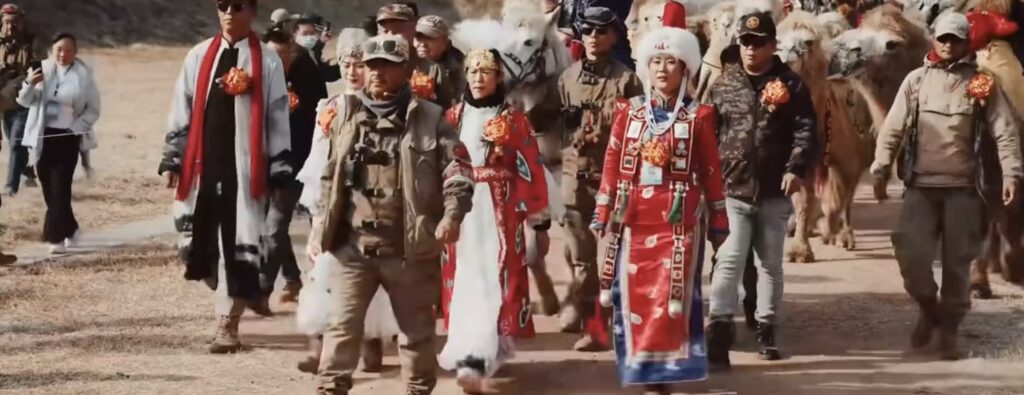
Luoyang, Henan Province — On the morning of January 7, 2026, a remarkable camel caravan originating from the East Tianshan region of Xinjiang finally arrived at the historic Dingding Gate in Luoyang, greeted by a grand welcoming ceremony attended by local residents, officials, and cultural enthusiasts.
The “East Tianshan Camel Team” set out from Barkol Kazakh Autonomous County in Hami, Xinjiang, in August 2025. Comprising 33 Bactrian camels, more than 30 team members from four different ethnic groups, three horses, and three dogs, the group covered over 3,000 kilometers in more than 130 days, passing through Gansu, Ningxia, Shaanxi, Henan, and other provinces.
Team liaison officer Dawei, who spoke to reporters before the arrival, described the journey as “unforgettable for a lifetime.” He explained that the team deliberately chose rural roads, village paths, county roads, and provincial highways to avoid disrupting regular traffic in urban areas. Upon entering Luoyang city for the welcoming event, the camels were transported by vehicle for the first time during the entire expedition.
The caravan started in the heat of summer and finished in the depths of winter. To cope with the changing seasons, the team leader personally purchased leather coats for all members. A small fleet of support vehicles trailed behind, carrying daily necessities, camel feed, and other supplies. The team also coordinated with local sanitation departments at every stop to ensure prompt cleanup of camel droppings, maintaining environmental cleanliness throughout the journey.
One of the most moving moments occurred in Pingliang, Gansu, where the caravan made a special detour to visit a 100-year-old man. In his youth, the elderly gentleman had once traveled to Xinjiang by horse cart and still held deep affection for the region. When the camel team arrived at his home, the centenarian was so touched that tears streamed down his face.
The purpose of this long and arduous trek was to experience and promote the timeless spirit of the ancient Silk Road, foster cultural exchange, strengthen ethnic unity, and showcase Xinjiang’s tourism resources and specialty products to the rest of the country. Luoyang, as one of the traditional eastern termini of the Silk Road, held special symbolic significance as the planned destination.
While the team has now reached its original goal, Dawei indicated that future plans — including possible extension tours or exhibitions in other cities — will be decided by the team leader.
This 21st-century recreation of an ancient caravan not only bridged vast geographical distances but also rekindled the enduring values of openness, mutual respect, perseverance, and cultural connection that have defined the Silk Road for more than two thousand years.