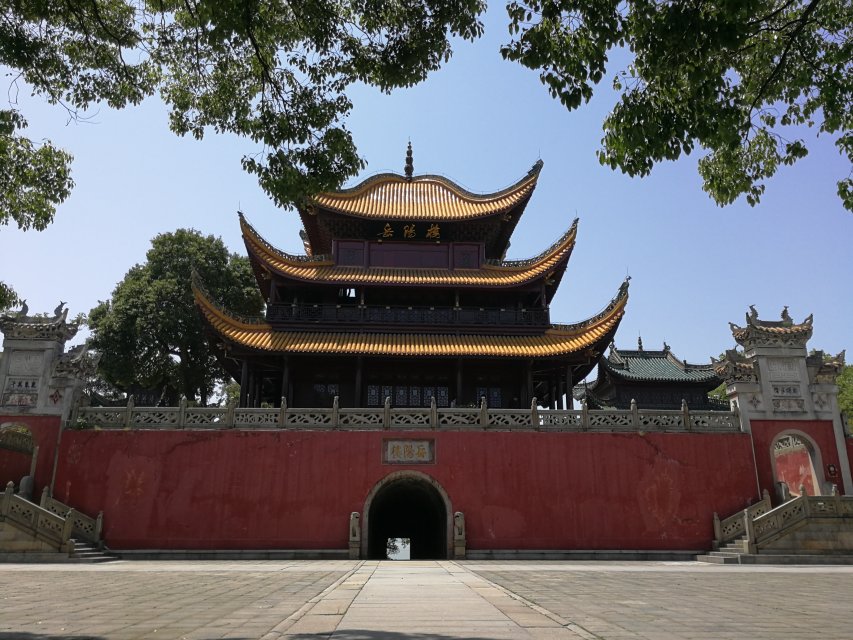
The ferry from the south bank chugs across water the color of weak tea, the wake cutting through mats of floating lotus leaves. Ahead, the yellow glazed tiles of Yueyang Tower catch the late light, perched on the city wall like a crown on a weathered head. There is no grand plaza, no ticket hall — just a stone stairway disappearing into plane trees and the smell of lake mud and frying chili oil drifting from a stall at the bottom.
Getting oriented
Yueyang spreads along the northeastern shore of Dongting Lake where the Yangtze pushes in from the west. The old city sits on a peninsula; the modern districts stretch inland along the ring road. Most visitors stay in Yueyanglou District, walking distance from the tower, the lakefront promenade, and the night market on Baling Road. Junshan District covers the island in the lake and the wetlands to the east — quieter, greener, reachable by a twenty-minute ferry. Yunxi District is newer, flatter, full of business hotels and the high-speed rail station. Taxis are plentiful; the green electric buses numbered 1, 15, and 22 connect the tower, the station, and the lake park for two yuan a ride.
When to show up
Spring arrives early here. By the third lunar month the peach blossoms on Junshan Island are open and the lake water rises, flooding the reed beds where egrets nest. Summer brings thunderstorms that roll across the water in black walls; the tower looks best then, lightning outlining its eaves. The Mid-Autumn Festival in the eighth lunar month draws crowds for moon-viewing banquets on the lake — book a boat a week ahead. Winter is damp and gray, but the migratory birds arrive in the tens of thousands: swan geese, hooded cranes, oriental storks. The wetlands observation deck on the eastern shore is empty on weekday mornings.
The tower and the poem
Yueyang Tower is not a museum piece. It is a working building — scholars still climb the stairs to copy Fan Zhongyan’s “Record of Yueyang Tower” on red paper, tourists sip tea in the side halls, and a calligrapher sells brush-stroked couplets at a folding table on the second floor. The current structure dates to the Qing reconstruction, but the bones are Song dynasty. Walk the perimeter balcony at dusk. The lake stretches to the horizon, the Yangtze a silver thread on the left, the city lights flickering on behind you. No one checks tickets after six in the evening; the guard waves you through if you look like you belong.
Junshan Island: tea, tombs, and silence
The ferry drops you at a stone pier shaded by camphor trees. A paved path circles the island in forty minutes if you don’t stop. You will stop. The Junshan Silver Needle tea bushes grow on the western slope — tiny white buds picked before the Grain Rain solar term. The factory shop lets you watch the pan-firing and taste the brew: pale green, sweet as melon, no astringency. Further up, the Twin Tombs of the Xiang Consorts sit under a grove of ancient pines. Legend says the wives of Emperor Shun drowned themselves here; locals still leave red thread and rice wine at the stone tablets. The island’s only restaurant serves steamed fish head with chopped chili and a bowl of lake shrimp the size of thumbs. Eat on the terrace watching the ferry return to the mainland.
Dongting wetlands: the bird watcher’s morning
Take bus 22 to the terminal at Dongting Lake National Wetland Park. Rent a electric cart at the gate — fifty yuan for two hours — and drive the boardwalk loops before nine. The reeds stand three meters high, seeded heads brushing the roof. Herons stand motionless in the channels; a flock of spoonbills sweeps the shallows side to side. The observation tower at the far end has a fixed telescope aimed at a sandbar where the cranes roost. Bring a thermos of hot water and instant coffee. The park cafeteria only opens at eleven and serves instant noodles.
Eating in the lanes behind the tower
Baling Road night market sets up at sunset. The smell hits you fifty meters out: fermented bean curd, grilled oysters, pork belly skewers brushed with cumin and chili powder. Find the stall with the longest line — usually a woman frying stinky tofu in a blackened wok. She drops cubes into oil, flips them once, drains them on a wire rack, then splits each one and stuffs it with garlic paste, pickled mustard greens, and a spoonful of chili oil. Eat standing, burning your fingers. Two blocks west, a hole-in-the-wall serves Dongting Lake soft-shell turtle stewed with ginger and scallion. The broth is milky, the meat falls off the bone. Order a side of cold lotus root slices dressed with vinegar and sesame oil to cut the richness.
Getting there and moving around
High-speed trains from Changsha take thirty minutes; from Wuhan, two hours. The station sits in Yunxi District, a twenty-minute taxi ride to the tower. Long-distance buses still run from the south station near the old city wall — cheaper, slower, and the drivers know which tea house makes the best morning noodles. If you drive, the Jingzhu Expressway cuts straight north; the lakefront road is scenic but narrow, often clogged with trucks hauling sand. Bicycles can be rented by the hour from kiosks along the promenade — scan the QR code, unlock, return anywhere. Helmets are theoretical.
What newcomers get wrong
They come for the tower, spend forty minutes inside, then leave. They miss the lake at dawn when the mist lifts in strips and the fishing boats motor out in a V formation. They eat at the restaurant inside the scenic area — overpriced, reheated dishes — instead of walking three blocks to where the delivery drivers eat lunch. They skip Junshan because the ferry schedule confuses them; boats run every half hour from the pier at the base of the tower, no reservation needed. They pack umbrellas for summer rain but forget mosquito repellent for the wetlands. And they never learn the two phrases that open every door: “Laoban, shao la” — boss, less spice — and “Xiexie, bu yao” — thanks, no bag — when the vendor tries to wrap your skewers in three plastic bags.