Common Mistakes Newcomers Make
How to Join Without Offending
If you are invited into a family courtyard, remove your shoes at the threshold. The hearth sits in the center of the main room; never step over the fire tripod. Sit where you are directed — usually on a low stool to the host’s left. When a torch is handed to you, hold it upright, tip slightly forward, and walk clockwise around the hearth three times. This drives illness from the house. Do not blow on the flame; let the wind do the work. If you are offered the first slice of mutton, accept it with both hands. Refusing is seen as rejecting the family’s protection for the coming year.
Bring a small gift: a pack of good cigarettes, a bottle of strong baijiu, or a bag of rock sugar
Dress in dark cotton; synthetic fabrics melt when a spark lands
Carry a cotton towel to wipe soot from your face and hands
Learn two phrases in Nuosu: “A qie” (thank you) and “Wu xi” (delicious)
Stay until the last torch is stacked against the communal bonfire; leaving early breaks the circle
Common Mistakes Newcomers Make
The biggest error is treating the night as a photo op. Flashlights and phone screens ruin the atmosphere the fire creates. Villagers will not stop you, but the elders will stop speaking. Another mistake is wearing sandals. The ground is littered with hot embers and broken glass from liquor bottles. A burned foot ends your night fast. Some visitors try to light their own torch from the communal pile without asking. The fire keeper — usually an older man with a blackened beard — controls the source. Wait for him to offer a flame. Finally, do not ask what the festival “means” in a single sentence. The answer lives in the wrestling, the horse race, the noodles, the direction you walk around the fire. Watch. Eat. Walk. Listen. The meaning accumulates in the smoke on your clothes.
Getting There and Staying Close
Xichang has an airport with flights from Chengdu and Kunming. From the city, a hired car takes ninety minutes to the larger Yi townships like Butuo or Meigu. Roads wind through cornfields and over passes where mist clings to the pines. Guesthouses in the county seats are basic — concrete floors, shared bathrooms, hot water only in the evening. In the villages, families often clear a storage room for guests. Sleep on a wooden bed under a stack of quilts. The rooster wakes you before dawn. By then the torches are ash, the mutton bones picked clean, and the village already talking about next year’s fire.
How to Join Without Offending
If you are invited into a family courtyard, remove your shoes at the threshold. The hearth sits in the center of the main room; never step over the fire tripod. Sit where you are directed — usually on a low stool to the host’s left. When a torch is handed to you, hold it upright, tip slightly forward, and walk clockwise around the hearth three times. This drives illness from the house. Do not blow on the flame; let the wind do the work. If you are offered the first slice of mutton, accept it with both hands. Refusing is seen as rejecting the family’s protection for the coming year.
Bring a small gift: a pack of good cigarettes, a bottle of strong baijiu, or a bag of rock sugar
Dress in dark cotton; synthetic fabrics melt when a spark lands
Carry a cotton towel to wipe soot from your face and hands
Learn two phrases in Nuosu: “A qie” (thank you) and “Wu xi” (delicious)
Stay until the last torch is stacked against the communal bonfire; leaving early breaks the circle
Common Mistakes Newcomers Make
The biggest error is treating the night as a photo op. Flashlights and phone screens ruin the atmosphere the fire creates. Villagers will not stop you, but the elders will stop speaking. Another mistake is wearing sandals. The ground is littered with hot embers and broken glass from liquor bottles. A burned foot ends your night fast. Some visitors try to light their own torch from the communal pile without asking. The fire keeper — usually an older man with a blackened beard — controls the source. Wait for him to offer a flame. Finally, do not ask what the festival “means” in a single sentence. The answer lives in the wrestling, the horse race, the noodles, the direction you walk around the fire. Watch. Eat. Walk. Listen. The meaning accumulates in the smoke on your clothes.
Getting There and Staying Close
Xichang has an airport with flights from Chengdu and Kunming. From the city, a hired car takes ninety minutes to the larger Yi townships like Butuo or Meigu. Roads wind through cornfields and over passes where mist clings to the pines. Guesthouses in the county seats are basic — concrete floors, shared bathrooms, hot water only in the evening. In the villages, families often clear a storage room for guests. Sleep on a wooden bed under a stack of quilts. The rooster wakes you before dawn. By then the torches are ash, the mutton bones picked clean, and the village already talking about next year’s fire.
Wrestling, Horses, and the Beauty Contest
By early evening the eating slows. A cleared dirt ring appears at the edge of the square. Wrestlers wear heavy leather belts and short jackets; the goal is to throw the opponent onto his back without losing your own footing. There are no weight classes — a teenager may face a man twice his size. The crowd presses close, shouting advice in Nuosu. A win earns a silk scarf and a live chicken, carried home upside down by the legs.
On the grassy slope above the village, horses race bareback. Riders lean low, whips made of braided yak tail flicking. The course is a straight gallop of about two kilometers, marked only by a white flag at the far end. The winning horse gets a red ribbon woven into its mane; the rider takes home a bolt of indigo cloth. Later, young women in pleated skirts and silver headdresses dance the “Da Ge” — a circle dance where the steps mimic the movements of locusts being driven from the fields. The beauty contest is not a catwalk. Judges look for knowledge of Yi script, ability to sing the old epics, and how well a candidate can manage a household fire.
How to Join Without Offending
If you are invited into a family courtyard, remove your shoes at the threshold. The hearth sits in the center of the main room; never step over the fire tripod. Sit where you are directed — usually on a low stool to the host’s left. When a torch is handed to you, hold it upright, tip slightly forward, and walk clockwise around the hearth three times. This drives illness from the house. Do not blow on the flame; let the wind do the work. If you are offered the first slice of mutton, accept it with both hands. Refusing is seen as rejecting the family’s protection for the coming year.
Bring a small gift: a pack of good cigarettes, a bottle of strong baijiu, or a bag of rock sugar
Dress in dark cotton; synthetic fabrics melt when a spark lands
Carry a cotton towel to wipe soot from your face and hands
Learn two phrases in Nuosu: “A qie” (thank you) and “Wu xi” (delicious)
Stay until the last torch is stacked against the communal bonfire; leaving early breaks the circle
Common Mistakes Newcomers Make
The biggest error is treating the night as a photo op. Flashlights and phone screens ruin the atmosphere the fire creates. Villagers will not stop you, but the elders will stop speaking. Another mistake is wearing sandals. The ground is littered with hot embers and broken glass from liquor bottles. A burned foot ends your night fast. Some visitors try to light their own torch from the communal pile without asking. The fire keeper — usually an older man with a blackened beard — controls the source. Wait for him to offer a flame. Finally, do not ask what the festival “means” in a single sentence. The answer lives in the wrestling, the horse race, the noodles, the direction you walk around the fire. Watch. Eat. Walk. Listen. The meaning accumulates in the smoke on your clothes.
Getting There and Staying Close
Xichang has an airport with flights from Chengdu and Kunming. From the city, a hired car takes ninety minutes to the larger Yi townships like Butuo or Meigu. Roads wind through cornfields and over passes where mist clings to the pines. Guesthouses in the county seats are basic — concrete floors, shared bathrooms, hot water only in the evening. In the villages, families often clear a storage room for guests. Sleep on a wooden bed under a stack of quilts. The rooster wakes you before dawn. By then the torches are ash, the mutton bones picked clean, and the village already talking about next year’s fire.
Wrestling, Horses, and the Beauty Contest
By early evening the eating slows. A cleared dirt ring appears at the edge of the square. Wrestlers wear heavy leather belts and short jackets; the goal is to throw the opponent onto his back without losing your own footing. There are no weight classes — a teenager may face a man twice his size. The crowd presses close, shouting advice in Nuosu. A win earns a silk scarf and a live chicken, carried home upside down by the legs.
On the grassy slope above the village, horses race bareback. Riders lean low, whips made of braided yak tail flicking. The course is a straight gallop of about two kilometers, marked only by a white flag at the far end. The winning horse gets a red ribbon woven into its mane; the rider takes home a bolt of indigo cloth. Later, young women in pleated skirts and silver headdresses dance the “Da Ge” — a circle dance where the steps mimic the movements of locusts being driven from the fields. The beauty contest is not a catwalk. Judges look for knowledge of Yi script, ability to sing the old epics, and how well a candidate can manage a household fire.
How to Join Without Offending
If you are invited into a family courtyard, remove your shoes at the threshold. The hearth sits in the center of the main room; never step over the fire tripod. Sit where you are directed — usually on a low stool to the host’s left. When a torch is handed to you, hold it upright, tip slightly forward, and walk clockwise around the hearth three times. This drives illness from the house. Do not blow on the flame; let the wind do the work. If you are offered the first slice of mutton, accept it with both hands. Refusing is seen as rejecting the family’s protection for the coming year.
Bring a small gift: a pack of good cigarettes, a bottle of strong baijiu, or a bag of rock sugar
Dress in dark cotton; synthetic fabrics melt when a spark lands
Carry a cotton towel to wipe soot from your face and hands
Learn two phrases in Nuosu: “A qie” (thank you) and “Wu xi” (delicious)
Stay until the last torch is stacked against the communal bonfire; leaving early breaks the circle
Common Mistakes Newcomers Make
The biggest error is treating the night as a photo op. Flashlights and phone screens ruin the atmosphere the fire creates. Villagers will not stop you, but the elders will stop speaking. Another mistake is wearing sandals. The ground is littered with hot embers and broken glass from liquor bottles. A burned foot ends your night fast. Some visitors try to light their own torch from the communal pile without asking. The fire keeper — usually an older man with a blackened beard — controls the source. Wait for him to offer a flame. Finally, do not ask what the festival “means” in a single sentence. The answer lives in the wrestling, the horse race, the noodles, the direction you walk around the fire. Watch. Eat. Walk. Listen. The meaning accumulates in the smoke on your clothes.
Getting There and Staying Close
Xichang has an airport with flights from Chengdu and Kunming. From the city, a hired car takes ninety minutes to the larger Yi townships like Butuo or Meigu. Roads wind through cornfields and over passes where mist clings to the pines. Guesthouses in the county seats are basic — concrete floors, shared bathrooms, hot water only in the evening. In the villages, families often clear a storage room for guests. Sleep on a wooden bed under a stack of quilts. The rooster wakes you before dawn. By then the torches are ash, the mutton bones picked clean, and the village already talking about next year’s fire.
What Arrives on the Table
Whole roast lamb or mutton, salted the night before and turned slowly over pine charcoal
Buckwheat noodles (qiao mian) served cold with chili oil, Sichuan pepper, garlic, and fresh cilantro
Tuotuo rou — hand-torn chunks of boiled pork belly dipped in a sauce of fermented bean paste, minced ginger, and green onion
Roasted potatoes buried in the ash, skin blackened, flesh steaming and sweet
Maize liquor (gao liang jiu) in small porcelain cups, passed clockwise around the circle
Butter tea for the elders, churned in a wooden cylinder until the surface shines
The mutton should pull cleanly from the bone, the fat rendered to a golden crust. The noodles must have bite — overcooked strands are a sign of a hurried kitchen. When you are handed a cup of liquor, tap two fingers on the table before drinking; it is a quiet thank-you to the pourer. Do not drain the cup in one go unless the host shouts “gan bei.” Sip, pass, sip again. The potatoes are eaten with fingers, ash brushed off on the grass.
Wrestling, Horses, and the Beauty Contest
By early evening the eating slows. A cleared dirt ring appears at the edge of the square. Wrestlers wear heavy leather belts and short jackets; the goal is to throw the opponent onto his back without losing your own footing. There are no weight classes — a teenager may face a man twice his size. The crowd presses close, shouting advice in Nuosu. A win earns a silk scarf and a live chicken, carried home upside down by the legs.
On the grassy slope above the village, horses race bareback. Riders lean low, whips made of braided yak tail flicking. The course is a straight gallop of about two kilometers, marked only by a white flag at the far end. The winning horse gets a red ribbon woven into its mane; the rider takes home a bolt of indigo cloth. Later, young women in pleated skirts and silver headdresses dance the “Da Ge” — a circle dance where the steps mimic the movements of locusts being driven from the fields. The beauty contest is not a catwalk. Judges look for knowledge of Yi script, ability to sing the old epics, and how well a candidate can manage a household fire.
How to Join Without Offending
If you are invited into a family courtyard, remove your shoes at the threshold. The hearth sits in the center of the main room; never step over the fire tripod. Sit where you are directed — usually on a low stool to the host’s left. When a torch is handed to you, hold it upright, tip slightly forward, and walk clockwise around the hearth three times. This drives illness from the house. Do not blow on the flame; let the wind do the work. If you are offered the first slice of mutton, accept it with both hands. Refusing is seen as rejecting the family’s protection for the coming year.
Bring a small gift: a pack of good cigarettes, a bottle of strong baijiu, or a bag of rock sugar
Dress in dark cotton; synthetic fabrics melt when a spark lands
Carry a cotton towel to wipe soot from your face and hands
Learn two phrases in Nuosu: “A qie” (thank you) and “Wu xi” (delicious)
Stay until the last torch is stacked against the communal bonfire; leaving early breaks the circle
Common Mistakes Newcomers Make
The biggest error is treating the night as a photo op. Flashlights and phone screens ruin the atmosphere the fire creates. Villagers will not stop you, but the elders will stop speaking. Another mistake is wearing sandals. The ground is littered with hot embers and broken glass from liquor bottles. A burned foot ends your night fast. Some visitors try to light their own torch from the communal pile without asking. The fire keeper — usually an older man with a blackened beard — controls the source. Wait for him to offer a flame. Finally, do not ask what the festival “means” in a single sentence. The answer lives in the wrestling, the horse race, the noodles, the direction you walk around the fire. Watch. Eat. Walk. Listen. The meaning accumulates in the smoke on your clothes.
Getting There and Staying Close
Xichang has an airport with flights from Chengdu and Kunming. From the city, a hired car takes ninety minutes to the larger Yi townships like Butuo or Meigu. Roads wind through cornfields and over passes where mist clings to the pines. Guesthouses in the county seats are basic — concrete floors, shared bathrooms, hot water only in the evening. In the villages, families often clear a storage room for guests. Sleep on a wooden bed under a stack of quilts. The rooster wakes you before dawn. By then the torches are ash, the mutton bones picked clean, and the village already talking about next year’s fire.
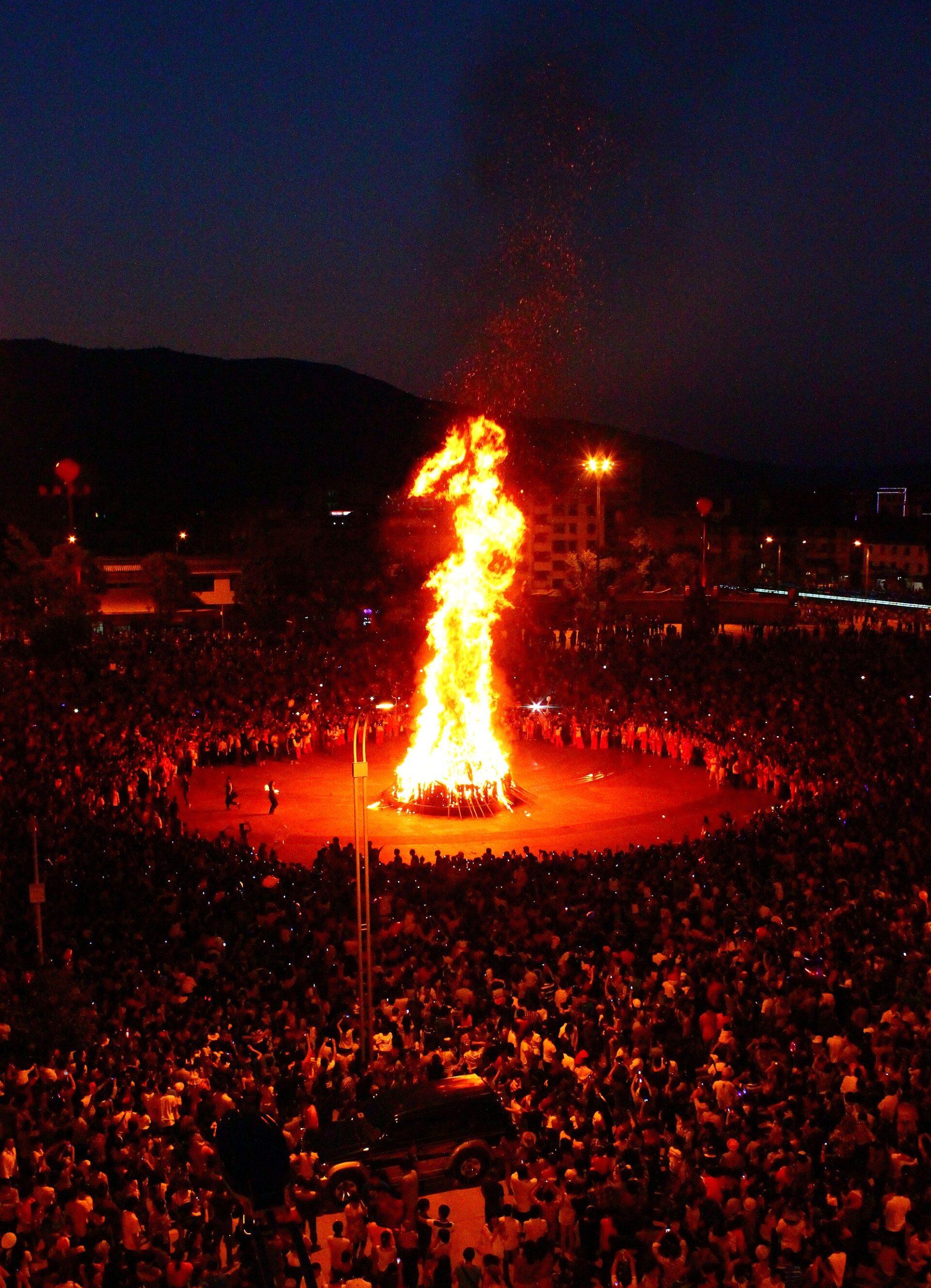
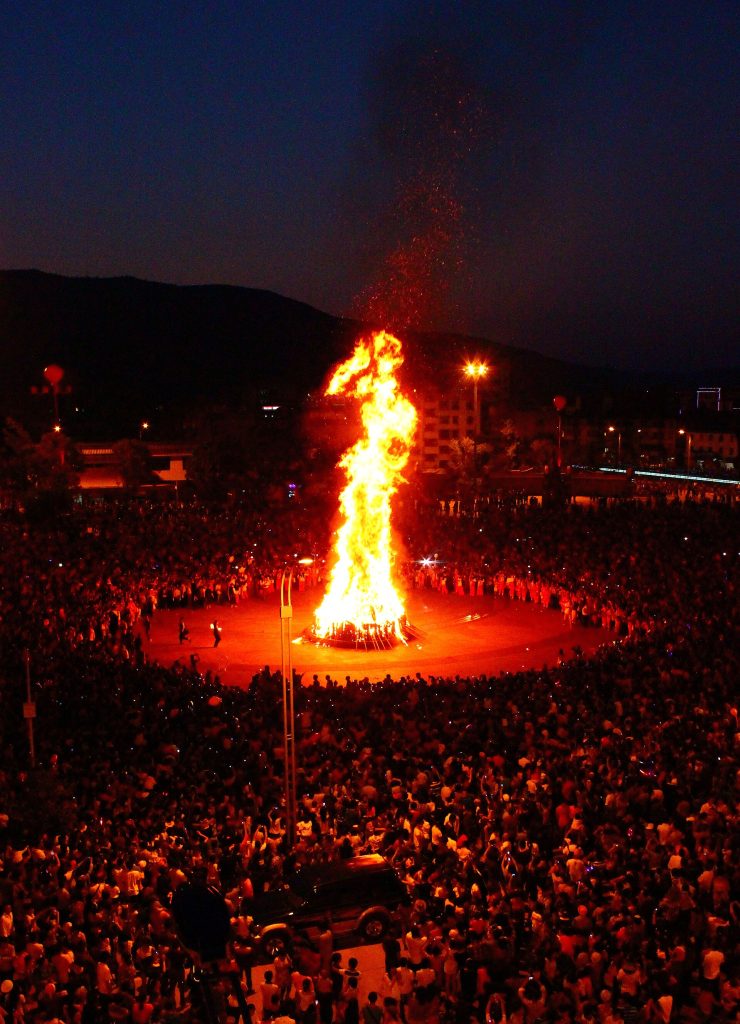
The night air in a Liangshan valley smells of pine smoke and roasted mutton before you see the first flame. By the time the sky goes fully dark, hundreds of torches — some no longer than a forearm, others as tall as a grown man — are moving through the village lanes like a slow river of fire. Children dart between the adults, swinging smaller brands, while elders sit on low stools, fanning sparks from their trouser legs. This is not a staged show for tour buses. It is the Torch Festival, the Yi New Year by the old calendar, and everyone here is participating in a ritual that has outlasted dynasties.
When the Fire Starts Moving
The festival falls on the twenty-fourth or twenty-fifth day of the sixth month in the Yi calendar, usually landing in the heat of late summer. In the villages around Xichang and deeper in the mountains, preparation begins days earlier. Families gather fallen pine branches, strip the bark, and bind the resin-rich wood with wire or twisted bark rope. A good torch burns for two hours without dripping; a bad one sputters and sends hot pitch onto your feet. By mid-afternoon on the main day, the village square fills with the smell of charcoal grills. Whole sheep turn on spits, their fat hissing into the coals. Bowls of cold buckwheat noodles tossed with chili oil, garlic, and cilantro appear on wooden tables alongside jars of maize liquor.
What Arrives on the Table
Whole roast lamb or mutton, salted the night before and turned slowly over pine charcoal
Buckwheat noodles (qiao mian) served cold with chili oil, Sichuan pepper, garlic, and fresh cilantro
Tuotuo rou — hand-torn chunks of boiled pork belly dipped in a sauce of fermented bean paste, minced ginger, and green onion
Roasted potatoes buried in the ash, skin blackened, flesh steaming and sweet
Maize liquor (gao liang jiu) in small porcelain cups, passed clockwise around the circle
Butter tea for the elders, churned in a wooden cylinder until the surface shines
The mutton should pull cleanly from the bone, the fat rendered to a golden crust. The noodles must have bite — overcooked strands are a sign of a hurried kitchen. When you are handed a cup of liquor, tap two fingers on the table before drinking; it is a quiet thank-you to the pourer. Do not drain the cup in one go unless the host shouts “gan bei.” Sip, pass, sip again. The potatoes are eaten with fingers, ash brushed off on the grass.
Wrestling, Horses, and the Beauty Contest
By early evening the eating slows. A cleared dirt ring appears at the edge of the square. Wrestlers wear heavy leather belts and short jackets; the goal is to throw the opponent onto his back without losing your own footing. There are no weight classes — a teenager may face a man twice his size. The crowd presses close, shouting advice in Nuosu. A win earns a silk scarf and a live chicken, carried home upside down by the legs.
On the grassy slope above the village, horses race bareback. Riders lean low, whips made of braided yak tail flicking. The course is a straight gallop of about two kilometers, marked only by a white flag at the far end. The winning horse gets a red ribbon woven into its mane; the rider takes home a bolt of indigo cloth. Later, young women in pleated skirts and silver headdresses dance the “Da Ge” — a circle dance where the steps mimic the movements of locusts being driven from the fields. The beauty contest is not a catwalk. Judges look for knowledge of Yi script, ability to sing the old epics, and how well a candidate can manage a household fire.
How to Join Without Offending
If you are invited into a family courtyard, remove your shoes at the threshold. The hearth sits in the center of the main room; never step over the fire tripod. Sit where you are directed — usually on a low stool to the host’s left. When a torch is handed to you, hold it upright, tip slightly forward, and walk clockwise around the hearth three times. This drives illness from the house. Do not blow on the flame; let the wind do the work. If you are offered the first slice of mutton, accept it with both hands. Refusing is seen as rejecting the family’s protection for the coming year.
Bring a small gift: a pack of good cigarettes, a bottle of strong baijiu, or a bag of rock sugar
Dress in dark cotton; synthetic fabrics melt when a spark lands
Carry a cotton towel to wipe soot from your face and hands
Learn two phrases in Nuosu: “A qie” (thank you) and “Wu xi” (delicious)
Stay until the last torch is stacked against the communal bonfire; leaving early breaks the circle
Common Mistakes Newcomers Make
The biggest error is treating the night as a photo op. Flashlights and phone screens ruin the atmosphere the fire creates. Villagers will not stop you, but the elders will stop speaking. Another mistake is wearing sandals. The ground is littered with hot embers and broken glass from liquor bottles. A burned foot ends your night fast. Some visitors try to light their own torch from the communal pile without asking. The fire keeper — usually an older man with a blackened beard — controls the source. Wait for him to offer a flame. Finally, do not ask what the festival “means” in a single sentence. The answer lives in the wrestling, the horse race, the noodles, the direction you walk around the fire. Watch. Eat. Walk. Listen. The meaning accumulates in the smoke on your clothes.
Getting There and Staying Close
Xichang has an airport with flights from Chengdu and Kunming. From the city, a hired car takes ninety minutes to the larger Yi townships like Butuo or Meigu. Roads wind through cornfields and over passes where mist clings to the pines. Guesthouses in the county seats are basic — concrete floors, shared bathrooms, hot water only in the evening. In the villages, families often clear a storage room for guests. Sleep on a wooden bed under a stack of quilts. The rooster wakes you before dawn. By then the torches are ash, the mutton bones picked clean, and the village already talking about next year’s fire.