This autumn the mainland calendar splits. Mid-Autumn Festival is a three-day weekend from Friday 25 to Sunday 27 September 2026. National Day Golden Week then runs from Thursday 1 to Wednesday 7 October. Between them sit three ordinary working days: Monday 28, Tuesday 29 and Wednesday 30 September. Last year the two holidays fused into one eight-day stretch. This year they do not.
That is not a rumour from a booking app. It is the State Council’s notice on 2026 holidays (国办发明电〔2025〕7号), issued on 4 November 2025 and printed in the State Council Gazette. Mid-Autumn has no makeup workday of its own, because the festival already falls on a Friday. The two makeup days that do appear — Sunday 20 September and Saturday 10 October — belong to National Day. Treat 20 September as a free day and mainland offices will be open.
When is Golden Week 2026 in China?
On the mainland, Golden Week 2026 is the seven-day National Day rest from 1 to 7 October, not a thirteen-day block from 25 September. Read the autumn as five stretches.
Sunday 20 September is a makeup workday: offices are open; it belongs to National Day, not to Mid-Autumn. Friday 25 to Sunday 27 September is the Mid-Autumn holiday — three days, no Mid-Autumn makeup attached. Monday 28, Tuesday 29 and Wednesday 30 September are ordinary working days, the gap, when museums and government offices run a weekday timetable. Thursday 1 to Wednesday 7 October is National Day Golden Week: seven days, built from three statutory days plus the adjacent weekend, paid back by the two makeup workdays. Saturday 10 October is the second makeup workday. Offices open again after the week.
The 2026 notice also asks workplaces to combine the break with paid annual leave and to stagger travel — 错峰出行. Stack Mid-Autumn, the three working days, and Golden Week into one long autumn only if you have that leave, or if you do not need a mainland office to be open.
Why are Mid-Autumn and National Day separate this year?
In 2025, Mid-Autumn landed on 6 October, inside National Day. The same office had already written the rule: when the two festivals meet, they merge into eight days. That produced the 1–8 October holiday (国办发明电〔2024〕12号, 12 November 2024).
In 2026 the moon comes earlier. The lunar fifteenth of the eighth month is 25 September, six days before 1 October. The festivals no longer overlap, so the merge rule does not fire. You get a family weekend, three working days, then a seven-day Golden Week.
The moon festival itself is a different piece. See Mooncakes and a Friday Night Moon. This one is about the gap, and the longer holiday that follows.
What does 1 October actually mark?
National Day commemorates the founding of the People’s Republic of China on 1 October 1949, proclaimed at Tiananmen. On 2 December 1949 the Central People’s Government Committee adopted a resolution making 1 October the national day from 1950 onward. That is the legal date. It is not a harvest festival, and it is not a second Mid-Autumn.
Under the Measures for National Holidays and Memorial Days, last revised in November 2024, National Day is three statutory days, 1 to 3 October. The seven-day Golden Week is those three days plus adjacent weekend days, paid back by the two makeup workdays.
Do Hong Kong and Macao get the same Golden Week?
They do not. Hong Kong gazetted National Day as Thursday 1 October only, on 16 May 2025. Its Mid-Autumn public holiday is the day after the festival, Saturday 26 September, not the Friday night itself. Macao lists 1 October as National Day of the People’s Republic of China and, the next day, “the Day following National Day of the People’s Republic of China.” Macao’s Mid-Autumn holiday is likewise Saturday 26 September. Monday 28 September is listed there as a compensatory rest day for public employees, not as a general Golden Week.
Do not assume the office or the ferry is closed for the same stretch as Beijing or Shanghai. Crossing on 28–30 September is a mainland working-day trip, except for that Macao public-employee rest. If you are still in Hong Kong on 2 October, it is a normal Friday there and a mainland holiday.
How should travellers use 28–30 September?
Monday 28 to Wednesday 30 September are the travel window most visitors miss. Offices are open. Intercity trains are not empty, but they are not the Thursday-night homecoming of Mid-Autumn or the first-morning surge of Golden Week. Museums and restaurants run a weekday timetable. Hotel rooms in tourist towns are usually easier than a few days later.
Use the gap to move. If you want the moon night, be somewhere by Friday 25 September and stay put through the Sunday. If you want Golden Week for a longer trip, arrive on the 28th, 29th or 30th, check in while the destination is still on a weekday clock, and spend those three days on museums, parks that keep weekday hours, and the long-distance leg you do not want to ride on the evening of 30 September.
If you only have the seven-day week, ride or fly in during the gap and leave on the 6th or early on the 7th, before the return that usually builds from mid-afternoon on the last one or two days. That is the repeating pattern, not a 2026 headcount. The official advice is still 错峰出行: travel off the peak.
How do you book a train for Golden Week 2026?
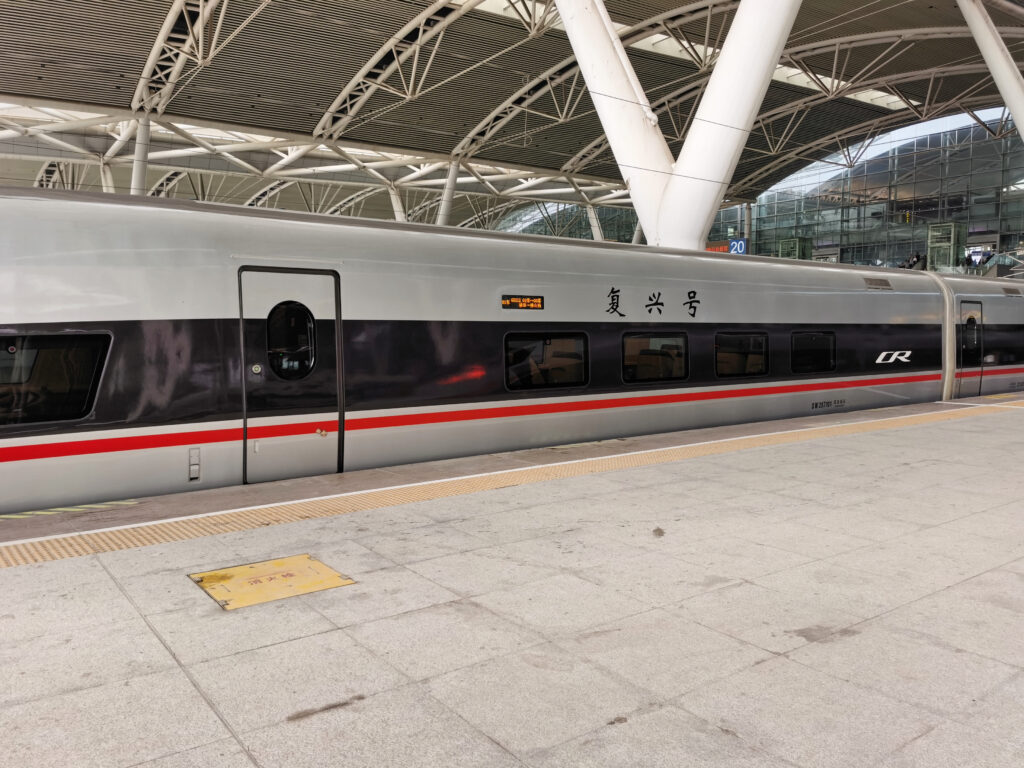
Trains still sell, in the ordinary way, on a 15-day pre-sale, including the day of travel. China Railway has not published a special nationwide window for Golden Week 2026. A live 12306 pre-sale query in late August showed sales about fifteen days out, consistent with that rule.
Book the long-distance legs first. Register on 12306 — the website at 12306.cn or the official app — with the passport you will carry. Copy the name as it is printed on the bio page. Resellers are not 12306. Finish real-name identity verification before you need a seat: pending accounts can browse trains and still fail at payment. If automatic checks fail, finish verification at a station window with the original passport, or follow 12306’s photo-upload path for foreign passports.
When the 15-day window includes your travel day, search origin, destination and date. One identity document buys only one ticket for the same train on the same date. Pay with a method the checkout page actually offers; a station window remains an official channel. If the train shows as sold out, use the official waitlist (候补购票). Treat it as a chance, not a promise. Keep the e-ticket information and the same passport. The paper itinerary sheet is not a ticket.
What China Railway has published, on 20 July 2026, is a pilot on more than 200 Beijing–Shanghai trains: a 12306 reservation from the 60th day before departure through the 17th, fulfilled from the 20th day through the 16th. A reservation is not a ticket. Routes outside that pilot remain on the 15-day sale.
If you can ride on the 28th, 29th or 30th instead of the evening of the 30th or the morning of the 1st, do that. The middle days pack the well-known parks, old towns and mountain gates; the last one or two days, often from mid-afternoon, are the return.
How do you reserve the 1 October flag-raising?
If you want the 1 October flag-raising on Tiananmen Square, you still need a reservation. The Tiananmen Area Management Committee has required named bookings since 15 December 2021. Flag-raising is its own time slot, 升旗, not a morning stroll across the square.
The Committee’s most recent National Day notice, dated 22 September 2025, asked visitors to book one to seven days ahead and warned that people without a reservation would not get in. A 2026 holiday notice had not been posted by late August. Use the official mini-programme, Jingtong, or yuyue.tamgw.beijing.gov.cn. Book the 升旗 slot, not a generic morning visit, and carry the same identity document you booked with. If you have not reserved, choose another morning.
What not to do during Golden Week 2026
Do not treat Sunday 20 September as a holiday. It is a makeup workday.
Do not treat Friday 25 September through Wednesday 7 October as one public holiday. Mid-Autumn ends on the 27th. Golden Week starts on the 1st. The three days between are workdays.
Do not assume Hong Kong or Macao is closed for seven days. Hong Kong’s National Day is 1 October only. Macao adds 2 October.
Do not postpone the long-distance train until you see how crowded it looks.” Ordinary routes sell on a 15-day clock. A Beijing–Shanghai reservation, where the pilot applies, is still not a ticket until it is fulfilled.
Do not go to Tiananmen for the flag without a named reservation, and do not confuse a square visit with the 升旗 slot.
Treat Mid-Autumn as a family weekend. Treat the three working days as the quiet joint in the calendar. Treat Golden Week as a national holiday that millions will use at the same time. Two autumns, not one. The dates are already on the paper.
FAQ
When is Golden Week 2026 in China?
National Day Golden Week 2026 runs from Thursday 1 October to Wednesday 7 October on the mainland, per the State Council notice 国办发明电〔2025〕7号. Makeup workdays are Sunday 20 September and Saturday 10 October.
Are Mid-Autumn and National Day the same holiday in 2026?
No. Mid-Autumn is Friday 25 to Sunday 27 September. National Day is 1–7 October. They merged in 2025 because the moon fell inside National Day. In 2026 they do not.
How far ahead can I book a train for Golden Week 2026?
Most trains still sell on a 15-day pre-sale, including the day of travel. China Railway has not published a nationwide special window. The Beijing–Shanghai pilot takes requests from the 60th day through the 17th before departure; a reservation is not a ticket.
Do I need a reservation for the 1 October flag-raising?
Yes. Named bookings have been required since 15 December 2021. The 22 September 2025 National Day notice asked visitors to book one to seven days ahead. A 2026-specific notice had not been posted by late August. Use the official platform and the 升旗 slot.
Is 28–30 September 2026 a public holiday?
Not on the mainland. Monday 28, Tuesday 29 and Wednesday 30 September are ordinary working days between Mid-Autumn and Golden Week. Use them to move.