On Friday 25 September 2026, the moon will be full over China. That is not a weather forecast. It is the calendar. The fifteenth night of the eighth lunar month is Mid-Autumn Festival, 中秋节, the night families try to sit in the same room, or at least under the same sky, and eat something round.
If you know China only through Spring Festival, this one will feel quieter: fewer fireworks, fewer red envelopes, fewer days on the road. What you get instead is a table, a box of dense pastry, and a moon people have been watching, on purpose, for a very long time.
What the festival is
Mid-Autumn is a harvest festival that settled, over centuries, into a family holiday. The date is fixed to the lunar calendar, so it slides around the Gregorian year, always between early September and early October, close to the autumn equinox. In 2026 the equinox falls on 23 September; the festival comes two days later.
The festival was added to China’s first national intangible cultural heritage list in 2006, and it has been a statutory public holiday on the mainland since 2008. The day is still about three things that sit close together: reunion, thanks for the harvest, and looking up.
The 2026 dates, without the guesswork
- Festival night: Friday 25 September 2026 (the 15th day of the 8th lunar month).
- Mainland China public holiday: Friday 25 September through Sunday 27 September, three days. Because the dates already fall on a weekend, there is no makeup workday attached to Mid-Autumn itself. That arrangement comes from the State Council notice on 2026 holidays (国办发明电〔2025〕7号), issued on 4 November 2025.
- Hong Kong and Macao: the public h
One calendar trap for travellers: Sunday 20 September is a makeup workday on the mainland, but it belongs to National Day, not Mid-Autumn. National Day holiday then runs from 1 to 7 October. If you stay on after the moon festival, you will walk straight into Golden Week.
Mooncakes, and what else is on the table
The mooncake is not a dessert you finish alone. It is a small, heavy round pastry, usually with a thin baked crust and a filling so rich that a single cake is sliced into wedges and passed around the table with tea. The round shape is the point. Completeness, reunion, the moon.
The version you will see in most shops is Cantonese
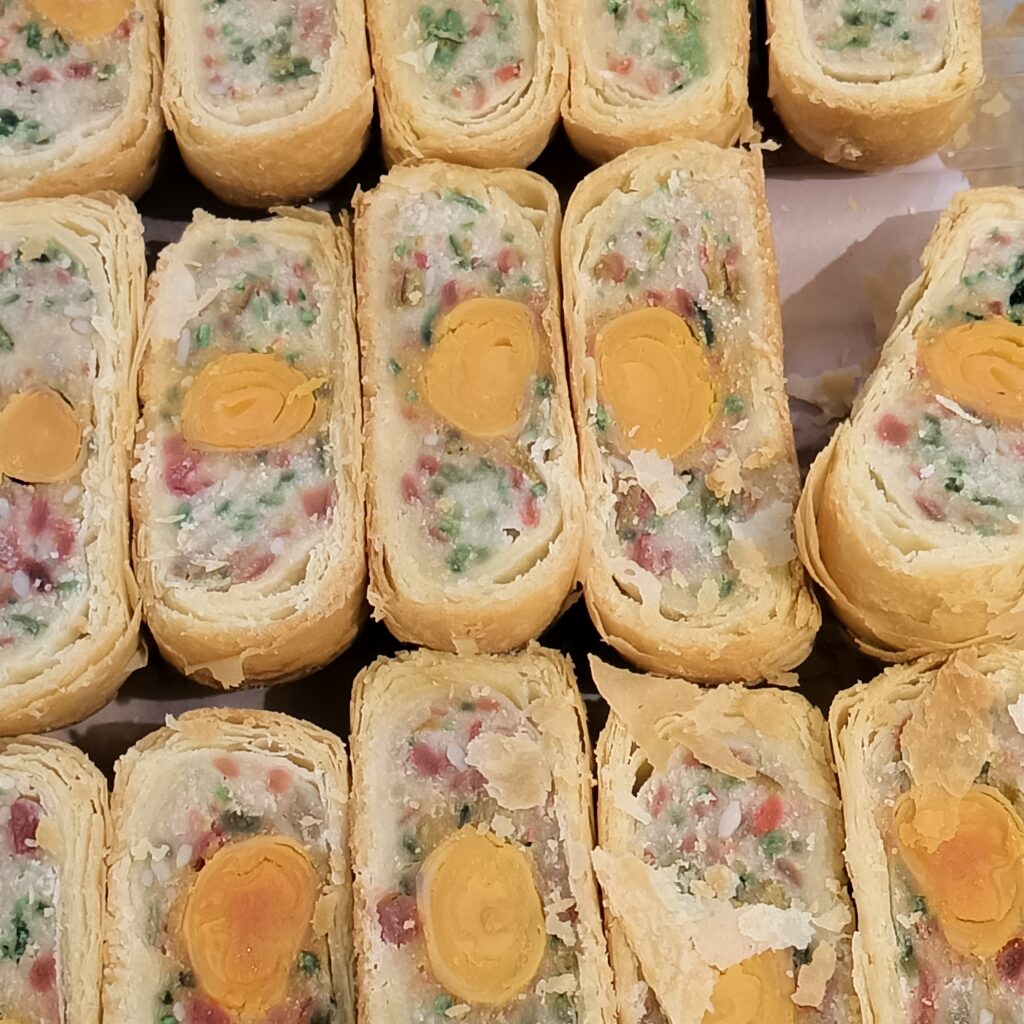
- Suzhou-style (苏式): a flaky, layered crust, often savoury, sometimes filled with pork and sugar. It is closer to a pastry than to the sweet Cantonese cake.
- Yunnan-style (滇式): Xuanwei ham mixed with honey and sugar, sweet and salty in the same bite.
- Snow-skin (冰皮): a modern, unbaked skin that feels a little like mochi. It became popular in Hong Kong and now sits next to the traditional tins in bakeries across big cities.
Boxes of four are the usual gift, bought for family, colleagues, and neighbours. They start appearing in shops in late August. By mid-September the tins stack up near every checkout. Do not treat a mooncake as a muffin. Cut it. Share it. Drink tea.
How families actually spend the day
The public version of the holiday is lanterns in a park. The private version is more ordinary, and more important.
People who can go home, go home. Those who cannot video-call and still put mooncakes on the table. The main meal is not as ritualised as a Lunar New Year reunion dinner, but it is still a reunion dinner: whatever the household cooks well, plus the seasonal fruit, plus the cake. After dark, someone carries a plate outside, or at least to a window. Children still carry paper lanterns, especially in the south, and some parks hang lantern riddles, 灯谜, for anyone willing to guess.
Gifts move in the days before, not only on the nigh
Hong Kong, Tai Hang. For three nights starting on the 14th of the eighth lunar month, a Hakka village custom takes over a few streets in Causeway Bay. The Tai Hang Fire Dragon Dance has been performed since 1880, after a plague year, and is still run by the Tai Hang Residents’ Welfare Association. A dragon about 67 metres long, stuck with thousands of burning incense sticks, is carried through Wun Sha Street and Tung Lo Wan Road. The Hong Kong Tourism Board lists the 2026 dates as 24 to 26 September. The dance went onto the national intangible cultural heritage list in 2011.
Taiwan. The festival day is a holiday, and the modern habit, well established since the late twentieth century, is to barbecue outdoors with friends. Mooncakes and pomelo still appear. The grill is the local addition. You will smell it on the street.
Elsewhere the differences are quieter. In much of the south, lanterns matter more. In the north, the night is more about the moon and the cake. Jiangnan puts crabs on the table.
Trains and intercity buses fill up on the Thursday and Friday as people go home. Hotels in smaller hometowns get scarce; big-city rooms are usually easier, because many residents have left. Some neighbourhood restaurants close early on the 25th. Bakeries stay busy, and they are the right place to buy a mooncake.
If you want something organised, look up the Tai Hang nights in Hong Kong, or walk a city park after dark and follow the lanterns. Lakeshores, riverfronts, and any hill with a clear eastern sky will have people standing still at the same time. Do not expect a single official programme in every town.
One more practical point. Mid-Autumn 2026 sits only a few days before National Day. If your trip runs into October, you are stacking two holiday peaks. Book the long-distance legs first.
You do not need a special invitation to take part. Buy four mooncakes. Find someone to split them with. Step outside after dinner. The moon does the rest.
If you are visiting
Treat this as a family weekend that happens to have a full moon, not as a carnival you can book a ticket for.
t. A box of mooncakes is a polite way to close a small social debt, or to open one. In offices, tins appear on desks and then migrate home. The festival is one of the few times of year when a pastry is also a letter. It is a home holiday more than a temple holiday: more kitchens than processions, more balconies than stages.Two places that do the night differently
The festival table is not only pastry. Osmanthus blooms now, and the flower goes into a soft steamed cake and into wine. Cassia, or osmanthus, wine is the old “reunion wine” for the night. Round autumn fruit belongs here too: pomelo, whose Chinese name sits near words for blessing, and pomegranate, long used as an offering for the moon. In the lower Yangtze, Mid-Autumn is also crab season. There is a saying that when the autumn wind rises, the crabs get restless; when the chrysanthemums open, they are ready to eat. Yangcheng Lake and Taihu crabs turn up on reunion menus and as gifts. None of this is a 2026 product launch. It is what autumn already puts on the table.
: a soft, glossy syrup crust, lotus-seed paste, and one or more salted egg yolks standing in for the full moon. A Cantonese lineage of that craft (安琪广式月饼制作技艺) was added to the national intangible cultural heritage list in 2008. That does not make every supermarket tin heritage. It means the craft has a documented home.Other styles are worth hunting if you are in the right city:
oliday is the day after the festival, Saturday 26 September 2026, because the main events happen at night. Hong Kong gazetted its 2026 list on 16 May 2025. Macao lists the same Saturday as “the day following Chong Chao (Mid-Autumn) Festival.” - Taiwan: Friday 25 September is itself the public holiday.
The oldest layer is moon worship. The story most children still hear is about Chang’e, who swallowed an elixir of immortality and flew to the moon, leaving her husband Houyi on earth. People set out fruit and cakes for her. A jade rabbit is said to keep her company. You do not have to believe any of this to understand why the night matters. A full moon is complete. A family that can gather under it is, for one evening, complete too.