Why early autumn works for a first Xi’an trip
Xi’an rewards a calm two-to-three-day first visit more than a checklist sprint. In early autumn 2026, mornings are usually cooler for walking the Ming City Wall and the Muslim Quarter, while midday still suits museums and shaded courtyards. The calendar still shapes crowds: Mid-Autumn Festival falls on Friday 25 September 2026 (short holiday roughly 25–27 September), with a makeup workday on Sunday 20 September; National Day Golden Week runs 1–7 October 2026, with a makeup workday on Saturday 10 October (State Council notice 国办发明电〔2025〕7号).
If your dates sit near either holiday, read Golden Week 2026 vs Mid-Autumn before you lock every hotel night and Terracotta Warriors slot. Xi’an does not empty for holidays — it reshuffles. Local families visit parks and old-street snacks; tour groups still fill the warriors site; trains into and out of the city get denser. Your best first-timer strategy is simple: keep Day 1 for the wall and central landmarks, keep Day 2 for the Terracotta Warriors with buffer time, and leave evening food walks flexible.
Before you arrive: payments, SIM, and hotel check-in
Foreign visitors still lean hard on mobile payments. Set up Alipay and WeChat Pay with your overseas cards before you need a metro gate top-up or a snack stall that only shows a QR code. Keep a little cash as backup, but expect many places to prefer a scan.
A working local number or eSIM makes ride-hail and ticket apps easier — see China SIM and eSIM for foreign visitors. When you reach your hotel, follow the passport registration flow calmly; China hotel check-in with a foreign passport covers what front desks usually need.
Screenshot your hotel’s Chinese address and the nearest metro exits. Xi’an’s metro covers the Bell Tower / Drum Tower core, the city wall loop stations, and the rail links toward Lintong for the warriors. For airport or late-night hops, a working Didi setup saves stress; for daytime central hops, metro plus walking often feels calmer.
Day 1 — City wall, Bell Tower, and a paced old-street evening
Morning: walk a segment of the Ming City Wall
Start with elevation and orientation rather than a museum marathon. The Ming City Wall (城墙) is both landmark and practical loop: you can rent a bike or walk a section and see how Xi’an’s old core sits inside the rectangle. Aim for an early slot when the air is cooler and photo light is softer. Practical notes:
- Carry your passport if ticketing asks for real-name checks.
- Pick one or two gates as start/end points instead of trying to complete the full circuit on day one.
- Wear shoes with grip — stone paths can be polished and uneven after rain.
- Bring water; early autumn sun can still feel strong by late morning.
Use the wall as orientation: note where the Bell Tower sits toward the centre, and decide which old-street blocks feel walkable for the evening.
Midday: Bell Tower and Drum Tower without checklist panic
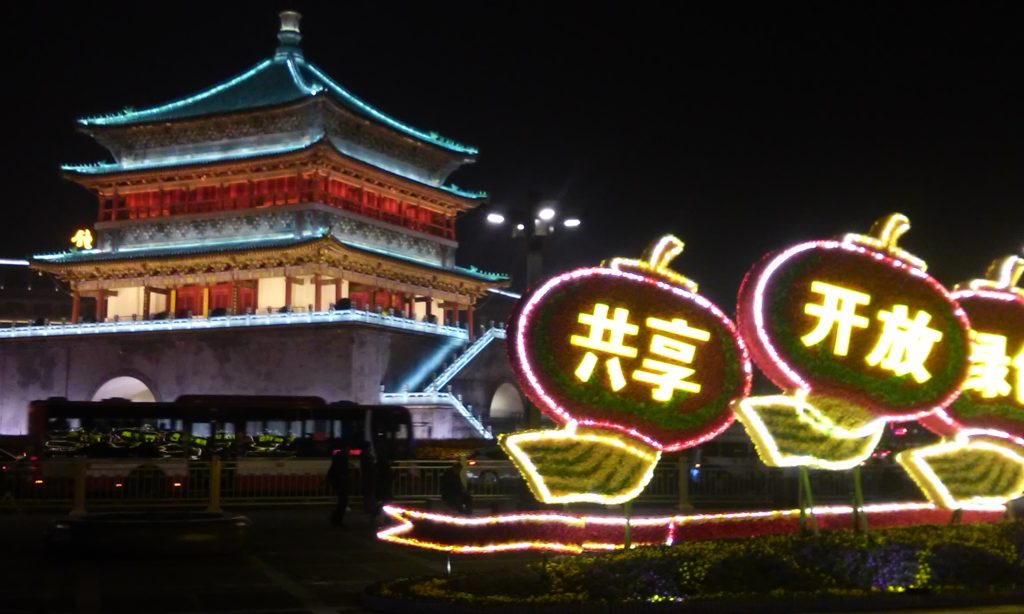
The Bell Tower (钟楼) and nearby Drum Tower (鼓楼) mark the classic central axis. Visit once in daylight if you want the exterior and square context; decide later whether an interior climb is worth the queue and energy. The surrounding streets connect easily to metro and food options — useful as a base, not as a place you must “complete.”
Eat a measured lunch. Xi’an’s signature flavours run rich, sesame-forward, and sometimes spicy. Order one hearty dish (for example a classic noodle or meat sandwich style plate) and one lighter vegetable or soup, then taste before you escalate chilli or oil. Leave room for an evening snack walk.
Afternoon: rest, then one museum or temple buffer
Pick either a short museum visit inside the wall area or a quieter courtyard stop — not both stacked tightly. Early autumn light is good for photos, but sudden showers still appear; a compact umbrella earns its bag space. When your feet complain, stop for tea or coffee indoors. A first Xi’an day is about learning the old-city grammar, not collecting every famous name.
Evening: Muslim Quarter with a soft landing
The Muslim Quarter (回民街) and nearby lanes are dense with snacks, neon, and evening crowds. Go with a plan: choose two or three items you actually want to try, share portions, and leave before you are exhausted. Near Mid-Autumn and Golden Week, lanes fill earlier — start a little before peak dinner if you prefer easier walking. End Day 1 early enough that Day 2’s warriors trip does not start as recovery.
Day 2 — Terracotta Warriors with buffer, then a calmer return
Morning: Terracotta Warriors as a timed outing
The Terracotta Army site east of the city is the trip’s biggest logistics block. Book authorised tickets ahead when you can, and build transfer time into your morning — metro-plus-bus, tourist shuttle, or a pre-planned ride. Treat the visit as a half-day with buffers, not a one-hour checkbox.
On site:
1. Follow the official route signs; pits have different crowd densities at different hours.
2. Keep bags zipped and phones charged — you will want maps and translation apps.
3. Read captions at a calm pace; you do not need every photo angle.
4. Eat a simple lunch nearby or bring water and a snack if lines are long.
If your dates fall in the Mid-Autumn short holiday or Golden Week, expect denser queues at gates and photo spots. Start earlier, protect return transport, and skip stacking another major site the same afternoon.
Afternoon: return to the city and protect recovery time
After the warriors, most first-timers benefit from a quiet hotel break before any evening plan. Optional add-ons only if energy remains: a short walk near the wall, a bookstore café, or packing for tomorrow’s train. Do not force a rushed second museum if your feet are done.
Evening: one neighbourhood dinner, then sleep
Choose a calmer dinner neighbourhood than the densest snack street if you already walked it on Day 1. Confirm tomorrow’s tickets and hotel nights. High-speed trains out of Xi’an are straightforward when booked ahead — see how visitors book mainland trains on 12306 if you still need the booking flow.
Optional Day 3 — deeper history or a softer cultural half-day
If you have a third day, pick one lane only: a major museum morning, a temple-and-park half-day, or a slower food neighbourhood outside the busiest lanes. Avoid stacking long transfers. Early autumn is a good season for outdoor courtyards, but holiday weekends still reward earlier starts and shorter lists.
Mid-Autumn and Golden Week timing for Xi’an
Before Mid-Autumn (early–mid September): Usually the calmest window for a first visit, with cooler mornings for the wall and fewer holiday-only crowds.
Mid-Autumn short holiday (~25–27 September 2026): Night snack streets and popular photo spots get busier; book warriors timing and hotel nights with more buffer. Makeup workday Sunday 20 September may affect weekday patterns around the festival.
Between Mid-Autumn and Golden Week: A useful gap for travellers who can shift dates — still autumn weather, with less peak-holiday pressure than early October.
Golden Week (1–7 October 2026): Expect denser transport hubs and major sites. Keep itineraries shorter, start earlier, and protect meal times with flexible plans. Makeup workday Saturday 10 October sits after the holiday week.
Practical packing and city manners
- Shoes: Comfortable soles for wall stone and long museum floors.
- Layers: Early autumn mornings can feel cooler on the wall; afternoons warm up.
- Power: Maps, tickets, and translation drain batteries — carry a cable and consider renting a power bank if you travel light.
- Queues: Stay patient at metro gates and attraction entrances; have your passport ready when real-name checks appear.
- Food pace: Share plates, drink water, and do not treat every snack stall as mandatory.
A simple two-day skeleton you can adapt
| Block | Day 1 | Day 2 |
| — | — | — |
| Morning | City wall segment | Terracotta Warriors |
| Midday | Bell/Drum Tower area lunch | On-site or nearby lunch |
| Afternoon | Rest + one indoor buffer | Return + hotel recovery |
| Evening | Muslim Quarter snacks (limited) | Calm dinner + pack |
Final tip
Xi’an’s first-visit magic is density of history within a walkable core — plus one big out-of-town site that needs respect for time. Early autumn 2026 gives you cooler walking weather if you stay ahead of Mid-Autumn and Golden Week peaks. Keep lists short, payments ready, and evenings flexible. For more calm China travel timing, start from Golden Week 2026 vs Mid-Autumn and build outward. Questions for Lovely China: [email protected]. Founded in 2025.