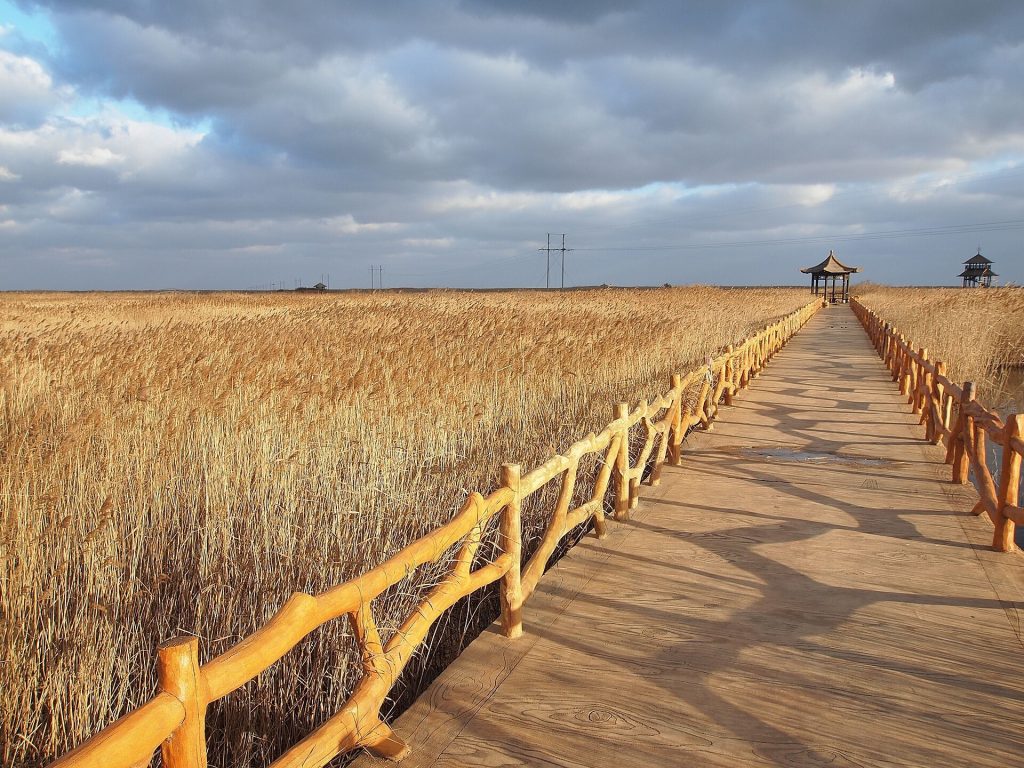
Why go to the Yellow River Delta in autumn
Where the Yellow River finally meets the Bohai Sea, in Dongying (东营), Shandong, it has built one of China’s youngest landscapes: a delta of reed marsh, tidal flats and new land. The Yellow River Estuary Ecological Tourism Area (黄河口生态旅游区) gives visitors access to part of the Shandong Yellow River Delta National Nature Reserve. China News Service describes the reserve as having the most complete, extensive and youngest wetland ecosystem in China’s warm-temperate zone.
For travellers and expats in northern China, autumn is the time to go. From September the reeds turn gold and silver-plumed. The low salt-tolerant plant seepweed (翅碱蓬, Suaeda) turns red across the mudflats, a scene known locally as the “red carpet.” From late October, migratory birds arrive in large numbers. It is a quieter, wilder alternative to classic autumn destinations, and it gets better after Golden Week rather than before.
This guide is written on 6 October 2026, day six of the National Day holiday (1–7 October; makeup workday Saturday 10 October). It focuses on the late-October to December window.
Why the delta matters for birds
The Yellow River Delta sits on two major migration routes: the East Asian–Australasian Flyway and the West Pacific flyway. Chinese media often call it an “international airport for birds.” Reserve monitoring cited by China News Service in February 2026 recorded 376 bird species in 2025, up from 187 in 1992. The reserve is especially known for breeding Oriental storks and wintering cranes, swans and ducks.
In 2024, UNESCO’s World Heritage Committee approved Phase II of “Migratory Bird Sanctuaries along the Coast of Yellow Sea–Bohai Gulf of China,” extending the World Heritage property to include Yellow River Estuary components. For visitors, this means the area is managed first for conservation, and access rules reflect that.
When to go: autumn timing in ranges
- September to early October: Reeds turning gold, red seepweed on the flats at its brightest, fewer birds than later. Good for landscape photos.
- Late October to November: Golden reeds and the arrival of large numbers of migrants. Local tourism sources describe late October to April as the main birdwatching season.
- November to December: The best chance of the famous “bird waves” (鸟浪), when huge flocks of ducks and other waterbirds lift off at once and swirl like smoke. Dongying news outlets note they tend to happen around dawn and dusk and are unpredictable, depending on weather and the birds’ movements.
As always, these are typical patterns, not promises. Check recent posts from Dongying’s official culture and tourism channels and the scenic area’s own notices before you travel.
Getting there
Dongying is in northern Shandong, between Jinan and the Bohai coast. The estuary scenic area is well outside the city centre, so plan for a long road transfer from downtown.
- Getting to Dongying: Dongying has rail and air links. Check 12306 for current train options from Jinan, Beijing or Qingdao, and airline apps for flights into Dongying Shengli Airport. Combine with our Jinan springs guide if you are coming via the provincial capital.
- To the scenic area: Most independent visitors use a taxi, ride-hailing car or hired driver for the day. Agree a return time with your driver; empty roads at sunset mean you may not find a car. See Didi for foreign visitors.
- Self-drive: Possible with a Chinese driving licence or official temporary permit. Roads along the coast are flat and long; keep fuel topped up.
For Dongying city basics, read our Dongying first-timers guide.
Inside the scenic area
The estuary scenic area is large and spread out. Visitors usually move between stops by the internal sightseeing bus; check fares and the last-bus time when you enter. Allow at least half a day, and preferably most of a day.
South bank birding line
Dongying’s tourism authorities describe a south-bank route with five birding points: an Oriental stork observation point, Bird Island (鸟岛), a viewing platform east of Bird Island, a natural willow forest boardwalk and a bird science park. Bird Island has long boardwalks and viewing towers through the reeds. This is the easiest choice for first-timers.
North bank line
A separate north-bank route has been described as a paid add-on requiring reservation, with more remote observation points. Ask at the visitor centre or check official notices; availability can change by season.
The river mouth and boat trips
Seasonal boat trips run toward the river mouth, where muddy Yellow River water meets the bluer sea, sometimes called the “yellow-blue boundary.” Boat operations depend on weather and water levels; confirm on the day.
Outside the gate: bird-wave viewing
Local media and Dongying tourism have highlighted roadside viewing along Binhai Avenue (滨海大道) east of its junction with Dongba Road (东八路) as a recent hotspot for bird waves, with a visitor service station. Pull over only where it is safe and legal, and never stop on the carriageway.
A practical one-day plan
1. Leave Dongying before sunrise if you want bird activity at dawn on the roadside viewing areas.
2. Enter the scenic area when it opens. Take the sightseeing bus to Bird Island and walk the boardwalks slowly. Mid-morning light on reeds is lovely.
3. Midday: Visit the stork observation point and willow boardwalk, or take a boat if running.
4. Afternoon: Return toward Binhai Avenue for dusk viewing, then head back to the city.
Food options are limited inside; bring water and snacks. Make sure you can pay by mobile (Alipay and WeChat Pay guide).
What to pack
The coast is flat, open and windy, and late autumn mornings are cold.
- Windproof jacket, warm layers, hat and gloves for November dawns
- Binoculars; a telephoto lens if you photograph birds
- Neutral-coloured clothing to avoid disturbing birds
- Sturdy, non-slip shoes for damp boardwalks
- Sunscreen and sunglasses for low glare over water
- A folding stool and thermos if you plan to wait for bird waves
See also our China autumn packing list.
Birding etiquette
- Keep a respectful distance; do not chase, shout at or throw things to make birds fly for photos.
- No drones near flocks unless explicitly allowed; they cause panic flights.
- Stay on boardwalks and marked paths; much of the wetland is a protected core zone.
- Do not feed wild birds.
- Take all litter out; plastic is a real hazard in wetlands.
- Be patient with other photographers’ tripods and share viewing spots.
If you enjoy this kind of trip, compare with northeast China’s crane reserves in our guides to Zhalong Nature Reserve and Xianghai Nature Reserve.
Combining with a Shandong trip
Dongying works as an add-on to Jinan or a coastal Shandong itinerary. Qingdao and Yantai are further east; see our Qingdao seaside autumn weekend for a contrasting city-and-sea trip. Do not try to squeeze the delta into a same-day round trip from Qingdao, since the distances are too long to enjoy it.
FAQ
When is the best time to see birds in the Yellow River Delta?
Late October through winter into spring is the main season. November and December offer the best chance of large flocks and “bird waves,” mainly around dawn and dusk.
When are the reeds and red seepweed at their best?
Reeds turn gold from around September into November. The red seepweed “carpet” is typically brightest in early to mid-autumn. Exact timing varies each year.
Do I need a guide?
Not for the main south-bank boardwalks. A local birding guide helps if you want specific species or the more remote areas.
Is the Yellow River Delta suitable for children?
Yes, the boardwalks and sightseeing bus make it manageable. Bring warm layers and snacks, and supervise children near water.
Can foreigners buy tickets?
Yes. If online booking requires a Chinese ID, buy at the ticket office with your passport and keep it with you.
Lovely China was founded in 2025 to help English-speaking travellers and expats find calmer, more rewarding corners of China. Questions or corrections: [email protected].
Cover photo: rheins / Wikimedia Commons (CC BY 3.0). Reed marsh boardwalk at the Yellow River Estuary, photographed in November.