The taxi driver didn’t brake for the yellow light. He accelerated, the engine whining as we shot through the intersection on a road wide enough for a military parade. Outside the window, the land stretched flat and pale, the kind of alkali flats where only saltwort and tamarisk survive. This was my first hour in Dongying: a city built on petroleum, laid out on a grid so rigid it feels drawn with a ruler, where the Yellow River finally sighs into the Bohai Sea.
Arriving on the Grid
Dongying doesn’t have a historic center. The city was born in 1974 when the first gusher blew at the Shengli Oilfield, and the planners laid out two distinct zones: Dongcheng (East City) for government and universities, and Xicheng (West City) for commerce and the older residential blocks. The expressways connecting them are smooth, broad, and strangely empty compared to Jinan or Qingdao. Most visitors fly into Dongying Shengli Airport, a compact terminal about 45 minutes from the city core. A taxi ride into town costs roughly the price of a bowl of beef noodles back in Beijing, but keep your seatbelt fastened. Local drivers treat the wide boulevards as personal drag strips, weaving through the sparse traffic with a confidence that borders on reckless.
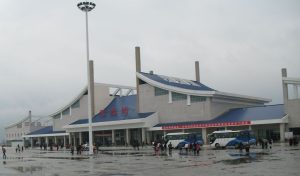
If you take the high-speed train, you’ll arrive at Dongying Station in the northern suburbs. It’s a massive, gleaming hall that sees a fraction of the foot traffic it was built for. From there, a ride-hailing app is more reliable than the official taxi queue; the drivers know the hotel clusters better than the dispatchers do. The city’s bus network is extensive and nearly free for seniors, but routes are labeled only in Chinese. Unless you read the characters for “Oilfield Hospital” or “Petroleum University,” the map is opaque.
Where the River Meets the Sea
The Yellow River Delta National Nature Reserve is the reason most outsiders bother with the journey. In late autumn, the wetlands turn into a staging ground for migratory birds—red-crowned cranes, Saunders’s gulls, oriental storks. The boardwalks near the estuary stretch for kilometers over reeds that hiss in the wind. You won’t find crowds here, even during the October holiday. The silence is broken only by wingbeats and the distant throb of pumpjacks on the horizon, a reminder that the oilfield and the wetland share the same substrate.
Hire a driver for the day if you want to reach the actual river mouth. The reserve’s shuttle buses run on a loose schedule and stop well short of the coastline. A local driver knows which dirt tracks are passable after rain and which ones swallow tires. Bring water, a windbreaker, and a telephoto lens. The birds keep their distance. The best light hits the mudflats in the late afternoon, turning the shallow channels into sheets of beaten copper.
Eating in an Oil Town
Dongying cuisine leans heavily on Lu (Shandong) traditions: salty, garlicky, vinegar-sharp, and designed to fuel roughnecks working twelve-hour shifts. The signature dish is Yellow River carp, usually braised in a thick bean-paste sauce until the bones soften. In a proper restaurant, the fish arrives whole, skin glistening, the sauce dark enough to stain porcelain. You pick the meat with chopsticks, dip it in the reduced gravy, and chase it with a mouthful of steamed mantou.
- Yellow River Carp (黄河鲤鱼): Fresh carp, fermented soybean paste, ginger matchsticks, scallion, rock sugar, aged vinegar. Score the fish, pan-fry until the skin crisps, then braise covered for twenty minutes. Finish with a splash of vinegar over high heat to tighten the sauce.
- Braised Sea Cucumber with Scallion (葱烧海参): Rehydrated sea cucumber, pork fat, massive Shandong scallions, light soy, Shaoxing wine. Blanch cucumber, fry scallion whites in pork fat until translucent, add stock and seasonings, simmer cucumber ten minutes. Thicken with potato starch.
- Dezhou Braised Chicken (德州扒鸡) — local variant: Whole chicken, star anise, cinnamon, clover, soy sauce, maltose. Simmer low and slow until the meat falls off the bone; brush with maltose for the lacquered finish.
Ordering in a busy Xicheng banquet hall requires speed. Flag the server, point to the tank of live carp, say “hongshao” (braised), and hold up two fingers if you want a pair. Don’t ask for “less salt.” The kitchen measures soy sauce by the ladle. If you’re vegetarian, your options narrow to cold kelp threads, stir-fried seasonal greens with garlic, and steamed buns. Learn the phrase “bu yao rou” (no meat) and “bu yao hai xian” (no seafood), and repeat it twice.
Breakfast is where the city wakes up. Look for steam rising from a cart near the Petroleum University gate. You’ll get a bowl of millet porridge, a youtiao cruller split and stuffed with pickled mustard root, and a cup of hot soy milk for pocket change. Eat standing at the counter. The vendor won’t have change for a hundred-yuan note.
Sleeping and Staying Connected
Business hotels cluster around the administrative center in Dongcheng and the commercial spine of Xicheng. A four-star international chain near the government complex charges what a two-star commands in Qingdao, and the rooms are larger. Book a place with a bathtub; the municipal water runs hard and slightly saline, and a long soak helps after a day on the alkaline dust. Free laundry service is common in mid-range hotels catering to oilfield crews—hand your bag to the bellman before 9 a.m., get it back pressed by evening.
Mobile signal is solid everywhere, including deep in the wetlands. Buy a data-only eSIM before you land or grab a physical SIM at the airport kiosk; the staff speak enough English to activate a 30-day plan. Public Wi-Fi in hotels requires a Chinese phone number for the SMS verification code. If you’re traveling solo without a local number, ask the front desk to register the device under their ID. They’re used to it.
What Locals Expect (And What Trips You Up)
Dongying residents move at a different rhythm. Shops open late—ten or eleven in the morning—and stay open past ten at night. Lunch rushes start at 11:30 sharp; arrive at noon and you’ll queue behind refinery workers in flame-retardant coveralls. Dinner doesn’t peak until eight. If you walk into a restaurant at six, the kitchen may still be prepping.
Cash is vanishing. Even the breakfast cart displays a QR code. But the occasional mom-and-pop noodle shop still prefers paper money, and their change drawer is often empty. Keep a stash of small bills—tens and twenties—in a separate pocket. Tipping is not expected anywhere. Leaving coins on the table confuses the server; they’ll chase you down the street to return them.
The biggest mistake newcomers make is treating Dongying as a transit hub. They book a single night, expecting a grim industrial stopover, then realize they’ve missed the tide tables for the estuary, the morning market where farmers sell salt-cured duck eggs from bamboo baskets, the evening square dancing in People’s Park where retirees move in unison to remixed folk songs. Give the city two full days. Walk the empty boulevards at dusk when the streetlights flicker on in perfect rows. Watch the pumpjacks nod in the fields beyond the ring road, metronomes counting the seconds of a city that exists because of what lies beneath the salt crust.