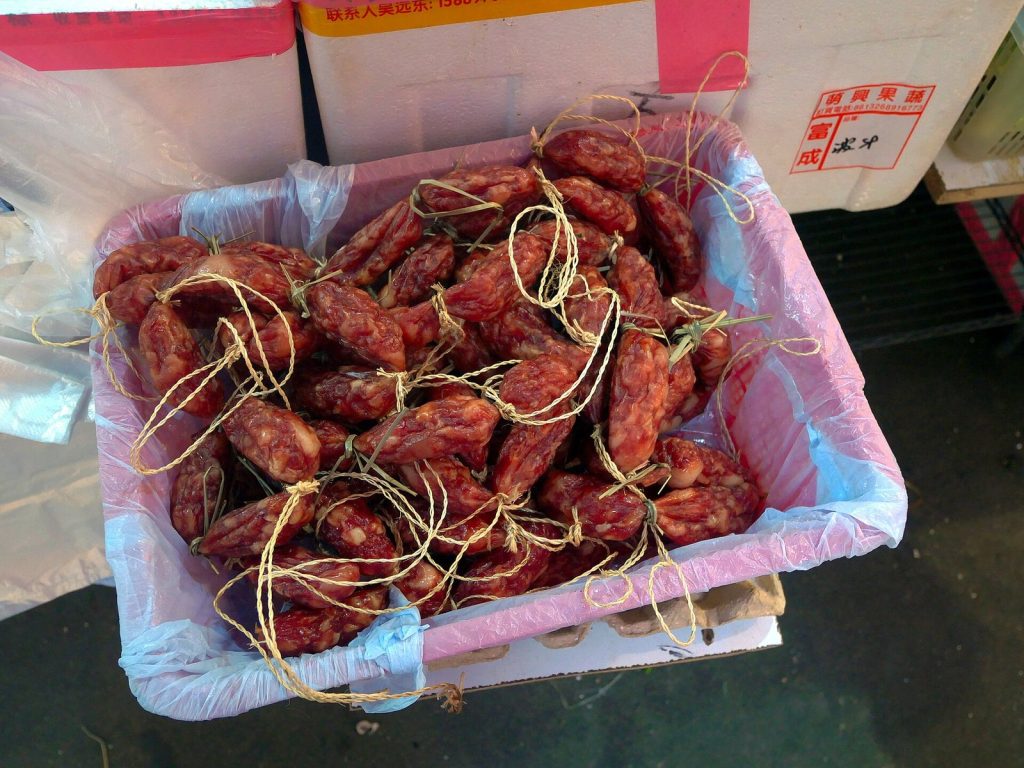
Walk through a market in Guangzhou or Hong Kong from mid-October onwards and you will see them: rows of glossy, dark-red sausages tied with string, hanging from hooks or piled in baskets. This is Chinese sausage — lap cheong in Cantonese, 腊肠 (làcháng) in Mandarin — one of the most useful and most misunderstood foods for visitors. It looks like salami, but you should not eat it raw. It tastes sweet as well as salty. And in southern China it has a season.
This guide explains what Chinese sausage is, why late autumn is the time to look for it, the main regional styles, how to eat and order it, where to buy it, and what to check if you have dietary restrictions.
What is Chinese sausage?
Chinese sausage is a cured, air-dried pork sausage. Diced lean pork and fat are mixed with seasonings, stuffed into casings, pricked to let moisture escape, then dried until firm. It belongs to a larger family called 腊味 (làwèi, Cantonese lap mei), “cured flavours”, which also includes cured belly pork (腊肉 làròu) and cured duck (腊鸭 làyā).
Key words to know:
- 腊肠 / 香肠 (làcháng / xiāngcháng): Chinese sausage. 香肠 is the general word; 腊肠 is the classic cured, dried type.
- 广式腊肠 (Guǎngshì làcháng): Cantonese-style sausage, sweet and fragrant.
- 川味香肠 (Chuānwèi xiāngcháng): Sichuan-style sausage, spicy and numbing.
- **润肠 / 膶腸 (rùncháng, Cantonese yeun cheung):** a darker sausage made with pork liver.
- 腊味 (làwèi): cured meats in general.
“When the autumn wind rises, eat lap mei”
Cantonese speakers have a saying for this season: 秋风起,食腊味 — “when the autumn wind rises, eat cured meats.” A 2022 Guangzhou Daily feature republished on the Guangzhou municipal government website explains why. Guangzhou’s autumn and winter are mild, dry and fairly rain-free, with a steady northerly wind. That dry wind — not strong sun — is what dries the sausages well, and there are fewer insects to spoil the meat.
The same article describes balconies across the city hung with drying sausages, cured pork and cured duck each autumn, and quotes a villager in Conghua, north of Guangzhou, saying the local custom is to make cured meats between the Autumn Equinox and the Winter Solstice. A cured-meat trade saying quoted in the piece, 百日红 (roughly “a hundred red days”), refers to the industry’s traditionally short peak season.
So if you are in Guangdong, Hong Kong or Macau from mid-October through winter, this is when fresh-season sausages appear in markets, restaurants add claypot rice to their menus, and the city’s old cured-meat shops get busy. Further north and west, a widely repeated folk saying — 小雪腌菜,大雪腌肉, “pickle vegetables at Minor Snow, cure meat at Major Snow” — places home curing a little later, in late November and December, in regions such as Sichuan, Chongqing and Hunan.
A short history
The Guangzhou Daily feature traces Chinese cured meats back more than two thousand years and notes that a sausage-making method already appears in the sixth-century agricultural text Qimin Yaoshu, which used lamb casings. Its account of Cantonese sausage is that cooks in Guangzhou, a major port on the Maritime Silk Road, combined sausage-stuffing techniques that arrived by sea with local curing methods, using diced pork in thin pork casings.
According to the same source, Guangzhou’s first specialist cured-meat shop, Cangzhouzhan (沧洲栈), opened in 1903. The well-known names Huangshanghuang (皇上皇) and Babaizai (八百载) followed in the 1930s and 1940s. In 2022, Cantonese cured-meat making techniques were added to Guangdong’s provincial intangible cultural heritage list.
The main styles
The Guangzhou article sums up regional cured meats in three words: 川麻、粤甜、湘辣 — Sichuan numbing, Cantonese sweet, Hunan hot.
- Cantonese (广式): the style most people outside China know. It is seasoned with salt, soy sauce and sugar, and flavoured with liquor — some makers use strong local spirits, others Fenjiu or rose wine. It tastes sweet, savoury and boozy, with visible white pieces of fat. In Guangzhou the popular fattier types are called 三七肠 and 六四肠, named after their lean-to-fat ratio.
- Liver sausage (润肠): almost black, richer and more mineral. Often sold alongside regular lap cheong.
- Sichuan and Chongqing (川味): red with chili and tingling with Sichuan pepper, less sweet, sometimes smoked.
- Hunan (湘味): often smoked and hot. Hunan is better known for smoked cured pork, 腊肉.
There is also a national standard for Chinese sausage: GB/T 23493-2022, General quality requirements for Chinese-style sausage, published by the national standards authority and in force since 1 July 2024. You don’t need to read it — but it is why packaged sausages carry a standard number on the label.
How to eat Chinese sausage
Chinese sausage is cured, not ready-to-eat. Cook it before eating. Common ways:
- Steamed. The simplest method: steam whole or sliced until the fat turns translucent and glossy, then slice diagonally. Often eaten with plain rice.
- On rice. Lay slices on rice as it finishes cooking so the fat and juices soak in. The Guangzhou article notes that a rice cooker gets you most of the way there at home.
- Claypot rice (煲仔饭 bāozǎifàn). The classic restaurant dish: rice cooked in a clay pot with sausage and other cured meats, finished with sweet soy sauce, with a prized crispy crust at the bottom. See our Cantonese claypot rice guide.
- Stir-fried. Sliced and stir-fried with vegetables such as Chinese broccoli or snow peas.
- In dim sum. You will find diced lap cheong in sticky rice parcels, turnip cake and steamed sausage buns (腊肠卷). Our Guangzhou yum cha guide explains how to order.
What does it taste like? Cantonese sausage is firm and slightly chewy, sweet first, then salty, with a wine aroma and soft, rich fat. Sichuan sausage hits you with chili heat and numbing pepper instead of sweetness.
How to order in a restaurant
Useful words and phrases:
- 腊味煲仔饭 — claypot rice with cured meats
- 腊肠煲仔饭 — claypot rice with sausage
- 腊味拼盘 — cured meat platter
- 腊肠炒菜心 / 腊肠炒荷兰豆 — sausage stir-fried with choy sum / snow peas
- 广式的还是川味的?— Cantonese style or Sichuan style?
- 辣不辣?— Is it spicy?
Claypot rice takes time to cook, so restaurants may warn you of a wait. Prices vary by shop and city; check the menu, and pay with Alipay or WeChat Pay.
Where to buy it
- Old cured-meat shops in Guangzhou. The Guangzhou Daily feature describes queues at Huangshanghuang’s branch on Xiajiu Road (下九路) in the old Xiguan district each autumn, with loose sausages hanging from the ceiling. Combine it with an autumn walk around Guangzhou. Check the shop’s current branch locations on a map app before you go.
- Wet markets. In Guangdong and Hong Kong, market stalls sell loose sausages by weight in season.
- Supermarkets. Vacuum-packed sausages from major brands are sold year-round. Our supermarket label guide helps you read ingredients and dates.
- Cantonese restaurants. Look for claypot rice, cured-meat platters and dim sum.
When buying loose sausages, look for firm, evenly dried links with a clean, cured smell. Ask for 广式 (Cantonese) or 川味 (Sichuan) depending on what you want.
Taking it home
Chinese sausage is a classic gift, but think before you pack it. Many countries — including the United States, Australia and the members of the European Union — restrict or ban meat products carried by travellers, and pork products from China are commonly refused. Check your destination’s customs rules before buying sausage as a souvenir.
Dietary notes
- Pork: almost all Chinese sausage is pork, often with a high fat content. Muslim travellers should note that Cantonese sausage is also cured with liquor. Our halal food guide suggests alternatives.
- Alcohol: Cantonese-style sausage is flavoured with spirits or rice wine.
- Sugar and salt: Cantonese sausage contains a fair amount of sugar and all types are salty. Lower-salt and lower-sugar products now exist; check labels.
- Gluten: soy sauce, which usually contains wheat, is a common seasoning.
- Additives: industrial sausages may list curing agents such as sodium nitrite (亚硝酸钠). Read the label if you avoid them.
- Liver: 润肠 contains pork liver; ask if you are unsure which sausage you are getting.
- Vegetarian: there is no vegetarian lap cheong in most shops; vegetarian restaurants sometimes make imitation versions.
Common first-timer mistakes
- Slicing it raw like salami. Cook it first.
- Assuming all Chinese sausage is sweet — Sichuan versions are fiery.
- Buying a big bag as a souvenir without checking customs rules at home.
- Ordering claypot rice when you are in a hurry.
- Leaving the crispy rice crust at the bottom of the claypot — that is the best part.
FAQs
What is lap cheong? The Cantonese name for Chinese sausage, a cured and dried pork sausage that is sweet, salty and fragrant with liquor.
Can you eat Chinese sausage raw? No. Treat it as raw cured meat and cook it by steaming, stir-frying or cooking it on rice.
When is Chinese sausage season? In Guangdong, cured meats are traditionally made and eaten from autumn into winter, when the dry north wind blows. Packaged sausages are sold all year.
What is the difference between 腊肠 and 香肠? 香肠 is the general term for sausage; 腊肠 usually means the classic cured, dried type such as Cantonese lap cheong.
Is Chinese sausage spicy? Cantonese style is not; Sichuan and Hunan styles usually are.
Is Chinese sausage halal? Almost always no — it is pork, and Cantonese style also contains alcohol.
Before you go
From mid-October, keep an eye out for strings of sausages drying in the autumn wind, order a claypot of 腊味煲仔饭, and save room for the crispy crust. Once you know to cook it first and to ask “Cantonese or Sichuan?”, Chinese sausage becomes one of the easiest and most satisfying foods to enjoy in China.
Sources
- Guangzhou Daily via the Guangzhou Municipal Government website (gz.gov.cn), “秋风起食腊味 排排坐好好味”, 9 November 2022 — season, history, styles, Huangshanghuang, provincial heritage listing.
- National Public Service Platform for Standards Information (openstd.samr.gov.cn), GB/T 23493-2022 中式香肠质量通则.
Lovely China was founded in 2025 to publish practical English guides for travellers and expats in China. Questions or a broken link? Email [email protected].
Cover photo: Peachyeung316 / Wikimedia Commons (CC BY-SA 4.0).