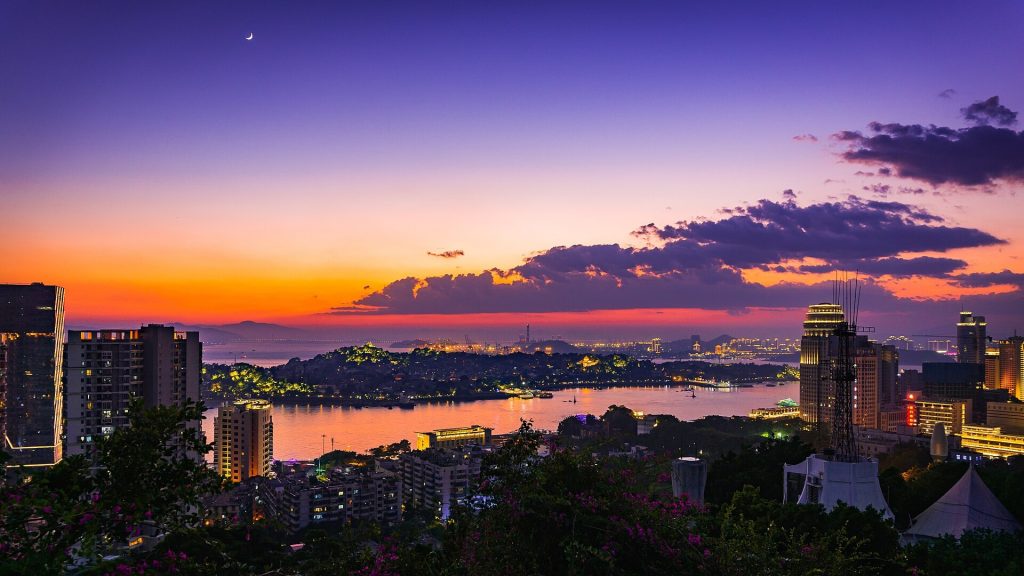
The last day-trip voices leave Gulangyu the way a tide leaves a step: not all at once, but enough that the lanes remember how narrow they are. In late December the air is winter-soft, milder than anything a traveller has felt in Beijing or even Shanghai the same week, and the island takes that mildness seriously. You stay out after the ferries have carried most of the afternoon away, and the colonial-era facades, which looked busy and photographed at three o’clock, begin to do quieter work.
This is not a ticket guide. Official ferry and island notices should be checked if you are still arriving or still need a last boat; those times are not invented here. A daytime, more practical visit belongs to Gulangyu autumn visit and to the wider city plan in Xiamen late December and New Year planner. Tonight is only a walk.
You come off the last stretch of the pier when the water is already holding the harbour lights in broken pieces. A ferry, whoever’s ferry it is, moves with a slow white shoulder of wake and then is only a sound. The stones underfoot are still warm from a sun that has gone. Somewhere to the left, behind a wall you cannot see over, a piano is being played without an audience in mind. It is not a concert. It is a room with a window on a lane, and a few bars that reach the street and stop, and then start again.
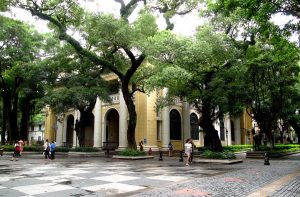
The lanes turn the way old lanes do, without asking whether a map app has caught up. Lamps come on in iron brackets and in shop doorways that have already pulled a shutter halfway down. A café keeps one table outside for no obvious rush of customers. You walk through a smell of sea and of something sweet being packed away, and then through no smell at all except plaster and leaves. The facades—European in outline, Southern Fujian in the way they have been lived in—hold a cream and ochre that electric light makes gentler than noon did.
A couple stops to look at a closed gate. A cleaner’s cart ticks over a crack in the stone. You do not need a story for them. Late December has thinned the island without emptying it. Residents go home along the same paths visitors used for their afternoon loop, and the difference is mostly in the pace: less posing at corners, more bags of vegetables, more knowledge of which turning is simply the way through.
You think, almost idly, of other southern evenings you have read about or walked, and then you let that thought go. This island has its own wind. It comes off the water in a soft push that would not count as cold in the north and still makes you close one more button. Hands can stay out of pockets. The sea at the end of a street is a dark band with a working harbour’s lights beyond, not a widescreen sunset arranged for a ticketed terrace.
Piano notes again, farther off, or perhaps a recording from a shop that has not decided to close. On Gulangyu the instrument is part of the island’s ordinary legend, and tonight it is also just a sound in a side street. You do not knock. You do not go looking for a named musician as if the evening were an interview. You take the next turning because the wall there is less crowded with signs, and because a tree has been allowed to stay awkward in the middle of the view.
A small square opens, then contracts back into a corridor of houses. Someone is speaking on a phone in a doorway, voice low. A bicycle is walked, not ridden, because the stones would rattle it. You pass a mural you saw earlier and hardly recognise; the colours have gone inward. If you came in autumn, you might remember a fuller press of footsteps from a more practical daytime visit. Tonight the island is not teaching. It is cooling.
You check the time because boats and closing gates are real, even in a story, and because a hotel on the Xiamen side or a guesthouse on the island will still want you back before you are merely wandering. That check is a glance, not a schedule rewritten on the pavement. The work is to finish a loop you did not strictly plan: one more glimpse of water, one more quiet facade, one more stretch where the lamp and the sea at the end of the street line up without effort.
When you finally turn toward wherever you are sleeping, the lanes behind you keep a low, domestic brightness. The water keeps the ferry lights a little longer than the sky deserves. You will remember the mildness more than any single doorway: that late December on Gulangyu could still be walked in an unhurried coat, that the piano was not arranged for you, and that the island, after the day-trip crowds had gone home, sounded like a place that had work to do in the morning and no need to explain itself tonight.
China travel tools page can wait until breakfast. The evening does not need another plan.
Related Lovely China reading
For payments, start with Alipay and WeChat Pay hub and WeChat Pay vs Alipay for tourists. For trains, keep high-speed rail first-timers guide and 12306 passport signup for foreigners handy. City hubs: Beijing first-visit guide, Shanghai first-visit guide. Connectivity: roaming vs local SIM honest guide, pocket Wi-Fi vs eSIM for China, offline maps for foreigners. Bookmark China travel tools page.
Practical checklist
- Confirm official rules on the relevant government, park, airline, or bank page near your travel week
- Screenshot bookings, tickets, and QR codes while you still have stable Wi-Fi
- Save hotel and attraction names in Chinese characters in your phone notes
- Carry passport, a backup payment method, and a small cash float (why cash is still needed)
- Test one small mobile payment before you rely on wallets at a gate or taxi
- Keep China travel tools page bookmarked for related Lovely China hubs
FAQ
Is this a ferry-ticket or opening-hours guide?
No. It is an evening walk on Gulangyu after the day-trip crowds thin. Check official ferry and island notices for live times if you still need a boat. For a practical visit, see the autumn Gulangyu guide and the Xiamen late-December planner.
Is late December cold on the island?
It is milder than northern China, and still cool enough for a layer after dusk. This story does not invent temperatures or a guarantee of a warm night.
Where should I go next if I want a day plan?
Use the Xiamen late December and New Year planner, and treat official ferry and island pages as the authority for logistics.
Notes for late 2026 travellers
Late December 2026 and the New Year week into 2027 bring colder mornings, earlier sunsets, and holiday crowds in many city hubs. Pack real winter layers in the north, and leave extra time on weekends and around 1 January.
This article does not invent ticket prices, opening hours, processing times, consular fees, or official statistics. When a number matters, verify it on the official site, app screen, or ticket board near your travel week.
If an official rule page disagrees with this guide, follow the official page. Lovely China orients English-speaking travellers; we are not an immigration, banking, or medical authority.