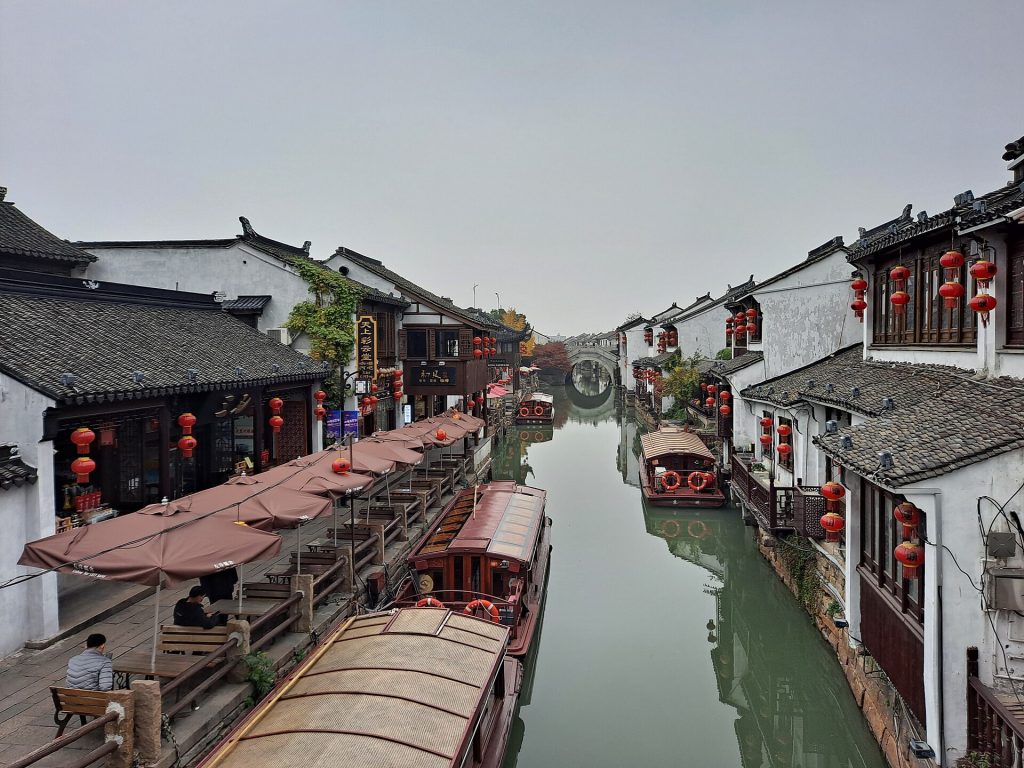
The stone is damp before you see the water. On a late-December evening, Suzhou’s Shantang Street (山塘街) holds the cold in its paving, and the canal takes the first lights and doubles them, slightly out of register, as if the street were rehearsing itself. You walk with your hands in your pockets, and the air smells of oil, sugar, and wet wood.
This is not Pingjiang Road. Pingjiang has its own December evening (a December evening on Suzhou’s Pingjiang Road), and its own autumn stroll (December evening on Suzhou’s Pingjiang Road). Shantang runs its own line, historically the way toward Tiger Hill, and in practice a tourist street that still becomes a canal when the day-trip groups thin. We will not invent imperial anecdotes or a ticket you must buy merely to step onto the lane. If a garden or Tiger Hill itself requires a ticket, that is a different gate, for daylight.
The hour when the street changes its mind
Late December dusk arrives early. If you come at four, you may still meet tour flags and cameras pointed at the same arched bridge. If you come after the light has gone, the flags are fewer, the shops that sell identical silk purses begin to close their outer shutters, and the remaining windows look more like rooms. A weekday is quieter than a Saturday. New Year week, when 1 January is a public holiday, can bring the noise back; the street does not exist outside the calendar.
You will want a real coat. Jiangnan cold is damp and climbs from the canal. The pretty thin scarf you packed for a photograph will not do the whole walk. Shoes should forgive puddles. Phone batteries fade; keep the handset inside the coat until you actually want a picture (power bank airport security).
Start at the busier, more commercial end if you need supper and a sense of crowds, then walk toward the quieter stretch as the lights settle. You do not have to reach Tiger Hill in the dark, and you should not treat an unlit path as a challenge. Turn around when the shops thin and the towpath feels like someone’s neighbourhood.
What you notice when you stop trying to cover ground
A stone bridge, seen from the next stone bridge, is the whole composition: railing, lantern, black water, a low white wall. Someone is cooking in a room no wider than a corridor. A boat, if one is still running, moves at a pace that makes walking feel hasty. We will not invent a schedule for those boats. If a pier is shut, the water is still there.
You pay for a snack the way you pay in any Chinese old street now: a QR code, a wallet that already works, a backup, and occasionally cash if a small stall prefers it (Alipay and WeChat Pay hub, why cash is still needed). There is no romance in standing in the cold while an app loads. Screenshot the success screen and move aside so the next person can order.
Voices bounce off the canal. Mandarin, Suzhou dialect, a little English from a shop sign that has given up being accurate. You do not need to buy the first embroidered item you are offered. You do need to watch your step at the edge of the water. There are no prizes for standing closer to the dark.
How to leave the evening intact
Eat something warm before you are too far from a door you would willingly enter. A noodle soup or a pot of tea will do more than a third souvenir. Then walk back the way you came, which will look different because the last shops have closed and the lanterns have you to themselves, or almost.
Metro or a Didi will get you to a hotel that will want your passport (Didi ride-hailing for foreigners, hotel registration for foreigners). Save the pickup point in Chinese; “the pretty bridge” is not a pin. If you are continuing to Hangzhou or staying in Suzhou for a quieter next morning, let the night end. A late-December canal is not improved by one more lane of identical merchandise.
Pingjiang will still be there tomorrow, if you want a comparison (a December evening on Suzhou’s Pingjiang Road). Shantang, on this evening, is enough: a cold straight water, a street that remembers it was a road to a hill, and a visitor willing to walk slowly enough to notice that the reflections are slightly late, like an echo, like a city repeating itself in winter.
A last look, then the ordinary way home
Near the water there is often a moment when a bicycle bell, a shutter, and a boat line up without anyone arranging it. That is a good time to stop walking. The street will still be there if you come back in morning light, when the same canal looks shorter and more workaday, with deliveries and mops where the lanterns were.
The ordinary way home is the correct ending: a station entrance or a pinned pickup, a warm seat, and the smell of the street fading from your scarf. You do not need a midnight extension. Late December in Suzhou is already doing the work, quietly, in the black water that keeps repeating the lights a half-second late.
Related Lovely China reading
For payments, start with Alipay and WeChat Pay hub and WeChat Pay vs Alipay for tourists. For trains, keep high-speed rail first-timers guide and 12306 passport signup for foreigners handy. City hubs: Beijing first-visit guide, Shanghai first-visit guide. Connectivity: roaming vs local SIM honest guide, pocket Wi-Fi vs eSIM for China, offline maps for foreigners. Bookmark China travel tools page.
Practical checklist
- Confirm official rules on the relevant government, park, airline, or bank page near your travel week
- Screenshot bookings, tickets, and QR codes while you still have stable Wi-Fi
- Save hotel and attraction names in Chinese characters in your phone notes
- Carry passport, a backup payment method, and a small cash float (why cash is still needed)
- Test one small mobile payment before you rely on wallets at a gate or taxi
- Keep China travel tools page bookmarked for related Lovely China hubs
FAQ
Is Shantang Street the same as Pingjiang Road?
No. They are different historic streets in Suzhou. Pingjiang has its own December evening story. Shantang is the canal street associated with the way toward Tiger Hill.
Do I need a ticket to walk on Shantang Street?
The lane itself is typically a public street. Individual gardens or Tiger Hill at one end of the wider axis may require their own tickets in daylight. We do not invent a street ticket.
When is a good time to go in late December?
After dusk, which comes early, and preferably not at the peak of a public-holiday evening if you want more canal and fewer tour flags. A weekday is usually quieter than a Saturday.
How do I get back to the hotel?
Save a metro entrance or a Didi pin in Chinese rather than ‘the pretty bridge.’ Pay for snacks as you would elsewhere, and dress for damp cold.
Notes for late 2026 travellers
Late December 2026 and the New Year week into 2027 bring colder mornings, earlier sunsets, and holiday crowds in many city hubs. Pack real winter layers in the north, and leave extra time on weekends and around 1 January.
This article does not invent ticket prices, opening hours, processing times, consular fees, or official statistics. When a number matters, verify it on the official site, app screen, or ticket board near your travel week.
If an official rule page disagrees with this guide, follow the official page. Lovely China orients English-speaking travellers; we are not an immigration, banking, or medical authority.