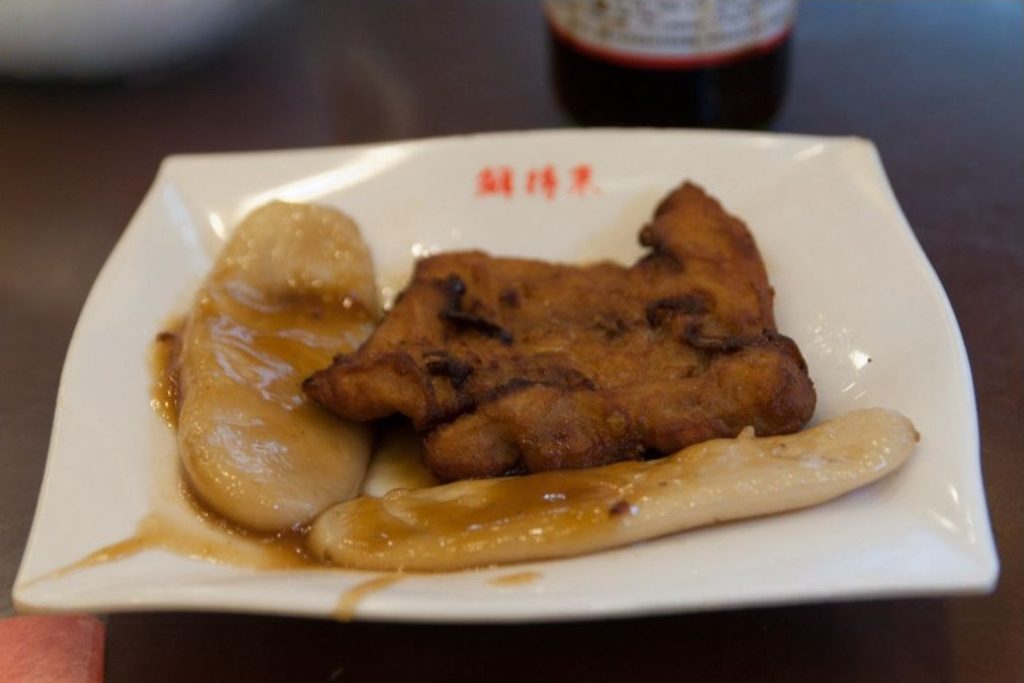
Paigu nian gao (排骨年糕) is a named Shanghai plate, not a vague instruction to “eat rice cake at New Year.” You get pork spare ribs and slices of chewy rice cake in a glossy, sweet-savoury sauce that belongs to the city’s benbang, or local, cooking. It is related to nian gao as a family of rice cakes, and it is still its own dish.
This first-timer guide is only about 排骨年糕. It is not a reprint of Shanghai nian gao around New Year, which explains sweet and savoury nian gao in a broader New Year context, and it is not Shanghai stir-fried rice cakes (chao niangao), which is specifically stir-fried rice cakes (炒年糕). We will not invent restaurant rankings, prices, or a single official recipe.
What arrives on the plate
The ribs are usually bone-in, lacquered, and meant to be eaten with your hands or with chopsticks and a little patience. The rice cakes are pale, thick slices that turn shiny in the sauce. They should be chewy, not crunchy and not mushy. The sauce is typically soy-based, a little sweet, and only mildly savoury; this is not a Sichuan chilli dish, and it is not a bowl of plain sweet New Year cake.
You may see it on a plate, in a shallow casserole, or as a combination the kitchen already treats as one order. Some shops fry the cakes or the ribs first, then braise them together; some lean more toward a wet, spoonable sauce. Those are kitchen styles, not signs that you have been served “the wrong dish.” What should worry you is a pile of unsauced, dry cake, or ribs that have no relationship to the cakes at all.
A full order can be rich. If you are two people who also want greens and soup, one plate of paigu nian gao is often enough to share. If you are alone and hungry, it can be a complete meal. We will not invent a gram weight. Look at the picture on the menu, or ask whether it is a large or small portion.
How to order
The useful words are 排骨年糕. If the menu is only in Chinese, a translation app will usually get close (translation apps honest guide); showing the characters is safer than saying “ribs and cake,” which could produce two unrelated dishes. In a benbang restaurant, a local Shanghai restaurant, or a snack shop that lists it as a house item, you can point and nod.
It is less common as a tiny breakfast-window item than ordinary savoury nian gao or a soy-milk counter, though some shops do serve it earlier in the day. Look at what is on the other tables. If everyone has soup dumplings and you are forcing a casserole that exists only in a dusty photo, choose something the kitchen is actually making (Shanghai xiaolongbao first-timers if that is the room you are in).
Spice is usually not the point. If a chilli oil appears, it is likely on the side. Sweetness is normal. If you dislike sweet-savoury meat sauces, this may not be your dish—and that is useful to know before you order it “because it is famous.”
Bones are real. A neat boneless version sometimes exists, but you should not expect it. Napkins, a wet towel if the restaurant offers one, and a slow pace will make you look like a person eating ribs, not like someone in a struggle.
Where it sits among Shanghai rice cakes
Shanghai nian gao around New Year will help you if you are staring at a bakery window of sweet rice cake and a savoury wok at the same time. Shanghai stir-fried rice cakes (chao niangao) will help you if the menu says 炒年糕 and there are no ribs involved. Paigu nian gao is the rib-and-cake combination: heavier, saucier, and more of a sit-down plate. You can eat all three on a long trip and still not be repeating yourself.
You will see it in Shanghai proper more reliably than in a random food court in another province, though Jiangnan restaurants elsewhere may offer it. “Shanghai style” on a sign is a clue, not a guarantee. Follow a busy local lunch more than a hotel set menu that translates everything as “rice cake with pork.”
Paying, sharing, and leftovers
Pay as you would in any ordinary Shanghai restaurant: a wallet you have already tested, a backup, and a little cash if a small shop wants it (Alipay and WeChat Pay hub, why cash is still needed). If you need an official invoice, ask before the bill is closed. Leftovers are normal; the cakes reheat more kindly than you might think, though hotel rules about outside food are the hotel’s rules.
If you are in the city for late December or New Year week, a warm plate of paigu nian gao is a better early dinner than another ambitious sightseeing hour in the drizzle (Shanghai early December first-visit planner). Order it because you want ribs and chewy cake, not because a pun about “rising year” requires a performance. The pun can wait. The sauce should not.
Related Lovely China reading
For payments, start with Alipay and WeChat Pay hub and WeChat Pay vs Alipay for tourists. For trains, keep high-speed rail first-timers guide and 12306 passport signup for foreigners handy. City hubs: Beijing first-visit guide, Shanghai first-visit guide. Connectivity: roaming vs local SIM honest guide, pocket Wi-Fi vs eSIM for China, offline maps for foreigners. Bookmark China travel tools page.
Practical checklist
- Confirm official rules on the relevant government, park, airline, or bank page near your travel week
- Screenshot bookings, tickets, and QR codes while you still have stable Wi-Fi
- Save hotel and attraction names in Chinese characters in your phone notes
- Carry passport, a backup payment method, and a small cash float (why cash is still needed)
- Test one small mobile payment before you rely on wallets at a gate or taxi
- Keep China travel tools page bookmarked for related Lovely China hubs
FAQ
Is paigu nian gao the same as New Year sweet rice cake?
No. Paigu nian gao is a savoury-sweet plate of spare ribs with chewy rice cakes. Sweet nian gao and stir-fried chao niangao have their own guides.
How do I order it?
Show or say 排骨年糕. Confirm it is one combined dish, not a separate rib plate and a separate cake. Expect bone-in ribs unless the menu clearly says otherwise.
Is it spicy?
Usually not. The flavour is typically soy-based and a little sweet. Chilli, if any, is often on the side. It is not a Sichuan chilli dish.
Where am I most likely to find it?
In Shanghai benbang or local restaurants and in some snack shops that list it as a house dish. It is less of a tiny breakfast-window item than ordinary savoury nian gao.
Notes for late 2026 travellers
Late December 2026 and the New Year week into 2027 bring colder mornings, earlier sunsets, and holiday crowds in many city hubs. Pack real winter layers in the north, and leave extra time on weekends and around 1 January.
This article does not invent ticket prices, opening hours, processing times, consular fees, or official statistics. When a number matters, verify it on the official site, app screen, or ticket board near your travel week.
If an official rule page disagrees with this guide, follow the official page. Lovely China orients English-speaking travellers; we are not an immigration, banking, or medical authority.