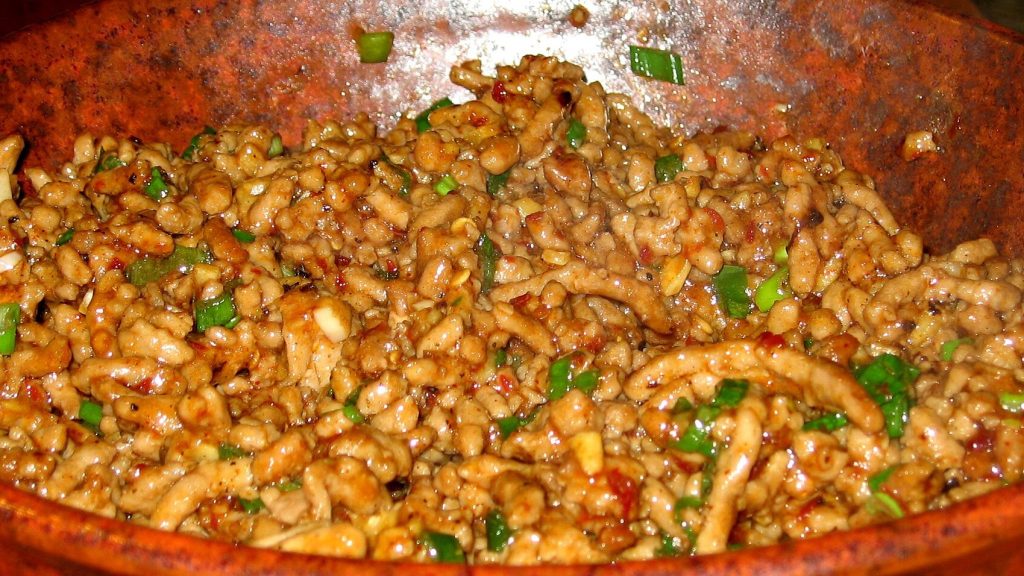
The first surprise about yu xiang rou si (鱼香肉丝) is in the name. “Fish-fragrant shredded pork” sounds as if a fish has been involved. In the standard Sichuan dish, there is no fish. The fragrance, 鱼香, is a sauce idea: pickled chilli, garlic, ginger, scallion, a little vinegar, soy, and a touch of sugar, cooked until the pork and vegetables taste bright, savoury, and lightly sweet-sour, with heat that you can usually negotiate.
This is a first-timer guide to 鱼香肉丝. It is not fish-fragrant eggplant (yu xiang qie zi) for first-timers, which applies a related sauce to eggplant. It is not Chengdu mapo tofu for first-timers, not Sichuan twice-cooked pork (hui guo rou) for first-timers, and not kung pao chicken. We will not invent a single official recipe, a chilli rating, or a restaurant ranking.
What should be on the plate
The pork is cut in thin shreds, not in large slices. You will often also meet wood-ear mushroom, and sometimes bamboo shoot, carrot, or green vegetables, all in similar shreds so that a single chopstick lift feels mixed. The sauce should coat, not drown, and it should be red-brown rather than a pale brown gravy.
Taste: savoury first, then a pickled tang, then sweetness, then heat. If you only taste sugar, or only taste oil, the kitchen had an off day or you are in a restaurant that is borrowing the name. If you taste actual fish, you may have been served a different idea; it is legal for a cook to experiment, but it is not what most people mean by the classic plate.
Texture matters. The pork should be tender, not dry threads. The vegetables should still have a little crunch. This is a stir-fry, usually eaten with rice, not a stew.
How to order, and how to talk about heat
The characters to show are 鱼香肉丝. If you say “fish pork,” you may confuse the server. A translation app is useful for the rest of the menu (translation apps honest guide); for this dish, the four characters are enough.
If you are sensitive to chilli, you can ask for a milder version—less spicy, 不要太辣 or 微辣, said calmly. A kitchen may agree, or it may tell you that the pickled chilli is already in the sauce and cannot be fully removed. Believe the second answer if you hear it. This is not a flavourless pork shred with ketchup. If you cannot eat chilli at all, choose something else.
In Chengdu, Chongqing, and other Sichuan or Sichuan-style restaurants, yu xiang rou si is a very ordinary “one of the vegetable-and-meat dishes to share.” It is not usually the spiciest thing on the table, and it is a friendly first Sichuan plate for people who are not yet ready for a dense mala hotpot (Chongqing hotpot for first-timers if you are in Chongqing; Chengdu has its own hotpot etiquette pieces). Pair it with a green vegetable and rice, not with three other heavy sauces.
Cousins that are not this dish
Fish-fragrant eggplant, 鱼香茄子, uses a related sauce on a different main ingredient (fish-fragrant eggplant (yu xiang qie zi) for first-timers). Twice-cooked pork is sliced, boiled then stir-fried, and tastes of chilli-bean paste more than of pickled “fish fragrance.” Kung pao brings peanuts and a different sweet-heat balance. Mapo tofu is tofu in a numb-hot sauce. You can like all of them and still order yu xiang rou si when you want shredded pork and rice, not a project.
Outside Sichuan, the dish travels well and also gets diluted. Hotel buffets may serve a tame, slightly sweet version. That can still be pleasant. If you want the sharper pickled-chilli edge, a busy local Sichuan restaurant at lunch is a better clue than a pan-China tourist menu.
At the table
This is typically a shared dish. If you are alone, it is still a reasonable bowl-with-rice lunch. Bones should not appear; this is shredded lean-and-fat pork, not a rib plate. If you need chopsticks confidence, relax: shreds are easier than whole fish (chopsticks etiquette for foreigners).
Pay with a wallet you have already tested (Alipay and WeChat Pay hub, why cash is still needed). If you are in Chengdu in late December, a warm plate of yu xiang rou si is a good midday reset after a damp outdoor morning (Chengdu early December first-visit planner). Order it because you want that sauce, and because you now know there is no fish to look for—only a name that has confused English menus for decades, and a dish that deserves to be eaten anyway.
Rice, leftovers, and a calm spice plan for the table
Order rice at the same time as the pork, unless a set lunch already includes it. Yu xiang rou si without rice is a sharp, rich plate with nowhere to land. If you are sharing, one meat dish, one green vegetable, and a soup or a cold starter is a steadier table than three bright sauces competing for the same bowl.
Related Lovely China reading
For payments, start with Alipay and WeChat Pay hub and WeChat Pay vs Alipay for tourists. For trains, keep high-speed rail first-timers guide and 12306 passport signup for foreigners handy. City hubs: Beijing first-visit guide, Shanghai first-visit guide. Connectivity: roaming vs local SIM honest guide, pocket Wi-Fi vs eSIM for China, offline maps for foreigners. Bookmark China travel tools page.
Practical checklist
- Confirm official rules on the relevant government, park, airline, or bank page near your travel week
- Screenshot bookings, tickets, and QR codes while you still have stable Wi-Fi
- Save hotel and attraction names in Chinese characters in your phone notes
- Carry passport, a backup payment method, and a small cash float (why cash is still needed)
- Test one small mobile payment before you rely on wallets at a gate or taxi
- Keep China travel tools page bookmarked for related Lovely China hubs
FAQ
Does yu xiang rou si contain fish?
In the standard Sichuan dish, no. ‘Fish-fragrant’ refers to a pickled-chilli, garlic, ginger, vinegar, soy, and sugar sauce, not to seafood.
How spicy is it?
It is usually a medium, bright heat rather than the most numbing dish on a Sichuan table, but kitchens vary. You can ask for milder; the cook may say the pickled chilli cannot be fully removed.
How is it different from fish-fragrant eggplant?
The sauce idea is related, but the main ingredient is shredded pork rather than eggplant. The eggplant dish has its own first-timer guide.
What should I order with it?
Rice, plus a green vegetable if you are sharing. It is a stir-fry meant to land on rice, not a stew and not a lone snack.
Notes for late 2026 travellers
Late December 2026 and the New Year week into 2027 bring colder mornings, earlier sunsets, and holiday crowds in many city hubs. Pack real winter layers in the north, and leave extra time on weekends and around 1 January.
This article does not invent ticket prices, opening hours, processing times, consular fees, or official statistics. When a number matters, verify it on the official site, app screen, or ticket board near your travel week.
If an official rule page disagrees with this guide, follow the official page. Lovely China orients English-speaking travellers; we are not an immigration, banking, or medical authority.