The mooncake sat on the lacquered tray, its crust glossy with egg wash, the imprint of a jade rabbit pressing into the lotus paste. Outside the courtyard gate, a grandmother lit a stick of sandalwood and set it in a ceramic burner, the smoke curling toward the round face hanging above the tiled roofs. A child tugged my sleeve and pointed upward. “She’s up there,” he said. “With the rabbit. Pounding medicine.” I had read the summaries in guidebooks, but standing in that lane with the scent of sweet bean and incense mixing in the cool autumn air, the story stopped being a myth and started being a neighbor’s memory.
The Woman Who Chose the Moon
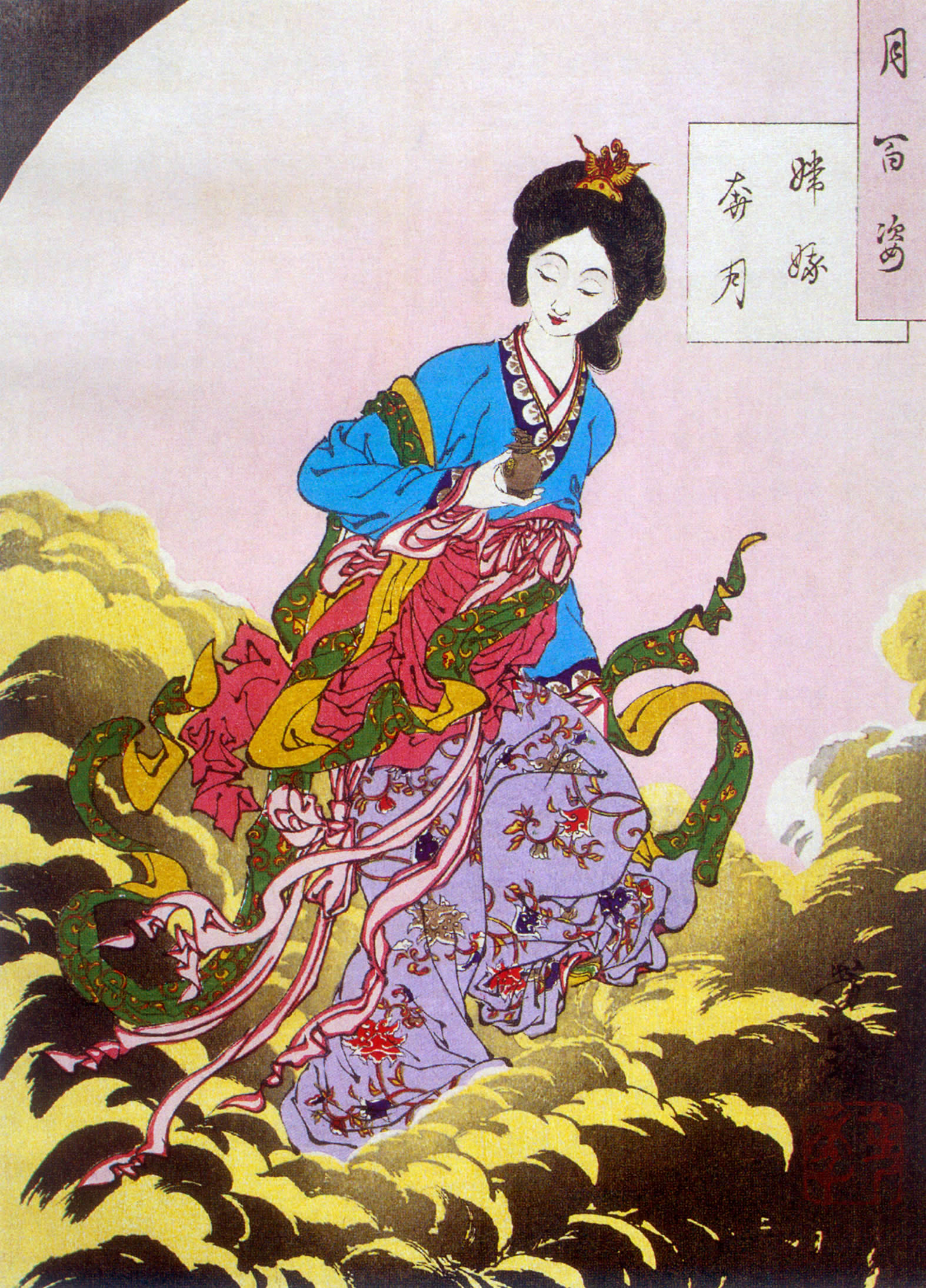
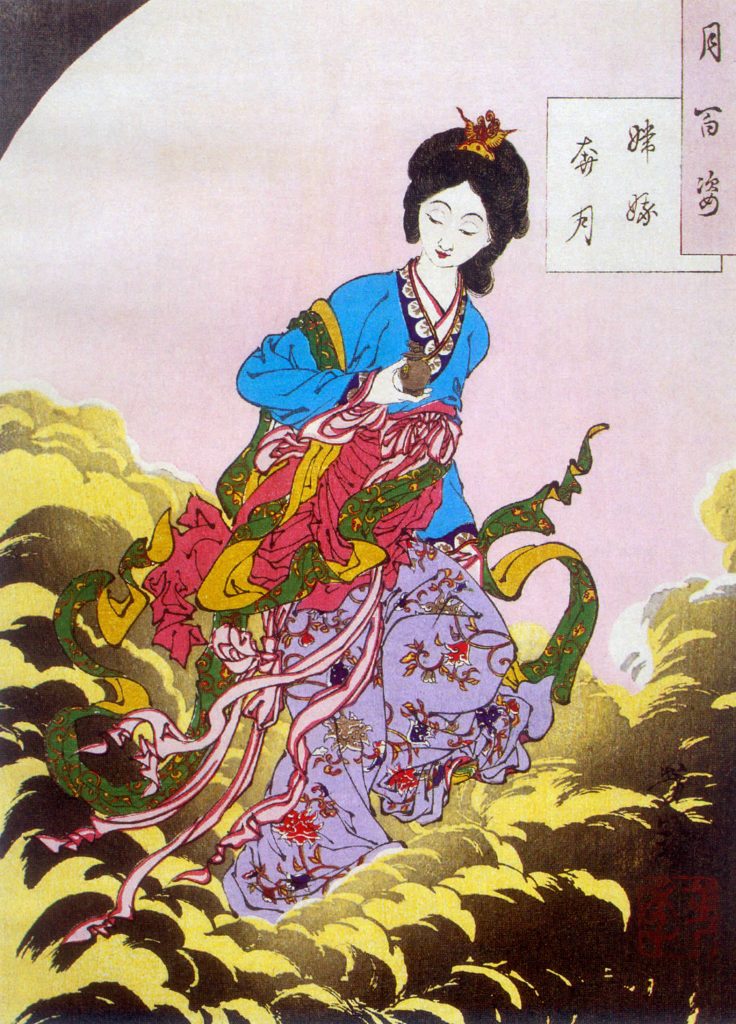
Ask ten people in China who Chang’e is and you will get ten slightly different answers. The skeleton of the tale stays the same: Hou Yi, the archer who shot down nine of ten suns scorching the earth, receives an elixir of immortality as reward. His wife, Chang’e, swallows it — either to keep it from a greedy apprentice or because she longs for the divine — and floats upward until the moon catches her. But the texture changes depending on where you sit. In a teahouse in Chengdu, an old man told me she drank it to escape a forced marriage. In a Hakka village near Meizhou, a woman stirring tea said she took it so Hou Yi could not become a tyrant with endless life. The details are not contradictions; they are the story breathing in different dialects.
What Arrives on the Altar
During the Mid-Autumn Festival, the fifteenth day of the eighth lunar month, families set a table in the courtyard or on the balcony. The moon is at its fullest, and Chang’e is closest to the world. The spread is practical and symbolic at once.
Mooncakes — thick, palm‑heavy rounds of golden crust wrapped around lotus seed paste, red bean, or salted egg yolk. The yolk sits in the center like the moon itself.
Pomelo — the thick rind peeled back to reveal pink segments; the word for pomelo (柚, yòu) sounds like “bless” (佑, yòu).
Water caltrops (菱角, língjiǎo) — black, horned nuts boiled in salt water, cracked open with a small hammer.
Taro — steamed whole, skin dusted with gray ash, flesh white and starchy.
Incense — three sticks, lit and bowed with three times, placed in a burner facing the moon.
Tea — usually oolong or aged pu’er, poured into tiny cups and left to cool as an offering.
If you are invited to a family gathering, do not reach for the mooncake first. Wait for the eldest to cut the cake into wedges — usually eight, one for each cardinal direction and the corners between. Take the piece handed to you with both hands. Eat slowly. The crust should shatter slightly, the paste yielding, the salted yolk grainy and rich on the tongue.
The Rabbit in the Palace
Chang’e does not live alone. The Jade Rabbit (玉兔, Yùtù) kneels beside a mortar in the Moon Palace (廣寒宮, Guǎnghán Gōng), pounding the elixir of immortality. In Beijing, I watched a paper‑cut artist snip a rabbit upright on its hind legs, pestle raised, from a single sheet of red paper in thirty seconds. “Give it to a child,” she said. “It keeps the cough away.” In old Shanghai alleyways, clay figurines of the rabbit — wearing armor, riding a tiger, or sitting cross‑legged — appear in shop windows weeks before the festival. They are not decorations. They are guardians.
If you buy one, choose a figure with the mortar clearly carved. The pestle should touch the bowl. A rabbit without tools is just a toy; a rabbit grinding medicine is doing its job.
What Locals Expect From a Visitor
You will not be quizzed on the Zhou dynasty divination text Guicang, nor on the name change from Heng’e to avoid the taboo of Emperor Liu Heng. What matters is presence. When the family gathers, stand beside the altar when the incense is lit. Bow your head. You may silently wish for your parents’ health or your own clarity — the moon does not check passports. Accept the slice of mooncake offered. Say “中秋快乐” (Zhōngqiū kuàilè) or simply “Happy Mid‑Autumn.” Do not ask “Is this religious?” The question marks you as someone who separates the sacred from the daily. Here, they are the same gesture.
A mistake I made my first year: I brought a box of expensive snow‑skin mooncakes — chilled, pastel, modern — to a rural household in Guangxi. The grandmother smiled, set them aside, and brought out her own hand‑pressed cakes, warm from the wood oven. The snow‑skin boxes sat untouched until I left. Lesson: match the kitchen, not the boutique.
Stories That Walk the Streets
In the weeks before the festival, storytellers set up stools in park pavilions. They do not recite the Classic of Mountains and Seas. They tell how Chang’e stole the herb because Hou Yi beat her; how the rabbit once leapt into a fire to feed a starving sage and was rewarded with the moon post; how Wu Gang, the woodcutter, chops a self‑healing osmanthus tree forever as punishment for laziness. The crowd — retirees, migrant workers, university students — laughs, argues, adds details. The myth is not fixed. It is a conversation between the dead and the living, conducted over melon seeds and tea.
If you linger near a pavilion, someone will offer you a seat. Listen. When the teller pauses, you may ask, “Why did she really drink it?” The answer will not be in any book. It will be the version that helped that teller survive a hard year. That is the version you carry home.
A Quiet Moment on the Balcony
After the feast, the dishes washed, the incense burned to ash, the family disperses. You step onto the balcony with a cup of cooling tea. The moon hangs white over the tile roofs, the plane trees, the distant construction cranes. No rabbit is visible in the shadows. No palace glitters. But the air carries the faint sweetness of lotus paste and the smoke of sandalwood. You understand then: Chang’e is not a figure in a textbook. She is the reason a stranger hands you a piece of cake. She is the pause in the noise when a city of millions looks up at the same light. You sip the tea. The night is ordinary. The moon is full. That is enough.