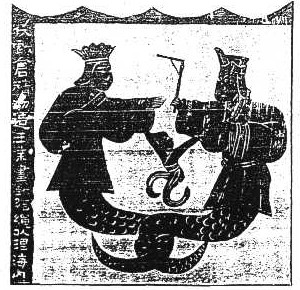
The minibus shuddered to a halt on a hairpin bend halfway up Fenghuang Mountain, the engine coughing in the thin air. Through the open door, the scent of pine resin and damp earth rushed in, mixing with the faint, metallic tang of incense smoke drifting down from the ridge. An elderly vendor leaning against a guardrail waved a bamboo pole strung with red prayer cards, shouting something about the Goddess’s birthday. I had come looking for stone tablets and architectural dates; instead, I found a mountain that still breathes with the stories of Nüwa, the mother who patched the sky.
The Summit Shrine Where the Sky Was Mended
The main temple complex sits on the highest accessible plateau, a cluster of grey-tiled halls built against a sheer cliff face. Unlike the manicured symmetry of major city temples, these structures feel grown rather than placed—rooflines follow the rock’s contour, and the courtyard paving yields to tree roots. Inside the central hall, the statue of Nüwa does not gleam with gold leaf. She is carved from dark, knotted camphor wood, her serpent tail coiled around a base of rough stone, human hands pressed together in the anjali mudra. Five colored stones—red, yellow, blue, white, black—are embedded in the altar table before her, representing the patches she melted to seal the heavens.
Locals approach differently than tourists. They do not pose for photos. An auntie from the village at the mountain’s foot kneels on a cushion, touches her forehead to the floor three times, then presses a packet of roasted peanuts and a bottle of millet wine into the offering burner. A young couple bows low, whispering a request for a child. The air is thick with the oily smoke of sandalwood coils hanging from the eaves. If you wait near the side door after the morning chanting ends, the resident Daoist priest—robes faded to the color of dried tea leaves—might pour you a cup of bitter green tea and point out the hairline fracture in the cliff behind the hall, the “scar” where the sky once split.
The Yellow Clay Kiln and the Cord-Made People
A fifteen-minute scramble down a stone stairway leads to a shallow cave shrine known as the Yellow Clay Kiln. No statue resides here, only a depression in the rock floor filled with ochre mud that never seems to dry out. Legend says this is where Nüwa scooped the first handfuls of yellow earth to mold the nobility, shaping each figure with her fingers, breathing life into them one by one. When fatigue set in, she dipped a vine rope into the slurry and flicked it across the land—droplets becoming the common folk, the “cord-made people.”
Visitors today buy small cloth bags of “sacred earth” from a nearby stall—usually a mix of local loam and ash from the incense burners. They rub a pinch between thumb and forefinger, feeling for the grit that signifies authenticity, then tuck the bag into a pocket or a child’s schoolbag for protection. I watched a grandfather teach his grandson to press a thumbprint into a fresh lump of the wet clay kept in a wooden trough by the cave mouth. “Make it deep,” he said. “So the Goddess knows whose hand it is.” The boy’s print joined hundreds of others hardening in the sun, a fragile archive of fingertips.
The Tortoise Leg Pillars and the Flood Stones
On the exposed western flank, where the wind scours the pines into bent bonsai shapes, stand four squat stone pillars. They are not carved columns but natural limestone towers, each capped with a flat slab. The myth claims Nüwa slaughtered a cosmic tortoise and used its four legs to prop up the collapsing corners of heaven. Geologists call them karst remnants; pilgrims call them the Pillars of Stability.
At the base of the northernmost pillar, a niche holds a collection of water-worn pebbles—white, grey, pink—brought by hikers from the river in the valley below. The tradition: you carry a stone up the mountain to “return weight to the sky,” a symbolic act of helping Nüwa bear the load. I saw a middle-aged man in a windbreaker place a smooth quartzite cobble reverently on the stack, then press his palm flat against the cold pillar, eyes closed, as if checking for a pulse. No sign forbids touching. No rope barriers exist. The mountain trusts you to know the difference between reverence and vandalism.
Festival Time: The Third Month Third
The mountain transforms on the third day of the third lunar month, Nüwa’s traditional birthday. The narrow access road clogs with chartered buses and private cars hours before dawn. Temporary stalls sprout along the switchbacks selling steamed corn on the cob, skewers of glazed hawthorn, and paper effigies of the five-colored stones. The main ceremony begins at the hour of the Dragon (7–9 AM) when the priest strikes the great bronze bell thirteen times—once for each month of the leap year cycle.
During the procession, a team of eight men carries a palanquin bearing a smaller, portable statue of the Goddess through the village at the mountain’s base. Firecrackers explode in strings, the smoke low and stinging. Women in embroidered Miao jackets dance the lusheng reed-pipe steps, silver headdresses flashing. If you are a foreign face in the crowd, someone will thrust a red-dyed boiled egg into your hand—eat it shell and all for luck, or peel it carefully and give the shell to the nearest child. Do not refuse. Do not ask what the characters on the egg mean. Accept the gesture, smile, and move with the flow.
Getting There Without Losing the Plot
Fenghuang Mountain sits about ninety kilometers west of the provincial capital. The most reliable approach: take a high-speed train to the county seat, then hire a driver for the final hour. The mountain road has been widened recently, but the last five kilometers remain a single lane with passing bays. Motion sickness tablets are wise if you are not used to mountain switchbacks.
- Base village guesthouses: Clean rooms, shared bathrooms, hot water only after 6 PM. Book by phone, not app; the owners rarely check online platforms.
- Footwear: Broken-in trail shoes. The stone steps are polished slick by generations of feet, and the cave floor stays wet year-round.
- Cash: Small denominations. The incense vendor, the clay seller, the egg boiler—none take mobile pay.
- Timing: Arrive before 9 AM on weekdays for quiet. Weekends and the third lunar month demand patience.
There is no entrance ticket booth. A donation box sits at the trailhead; twenty yuan is customary, more if you light the big coil. The temples are active religious sites, not museums. Shoulders and knees covered. Voices low. Photos of statues only with permission—ask the attendant sweeping the hall floor.
What Newcomers Get Wrong
First mistake: treating the myths as dead history. The stories are not exhibits; they are operating instructions for the landscape. When a villager points to a fissure and says “the sky cracked here,” they are not speaking metaphorically. Second mistake: hunting for the “original” temple. Fire, war, and the Cultural Revolution burned or smashed every structure at least twice. The current halls date to the 1980s reconstruction. The authenticity lives in the continuity of practice, not the timber.
Third mistake: skipping the valley river. The pebbles you carry up matter because they come from the water Nüwa calmed after the flood. Walk the riverbank at dusk when the herons hunt in the shallows. Pick a stone that fits your palm. Feel its temperature. That is the real pilgrimage—the weight in your hand, the climb in your calves, the smoke in your hair when you finally reach the summit and press your palm against the cold pillar, checking, like everyone before you, if the sky still holds.