My name is Liu Dehou. I’m from Shandong, and for twenty years I’ve been steaming buns in a small county town called Chayu in Tibet.
They call it a county town, but it’s really just two streets. One is the main road where the national highway passes through, and the other is a narrow stone-slab path leading to the monastery—so narrow that two cars can’t pass each other. The buildings on both sides are old, with walls made of rammed earth and wooden window frames hung with prayer flags. The most impressive structures in town are the county hospital and the white-walled, golden-roofed monastery—one for the body, one for the soul, standing at opposite ends.
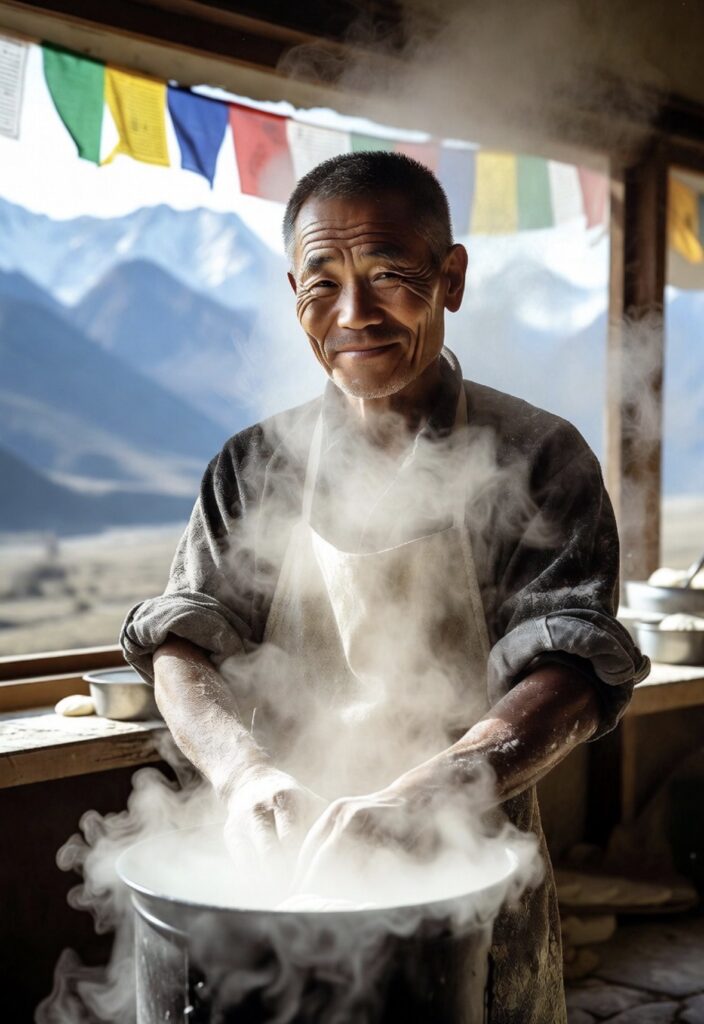
The reason I came here back then is almost funny. In 2003, I owed some debts back home. An old fellow from my hometown who ran transport told me that Tibet needed people who could make wheat flour foods, so I grabbed three hundred yuan and a train ticket and left. When I arrived, I discovered that locals mainly ate tsampa and Tibetan noodles. Steamed buns were only occasionally bought by a few Han cadres and Sichuan shopkeepers in town.
But I was already here. I had to survive.
I rented a tiny storefront at the end of the main street—so small that turning around would make you hit the wall. I set up a stove and a large steamer outside the door and started making dough at three o’clock every morning. To be honest, for the first six months, the buns I sold each day weren’t even enough for me to eat. But there’s one thing I’m good at: I’ve been kneading dough for over twenty years. The buns I make are snow-white, fluffy, and soft. Break one open and the honeycomb structure is perfectly even. One bite, and there’s a pleasant sweetness.
Chayu sits at over two thousand meters elevation—lower than Lhasa—but water boils at just over ninety degrees. The first month, my buns were always a bit sticky. Later, I figured it out: let the dough proof longer and add a little alkali. After that, they tasted almost like the ones I made back in Shandong.
Old Zhou, who ran the grocery store next door, was the first person I won over. He was from Leshan, Sichuan, and had been in Tibet for nearly thirty years—he’d seen everything. One day I handed him a fresh bun. He took one bite, paused for three seconds, and said, “Boss Liu, your buns taste better than my mom’s.” I asked if his mom was from Shandong. He said no, she was Sichuanese, and her buns were hard as rocks.
Old Zhou helped me open up the market. He told everyone how good my buns were and brought Tibetan locals who came to his shop over to me. Gradually, teachers from the county primary school started buying breakfast from me, then the young nurses from the health center, and eventually even the county government cafeteria placed regular orders.
Life went on like this, day after day. I partitioned off a small room behind the shop, put in a camp bed, and slept there after selling buns during the day. Winters were bitterly cold, but the stove stayed lit all night, and the dough proofed slowly beside it. The whole room was filled with a sweet, slightly sour aroma of fermented dough. That smell kept me company for twenty years—longer than any wife ever did. Of course, I didn’t have a wife. I’d just gotten divorced when I came to Tibet, and never remarried.
One spring day in 2006, a lama appeared in front of my bun shop for the first time.
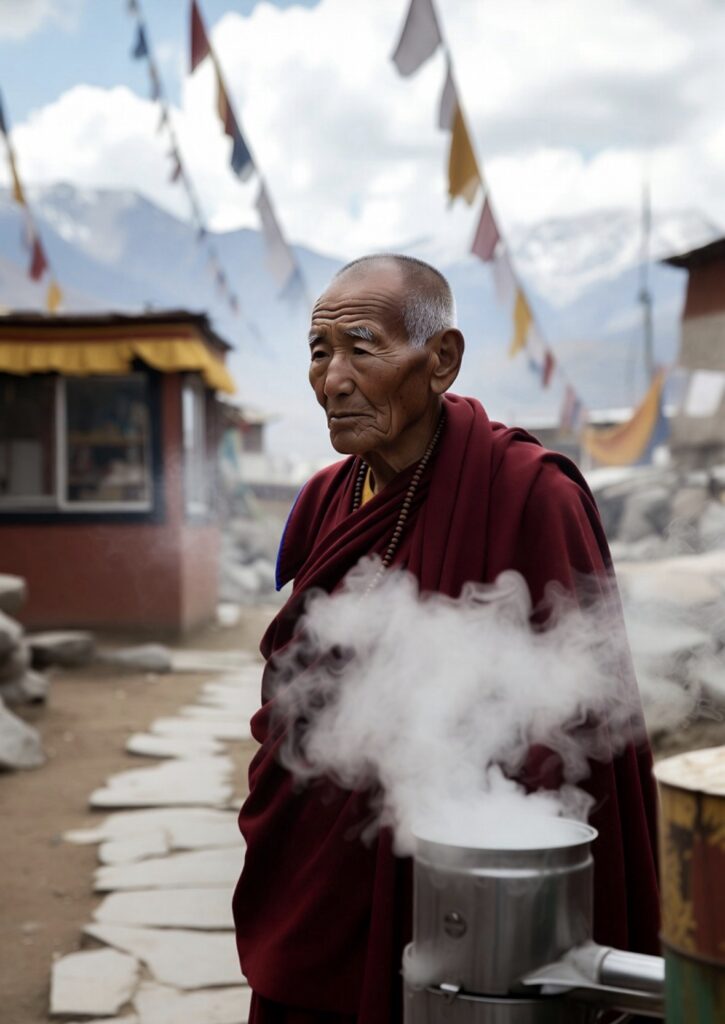
I had just taken the second steamer tray out, white steam billowing like clouds. When I looked up, I saw a man standing behind the vapor.
He looked about forty, wearing a dark red monastic robe that left one arm bare. His skin was tanned dark and shiny by the plateau sun. He wasn’t tall, but he stood very straight. His face showed little expression, but his eyes were bright—like mountain lakes untouched by pollution. He held a string of prayer beads, his lips moving slightly as if chanting.
I was momentarily stunned.
Not because he was a lama—I’d seen plenty in my three years in Chayu—but because he stood completely still, staring at the buns in my hand. His gaze wasn’t like someone looking at food. It was more like he was looking at something rare and wondrous, with childlike curiosity.
“Master, would you like some buns?” I asked in Mandarin with a heavy Shandong accent.
He didn’t speak, just nodded.
I took a plastic bag, put in two of the largest buns, and handed it to him. He took it, looked down at the buns, then up at me. His lips moved as if he wanted to say something, but in the end he said nothing and turned to leave.
I stood behind the stove, watching his robed figure walk slowly down the stone path toward the monastery on the hill. His steps were measured, each one landing on a steady rhythm.
“That master didn’t pay?” Old Zhou had appeared at my shop entrance at some point, cigarette in hand, squinting at the retreating figure.
“Maybe he forgot,” I said. “Two buns aren’t a big deal.”
Old Zhou took a drag and said nothing more.
I thought it was just a small incident and would soon be forgotten.
But the next month, on almost the same day and at the same time, the lama came again.
He wore the same robe and stood quietly in front of the stove, staring at the fresh buns. I recognized him and smiled. “Master, you’re back?”
He nodded without speaking.
I packed two buns for him again. This time I hesitated a little, but my hands kept moving. He took them and stayed a bit longer. He looked at the buns, then at my stove, and finally at my flour-covered hands, staring for several seconds.
Then he left again.
Still without paying.
This time I watched his back until he disappeared around the bend at the end of the stone path. Old Zhou poked his head out again. “No money again?”
“Maybe he really forgot.”
“Once a month, and he forgets every time?” Old Zhou stubbed out his cigarette on the doorframe, his voice carrying the weariness of experience. “Boss Liu, let me tell you—some of these practitioners don’t carry money. They see begging for alms as perfectly natural. Giving to them is accumulating merit.”
I didn’t reply. I’m not a Buddhist, but after years in Tibet, I understood some things. People here could split their own food and give half to a passing monk without blinking. Though I wasn’t Tibetan, since I made my living on this land, I had to respect some customs.
The third month, he came again.
I gave him two buns as usual. This time I looked at him more carefully. His robe was old but spotlessly clean. The cuffs were frayed but had no stains. His fingernails were short and neat. His fingers, which held the prayer beads, were long and strong, like those of someone who did manual work.
When he took the buns this time, he finally spoke.
“Thank you,” he said. His Mandarin had a heavy accent. Each word seemed squeezed from deep in his throat, but he spoke earnestly, one syllable at a time.
“You’re welcome,” I replied.
He stood there a little longer, then reached into his robe and handed me something. It was a stone strung on a red cord, dull gray, with some characters I couldn’t read carved on it.
“Blessed,” he said, then turned and left.
I stood there holding the stone for a long time. Old Zhou poked his head out again. “At least this time you got a stone in return.”
I ignored him and hung the stone on the wall beside the stove, next to the jars of seasoning.
And so it became a regular thing.
Every month or so, roughly every twenty to thirty days, the lama would appear in front of my shop. He never spoke more than a few words. He took the buns and left, never paying. Sometimes he would fumble in his sleeve and give me something in return—a small bag of tsampa, some dried meat, a piece of cheese, or a leaf picked from somewhere.
Once he brought a small bottle of yak butter, homemade by herders. It was golden and translucent, with a rich milky fragrance. I used it to fry some youtiao (fried dough sticks). Old Zhou ate three and said he’d never tasted anything so delicious in his life.
Another time he brought nothing but stood in front of my stove for a long time. That day, Chayu had its first snow of winter. The flakes were light and melted as soon as they landed on his robe. He stood for a full ten minutes, then suddenly reached out and straightened my crooked “Shandong Steamed Buns” sign, which was made of cardboard with characters I had written myself. After adjusting it, he stepped back, examined it, made one more small correction, and only then walked away satisfied.
Watching his back, I suddenly felt that this man wasn’t just buying buns—he was performing some kind of ritual. Every month, he walked down from the mountain, along the stone path, to my shop, took two buns, left something, and walked back. Like the hands of a clock, precise and never missing.
The years passed. One year, two, three, five.
Chayu changed a lot. The main road was paved with asphalt, streetlights were installed, the primary school got a new building, and a square was built. Old Zhou’s grocery became a small supermarket. He used a cellphone to order goods and no longer needed to drive a tractor to Nyingchi. My little bun shop moved across the street to a larger space, and I upgraded to a big steamer that could handle eight trays at once.
But I never raised the price of the lama’s buns.
I still gave him two. Whether buns sold for one yuan or two yuan each, his two were always free.
Later I learned his name—not from him, but from Dolma, who sold Tibetan noodles next door. Dolma’s mother-in-law had lived on this street for fifty years and knew everyone’s business. She said the lama was named Tenzin. He practiced at the Gongga Monastery on the hill and rarely came down. The monastery had several other monks, including some old lamas and young ones, but Tenzin was the quietest.
“He’s in charge of copying scriptures,” Dolma’s mother-in-law said, her voice raspy like wind over sand. “He gets up before dawn, lights a yak butter lamp in the scripture hall, and copies until sunset. His handwriting is the best in the monastery. Wealthy pilgrims all want a copy of scripture written by him.”
After hearing that, the little things Tenzin gave me felt different—the gray stone, the leaf, the bag of tsampa—all seemed to carry the scent of the butter lamp in the scripture hall and the warmth of words I couldn’t read.
In the sixth year, something happened.
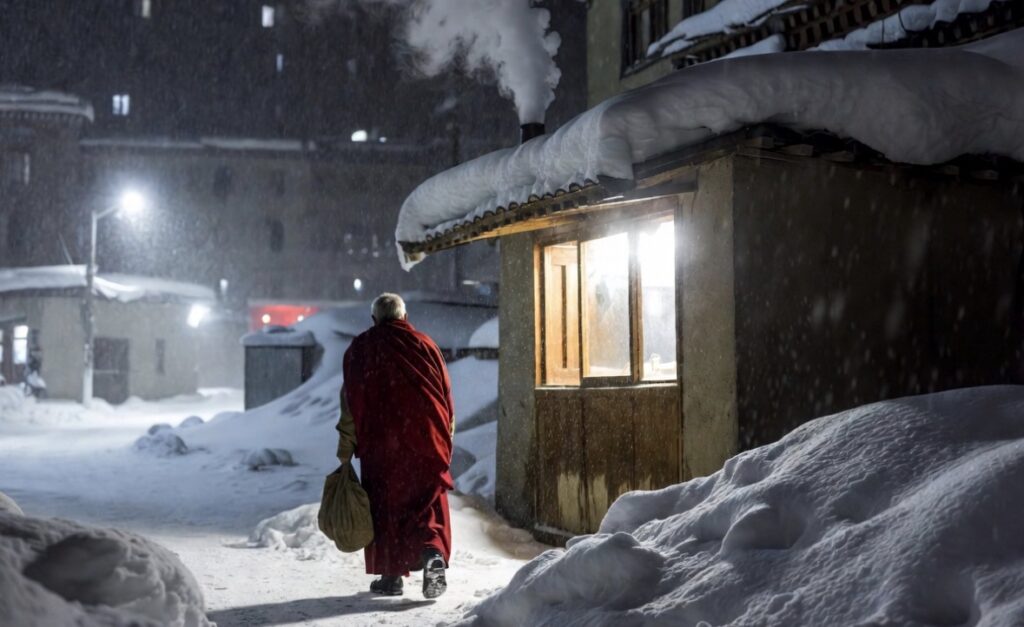
That winter was especially cold. Chayu had a massive snowfall—the kind you rarely see even in Shandong. It snowed heavily for a day and night, leaving snow nearly knee-deep. Power lines snapped, and the whole town lost electricity for three days. I couldn’t run the steamer or light the stove, so the shop closed.
For three days I huddled under a quilt, surviving on instant noodles and hot water Old Zhou brought. On the third night, after the snow stopped, I was dozing on the camp bed when I heard knocking on the rolling shutter.
Knock. Knock. Knock. Three steady knocks.
I got up, opened the door. Cold wind and snow rushed in, making me shiver. A man stood outside, covered in snow. The hem of his robe was soaked and crusted with ice. His face was red from the wind, frost hung on his eyelashes, but his eyes were still bright—like two butter lamps.
It was Tenzin.
He stood in the snow, holding something wrapped in cloth. When he saw me open the door, he handed it over and said in his deliberate way: “Eat.”
I took it and unwrapped the cloth. Inside were several pieces of barley bread and a small jar of yak butter. The bread was still warm, and the rich milky scent of the butter stood out sharply in the cold wind.
Holding the bundle at the doorway, I suddenly didn’t know what to say.
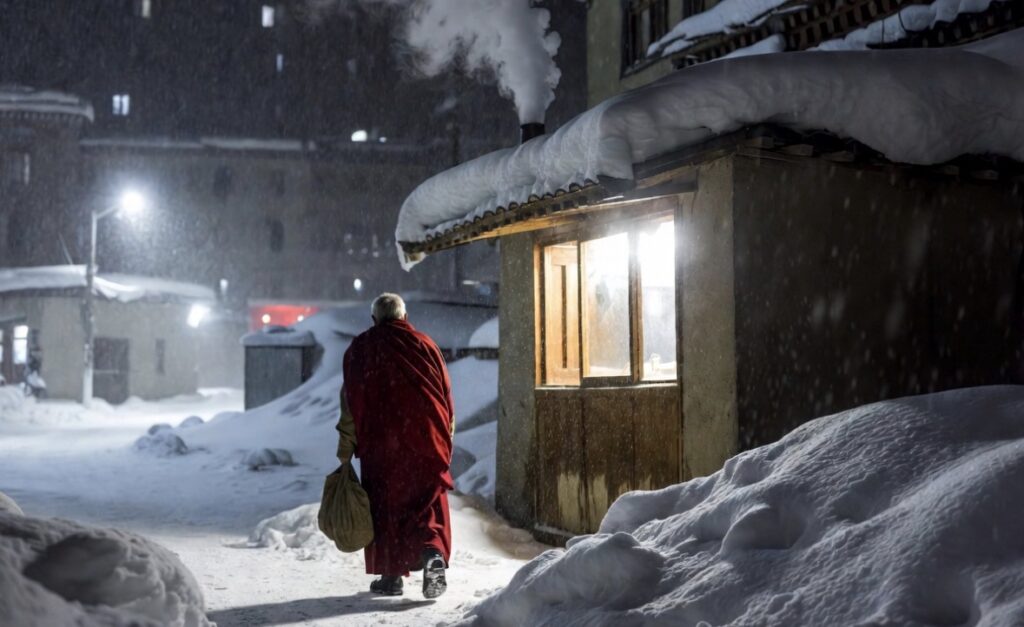
Tenzin looked at me, nodded, and walked back into the snowstorm. I watched him trudge up the hill, his robe flapping in the wind. After a few steps, he stopped, turned to look at me once more, then continued on.
That night, I sat on the camp bed, broke the barley bread into pieces, soaked it in hot water, and ate it with the yak butter. The bread was a bit hard, but the more I chewed, the sweeter it became. After swallowing, my mouth was filled with the sweetness of grain.
I remembered winters back in Shandong. My mother would bake flatbreads on the stove, adding a bit of salt to the flour, browning both sides. When I was little, I’d crouch by the stove waiting. My mother would tear off a small piece, blow on it so it wouldn’t burn me, and put it in my mouth.
I suddenly realized I hadn’t thought about these things for a very long time.
For years on the plateau, I’d been kneading dough, proofing it, steaming buns—my days turning like a prayer wheel. I thought I had forgotten those memories and those people. But they had only been buried deep down, like seeds under permafrost, waiting for the right moment to sprout.
After that winter, whenever Tenzin came, I started doing one extra thing.
I would slip two sugar buns into his bag.
Sugar buns are a Shandong specialty—steamed buns with a spoonful of sugar inside, pinched into a triangular shape. When steamed, the sugar melts. One bite and it’s sweetly delicious. I loved them as a child, and later made a few when steaming. They didn’t sell much, so I mostly ate them myself.
The first time Tenzin received a sugar bun, he held it in his palm and examined it for a long time, as if it were a rare treasure. He broke one open; the warm sugar filling flowed out. He dipped his finger in, tasted it, and his eyes suddenly brightened.
Just for a moment. Then his face returned to its usual expressionless state. He wrapped the bun carefully, put it in his robe, nodded to me, and left.
But I knew he liked them.
After that, every time he came, he would first check inside the bag. If it was regular buns, he left right away. If he felt the plump triangular shape, he would take it out first, hold it in his hand, and only open and eat it after walking a few steps.
Once I noticed this, I always put two sugar buns in his bag.
Sugar wasn’t expensive, but in this small county town at over two thousand meters, getting a bag of white sugar required traveling a long way.
In the tenth year, Old Zhou moved away.
He had run his shop in Chayu for fifteen years, saved enough money, and returned to Leshan to buy a house for his son. On the day he left, he invited me for a drink. We sat in his empty shop drinking loose barley liquor—sweet and sour, with a strong kick.
“Old Liu,” Old Zhou said, his face flushed and tongue a bit thick, “what are you doing this for? You’re here alone, no wife, no kids, just kneading and steaming buns for ten years.”
“I don’t know what I’m after,” I said. “I just keep kneading, and the days pass.”
“How much longer do you plan to stay?”
I thought for a moment. “I don’t know. Maybe when I can’t knead anymore, I’ll go back to Shandong.”
Old Zhou stared at me, then smiled. “You won’t leave. You’re like me. You talk about going back, but deep down you know you can’t.”
He stood up, patted my shoulder, stuffed the remaining half bottle of liquor into my hand, picked up his luggage, and left. His figure disappeared under the streetlights. The main street was empty except for the wind.
I carried the bottle back to my shop. The water on the stove was still boiling. Standing at the door, I suddenly heard the sound of chanting from the mountain—low and deep, like the earth breathing.
At that moment, I understood that Old Zhou was right.
I couldn’t go back. Not because of the debts or losing face, but because this land had grown into my bones. The white mist of flour in the early mornings, the thin cold air of the plateau, the white teeth of smiling Tibetan customers, and the dark red figure who appeared in front of my shop every month—these things had somehow become more real and more solid than my memories of Shandong.
In the fifteenth year, Tenzin grew old.
His robe was still clean, but when he walked, his legs weren’t as straight. He still turned his prayer beads, but his finger joints had become thick and gnarled like old tree roots. His hair had turned gray—not completely white, but a frost-like gray seeping from black, like grass covered in winter frost.
But he still came every month.
He came in snow and in rain. Once, after a heavy downpour that washed out the road, I thought he wouldn’t come. But in the afternoon, when the rain eased, I saw a soaked figure walking from the end of the stone path, clutching something wrapped in plastic.
He unwrapped it to reveal a string of dried mushrooms—brown, wrinkled, smelling of damp forest earth. When he handed them to me, his hands were shaking—not from cold, but from age. He could no longer hold things steady.
I took the mushrooms and gave him the two sugar buns I had prepared.
He took them but didn’t leave immediately. He sat down on the wet step in front of my shop, took out the sugar buns, and ate them slowly.
It was the first time I had ever seen him eat the buns.
He ate very slowly, breaking off tiny pieces, chewing for a long time before swallowing. His teeth were bad; he had to tilt his head and grind with one side. At the end, he turned the plastic bag inside out, poured the crumbs into his mouth, then folded the bag neatly and tucked it into his sleeve.
After eating the two sugar buns, he stood up and looked at me.
The look was calm, but for some reason, a difficult feeling surged in my chest—something stuck in my throat that I couldn’t swallow or spit out.
I said, “Master Tenzin, come again next month.”
He didn’t speak. He just looked at me, then turned and left.
In the nineteenth winter, I turned sixty.
That year I fell seriously ill. My lungs were damaged. I spent half a month in the county hospital. The doctor said it was related to kneading dough—long-term inhalation of flour dust had coated my lungs like paste. If I continued, it would become a big problem.
I asked what I should do. He suggested changing jobs and preferably leaving the plateau for lower altitude to recuperate.
I lay in the hospital bed thinking for a long time. Through the window, I could see the monastery on the mountain, its white walls and golden roof gleaming in the sunlight. In that direction, there was a man who, on a certain day each month, would walk down the mountain to my shop for two sugar buns.
After half a month in hospital, I came out twenty pounds lighter, unsteady on my feet. Back at the shop, the stove was cold, the pot was cold, and the dough I had left on the board had dried and cracked.
I sat in the shop in a daze. Old Zhou had long left. Dolma’s mother-in-law had passed away. The people on this street who knew me had changed several times. The only person who still came every month—would he come this month?
I didn’t light the stove that day. I was too tired; standing for a while made me breathless. I closed half the shop door and leaned against the wall, dozing off.
After some time, someone knocked on the rolling shutter.
Knock. Knock. Knock. Three times.
I woke with a start. When I pulled the door open too quickly, everything went black for a moment.
Tenzin stood outside.
He had aged too—more than me. His back was bent. His steps were small and shuffling, his left leg seemed lame, pausing with every step. But his clothes were still clean, and his eyes were still bright, though the light had softened, like the last glow of sunset.
When he saw me, he was stunned.
Later I realized he probably hadn’t seen me looking so wretched—unkempt beard, face sunken, leaning against the doorframe like a paper figure.
He looked at me for a long time, then took something from his robe and handed it to me.
It was a khata—a white silk scarf, folded neatly, like a cloud pressed flat by time.
For the first time, he spoke to me in a complete sentence.
“Boss Liu,” he said, his voice hoarse. Each word was difficult, but none were wrong. “You are a good person. May the Buddha bless you.”
I took the khata, my hand trembling.
For the first time, I also spoke a full sentence to him: “Master Tenzin, you don’t need to bring anything anymore. Whenever you want buns, just come. They’re yours anytime.”
He didn’t say thank you. He simply removed the string of prayer beads from his wrist and wrapped them around mine. The beads had been turned for countless years; each one was smooth as lacquer, carrying his body heat.
Then he turned and left.
He walked very slowly, stopping every few steps to catch his breath. He walked down the stone path, around the bend, without looking back.
I hung the khata above the stove, next to the gray stone. I wore the prayer beads on my wrist even while kneading dough. Flour worked its way into the spaces between the beads, mixing with the sweat stains from Tenzin’s decades of use, creating an indescribable color.
The twentieth year arrived, and the story still wasn’t over.
Last autumn, the monastery sent a young lama to my shop.
The young lama was named Tashi. He was in his early twenties, spoke much better Mandarin than Tenzin, and smiled like a child. He came carrying a copper butter lamp with half a lamp of yak butter still burning inside.
“Boss Liu,” Tashi spoke quickly, like a string of firecrackers, “Master Tenzin asked me to come. He said he won’t be able to come anymore and wanted me to tell you.”
My heart sank.
“Is he sick?” I asked.
Tashi shook his head, thought for a moment, and said, “Not exactly sick. He’s old, and his legs don’t work well anymore. He can’t walk such a long distance. The other elders in the monastery also told him not to go down the mountain. The road is too dangerous—if he fell, what then?”
I nodded, took two fresh sugar buns from the steamer, bagged them, and handed them to Tashi.
“Please give these to him,” I said.
Tashi looked at the sugar buns and suddenly smiled. “Master Tenzin told me about these. He said your sugar buns are the best thing in all of Chayu. I didn’t believe it—how good could sugar buns be? Looks like I’ll get to try them today.”
“These aren’t for you to try,” I said. “They’re for Master Tenzin.”
Tashi stuck out his tongue, then solemnly took the bag and tucked it into his robe. He placed the copper butter lamp on my worktable and said, “This is what Master Tenzin asked me to give you. He chanted in front of this lamp for ten years. The flame never went out. He wants you to keep it in your shop to light your way.”
The butter inside was still burning. The flame was small but steady, flickering slightly in the thin plateau wind.
After Tashi left, I placed the lamp beside the stove. The light reflected on the white khata hanging on the wall, on the gray stone, and on the prayer beads on my wrist covered in flour.
That night I didn’t turn on the electric light. I just sat in the shop with the single butter lamp, lost in thought. Occasionally a car passed outside, its headlights sweeping in, brightening then darkening.
I suddenly remembered a detail from many years ago.
The first time Tenzin came, after I gave him the bag of buns, he looked at the buns, then at my stove, and finally at my flour-covered hands for several seconds.
At the time, I didn’t understand what he was looking at.
Now I think I do.
He wasn’t looking at my hands. He was looking at what these hands had done.
In this small county town on the plateau, a stranger from Shandong kneaded dough, proofed it, and steamed buns. Day after day, year after year. What had these hands done on this land? Nothing special. They simply turned flour into buns and handed those buns to people who passed by.
But for a practitioner, perhaps that was enough.
Just like the scriptures he copied. He copied for a lifetime, through wind and sun. The words left on paper would eventually be blown away by the wind. But while copying, each stroke was real, and each thought of the heart was real.
This morning I steamed another batch of sugar buns.
When I lifted the steamer lid, hot steam rushed out, covering my face. In the white vapor, I suddenly saw a dark red figure slowly walking toward me from the end of the stone path.
I blinked. The steam dissipated. The stone path was empty, with only the wind blowing a few fallen leaves.
It wasn’t him.
But who knows?
Maybe next month, or the month after, or on some snowy winter day, when I lift a steaming tray from the stove and the white vapor billows out, an old lama in a worn red robe will stand behind the steam, looking at the buns in my hands with eyes as clear as mountain lakes.
He will say, “Boss Liu, two sugar buns.”
I will say, “Alright, here you go.”
He still won’t pay.
But he doesn’t need to.
Because he already has. Every time he came, he gave. Not the stone, not the tsampa, not the yak butter, not the khata, not the lamp.
It was the very act of him appearing at my shop door every month.
For twenty years, without missing once.
On this plateau where anything can disappear suddenly, this one person, in this way, told a wanderer who had drifted half his life: There is someone here who will come to see you once every month.
You are alive, and he knows it.
As long as you live well, he will come.
That is enough.
The water on the stove is boiling again. I put the steamer lid back on and wiped my hands on my apron. The dough on the board is still slowly proofing, waiting to become trays of snow-white buns tomorrow morning.
The copper butter lamp is still burning. The flame flickered once, then steadied again.
Outside, the prayer flags flutter loudly in the wind. The sky is very blue, and the clouds are very white.
Twenty years in Chayu. Twenty years of a bun shop.
Twenty years of wind and snow. Twenty years of sugar buns.
That lama who never paid taught a steamed bun master from Shandong what it truly means—to come.