The minibus coughs to a halt on a hairpin bend, doors folding open onto a gust of pine-scented air. Below, the valley is a quilt of tea terraces and grey-tiled roofs; above, the ridge disappears into a low ceiling of cloud. A monk in grey robes walks past, wooden clogs clicking on stone, a string of sandalwood beads clicking faster in his fingers. This is the first breath of Jiuhua — cool, vertical, and quietly insistent.
Reaching the Mountain
Most travelers enter through Chizhou or Tongling. High-speed trains from Nanjing, Hefei, or Shanghai pull into Chizhou station in under three hours. From the station forecourt, green-and-white tourist buses leave every forty minutes for the mountain’s south gate; the ride climbs forty minutes through bamboo corridors and villages where drying persimmons hang like orange lanterns. If you arrive at Tongling, the direct coach takes a little longer but skips the city transfer. Taxis wait at both stations, but drivers often quote a flat fee that doubles after sunset — agree on the meter or a price before the door shuts.
Driving yourself? The G50 expressway exits at Qingyang, then S221 winds upward. Parking lots at the main gates fill by mid-morning on holiday weekends. Arrive before eight, or plan to park at the lot near Jiuhua Street and take the shuttle — your knees will thank you later.
Moving Around the Slopes
Three cable-car lines stitch the major zones together. The east line runs from Jiuhua Street to Tiantai Peak — highest point, shortest walk. The west line connects the gate to Huacheng Temple area. The central line, newer and quieter, links Baisuigong to Zhiyuan. Cabins leave every five minutes; a one-way ticket costs roughly the price of a bowl of beef noodles in town. Queues snake back at sunrise and again at three in the afternoon when tour groups descend.
If you prefer boots, the stone-paved pilgrimage paths are wide enough for two abreast. Signposts show distances in li — two and a half li to Ganlu, four to Zhiyuan. Steps are uneven, worn smooth by centuries of sandals. Carry a collapsible stool; the flat rocks beside shrines make perfect rest spots when the mist rolls in.
Temples Worth the Climb
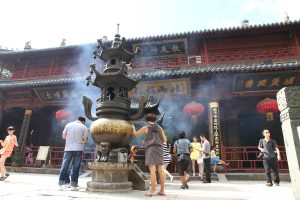
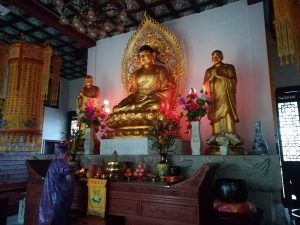
Huacheng Temple sits at the mountain’s heart, founded in the Eastern Jin dynasty and rebuilt more times than anyone counts. The main hall smells of aged cypress and candle wax. Inside, a gilt Dizang Bodhisattva gazes down from a lotus throne, fingers forming the wish-granting mudra. Monks chant the Dizang Sutra at six each morning — arrive early, sit on the cold flagstones, and let the low vowels settle in your ribs.
Baisuigong, the Hundred-Year Palace, clings to a sheer face above a waterfall. Its claim to fame is the mummified body of Monk Wu Xia, seated in a glass case, nails grown long as rice grains. Pilgrims press palms to the glass, whispering prayers for longevity. The courtyard’s gingko drops golden fans in late autumn; sweepers gather them into piles that smell like crushed almonds.
Ganlu Monastery — Sweet Dew — perches on a knife-edge ridge. The beamless brick hall, built without a single nail, has survived earthquakes that toppled lesser structures. Inside, a single bronze bell hangs from the ceiling. Strike it once with the wooden log provided; the tone hangs for thirty seconds, vibrating through the floorboards.
Zhiyuan Monastery feels more lived-in. Novices dry laundry on lines strung between magnolia trees. The vegetarian canteen serves lunch at eleven sharp: rice, braised bamboo shoots, tofu skin knots, and a bowl of clear radish soup. Eat in silence, return your tray to the hatch, bow to the server — no words needed.
Trails That Reward
The classic loop starts at Jiuhua Street, ascends via the ancient flagstone staircase to Huacheng, continues to Ganlu, then drops down the west flank to Baisuigong before the cable car returns you to the gate. Six hours at a pilgrim’s pace, eight if you pause for tea at every pavilion.
- Sunrise Ridge Trail — 3 km from Tiantai cable-car top station to the East Cliff platform. Rocky, exposed, wind-blasted. First light paints the sea of clouds copper.
- Bamboo Whisper Path — Gentle 2 km contour line linking Zhiyuan to a hidden tea plantation. Farmers still hand-roll green tea here; they’ll sell you a vacuum brick for half the shop price.
- Waterfall Staircase — Steep descent beside the cascade behind Baisuigong. Moss-slick steps, handrail only on one side. Not for wet days.
Carry a headlamp. Cloud banks can swallow the trail by four in the afternoon, and the last cable car descends at five-thirty. Mobile signal flickers; download offline maps the night before.
Eating and Sleeping on the Mountain
Guesthouses cluster around Jiuhua Street and the Huacheng zone. Rooms are basic: firm mattress, shared squat toilet, hot water from a solar tank on the roof. Proprietors speak dialect, not Mandarin — point at the bed, hold up fingers for nights, nod. A double with private bath runs about the cost of a mid-range city hotel; the view of incense smoke curling through pines is the real rate.
Meals are vegetarian by default. Breakfast: steamed corn bun, pickled mustard stem, millet congee. Lunch and dinner add seasonal greens — fiddlehead fern in spring, lotus root in autumn — stir-fried with garlic and a splash of vinegar. No alcohol sold on the mountain; the nearest beer is a twenty-minute walk down to the gate village.
Common Missteps
- Wearing city sneakers. Stone steps eat soft soles by noon. Trail runners with grip or light hiking shoes save ankles.
- Buying “blessed” bracelets from vendors at every gate. The real ones are sold inside temple shops, profits marked for restoration. Street versions are plastic from Yiwu.
- Skipping the morning chant. Tour groups arrive at nine. The six a.m. service at Huacheng is the only time the hall feels like a sanctuary, not a checkpoint.
- Assuming all paths are circular. Several ridge trails dead-end at cliff temples. Check the map board at each junction or you’ll backtrack in fading light.
- Photographing monks without asking. A slight bow and a pointed camera usually earn a shake of the head. Respect it.
When the last cable car grooms down the mountain, the ridge exhales. Incense ash settles on the steps. A night watchman lights a single lantern at the gate. You carry the scent of pine and sandalwood in your sleeves all the way back to the train — proof you walked where the clouds live.