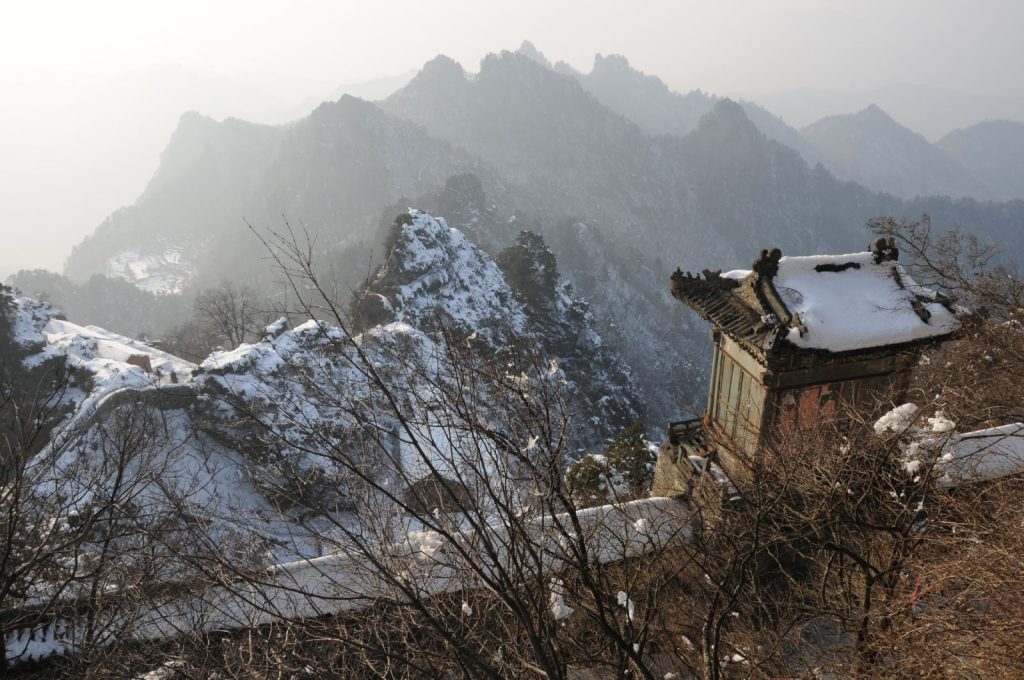
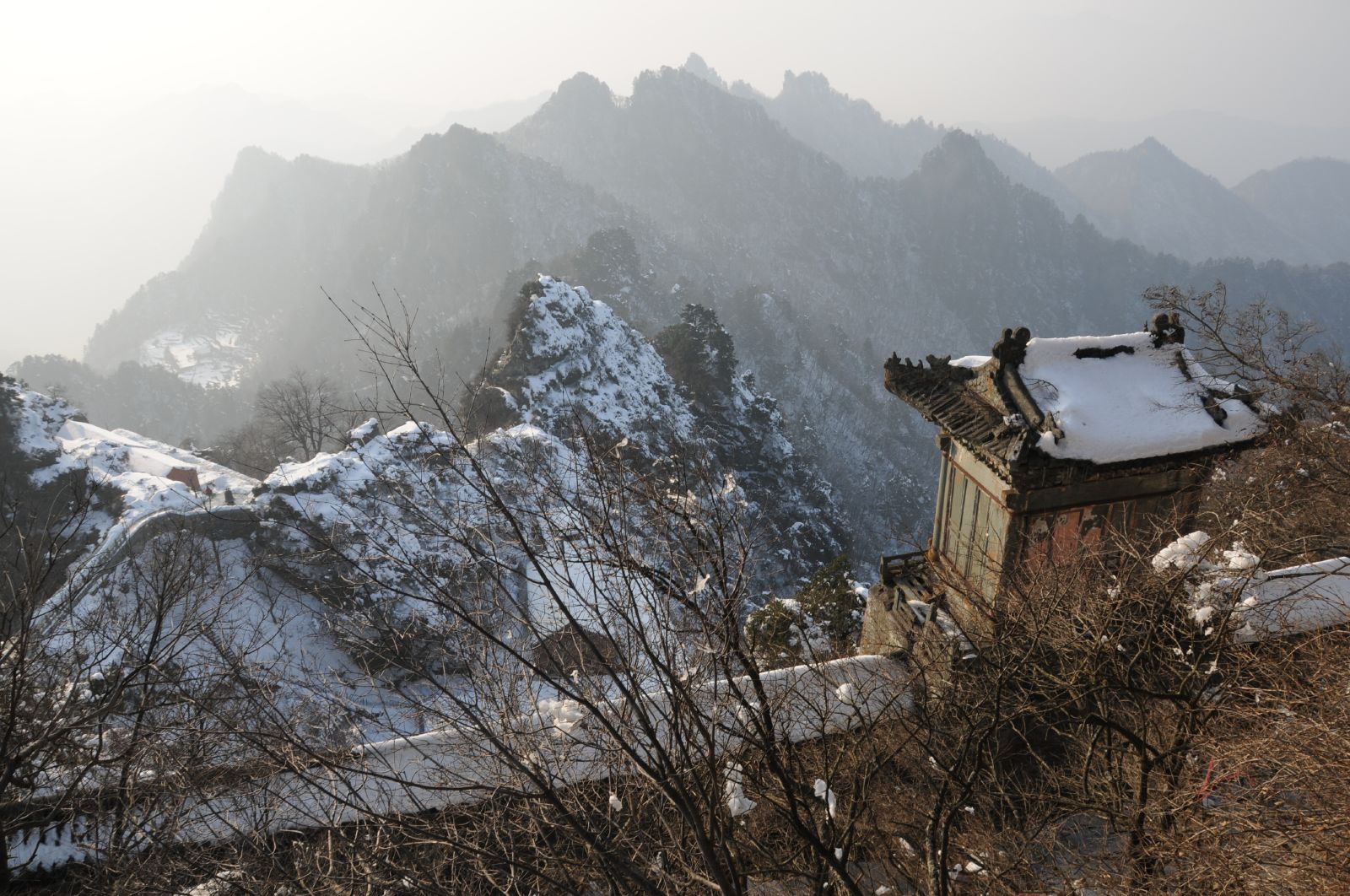
The minibus shudders to a halt at Qiongtai, the cable car’s lower station, and the doors fold open onto air that tastes of pine resin and damp stone. Vendors in padded jackets wave roasted sweet potatoes and thermoses of tea, their breath curling in the chill. Ahead, the steel cable disappears into a white veil where the mountain’s spine should be. You clip your daypack tight, step onto the swaying gondola, and watch the treetops fall away — first broadleaf, then bamboo, then the stunted pines that cling to sheer rock. Ten minutes later the summit platform deposits you beside a bronze palace that has caught every sunrise for six centuries, its green-glazed tiles glowing against cloud. This is the Golden Summit, 1,612 meters up, and the world below has gone silent.
Golden Summit: the bronze palace and the turtle rock
The centerpiece is the Forbidden City of the peaks — a hall cast entirely in gilded copper, beams and brackets forged in Ming furnaces and hauled up piece by piece on human shoulders. Incense smoke drifts through the lattice doors; pilgrims press foreheads to the threshold, murmuring prayers to Xuanwu, the Dark Warrior who cultivated here. Walk the marble terrace clockwise. At the western edge a boulder the size of a sedan perches on the cliff lip, its flat base worn smooth by centuries of wind. This is the Wind-Blown Rock, the “turtle” that seems ready to plunge into the abyss. A gust hits the railing and the mass shudders — a millimeter, maybe two — and your stomach drops. Monks say it has rocked like that since the Daoguang era without ever falling. Touch the cold copper column beside it; the metal hums with the same vibration.
Nanyan and the cliff-hanging halls
Descend the stone staircase toward South Heaven Gate, knees complaining on the uneven risers carved during the Yongle reign. Two hours of downward switchbacks bring you to Nanyan, where temples cling to a vertical honeycomb of caves. The Temple of Ten Thousand Gods is tucked into a grotto, its upturned eaves interlocking with the rock ceiling. Inside, clay statues of the Sixty Jiazi deities line the walls, each with a distinct face — scholar, general, farmer, child — molded by artisans whose names were never recorded. A narrow slit in the rear wall frames a sheer drop; clouds boil up from the valley floor, obscuring the forest. Sit on the stone threshold and listen. Wind through the cave mouth sounds like a flute played by invisible hands. This is where Zhang Sanfeng is said to have dreamed the first taiji movements, watching a snake and crane contest on the terrace.
Taizipo: the prince’s study
A shuttle bus from the tourist center drops you at Taizipo, the “Prince’s Slope,” where the crown prince Zhu Di — later the Yongle Emperor — once studied Taoist texts before seizing the throne. The Purple Heaven Palace here retains its original Ming bracket sets, dougong joints fitted without a single nail. In the rear courtyard a ginkgo trunk splits the flagstones, its roots forcing the pavement upward in slow motion. Autumn turns the canopy gold; winter strips it bare, revealing the skeleton of branches against gray walls. Monks still chant the morning liturgy at 5 a.m. If you overnight in the pilgrim guesthouse — a bare room with a wooden bed and a shared courtyard toilet — you can join them. The chant rises, falls, rises again, each syllable striking the bronze bowl. No tourists, only the old practitioners who have counted these beads for decades.
Wulong Palace and the five dragons
At the mountain’s foot, Wulong Palace spreads beside a stream that runs clear over polished pebbles. Five spring-fed pools — each a different shade of jade — give the site its name. The main hall houses a Ming lacquer altar black as ink, its surface carved with cloud dragons that seem to move when candlelight flickers. Behind the complex, a forest path leads to the “Immortal’s Cave,” a fissure where hermits once meditated through winters. The trail is steep, slick with moss, and unmarked beyond a faded red ribbon on a pine. Turn back when the light thins; the path swallows footprints. In the courtyard, an elderly nun sells hand-copied sutras on rice paper. She does not bargain. Place the money on the stone, bow, and walk away with the scroll warm in your palm.
Moving between sectors: cables, shuttles, and your own legs
Cable car: Qiongtai ↔ Golden Summit, runs 7 a.m.–5:30 p.m. in peak season, 8 a.m.–4:30 p.m. off-season. Buy tickets at the window or the official WeChat mini-program; queues can stretch an hour at midday.
Shuttle bus: Tourist center ↔ Taizipo ↔ Nanyan ↔ Qiongtai, departs every 20 minutes. One ticket covers unlimited rides for the day; keep the stub.
Stone staircases: The ancient pilgrimage route links all major sites. Golden Summit → Nanyan is roughly 3,000 steps down; Nanyan → Taizipo another 2,000. Allow six to eight hours if you walk the full spine. Wear broken-in hiking boots — the risers are irregular, some polished slick by centuries of sandals.
Overnight options: Pilgrim guesthouses at Taizipo and Nanyan (register at the temple office, bring ID). Private hotels cluster near the tourist center and Wulong Palace; book ahead on holiday weekends.
What newcomers get wrong
Treating it as a day trip from Wuhan. The mountain demands at least two nights to see the three core zones without rushing.
Wearing city sneakers on the stone steps. Wet granite becomes glass; ankles twist fast.
Skipping the early morning chant at Taizipo because “it’s too early.” That hour is the only time the halls belong to practitioners, not crowds.
Ignoring the altitude headache. At 1,600 meters the air is thin enough to punish a fast ascent. Hydrate, ascend slowly, carry glucose tablets.
Photographing inside the bronze palace with flash. The gilded interior is sacred space; signs forbid it, and the monks will ask you to leave.
Confusing this Wudang with Beiwudang in Shanxi. Different province, different geology, different lineage. Train tickets to “Wudangshan” station put you at the right mountain in Hubei.
When the last cable car descends and the summit empties, the bronze palace stands alone in the wind. The turtle rock shivers. Somewhere below, a bell strikes the hour — low, long, rolling over ridges. You pull your collar up, start the long staircase down, and let the mountain measure your breath.