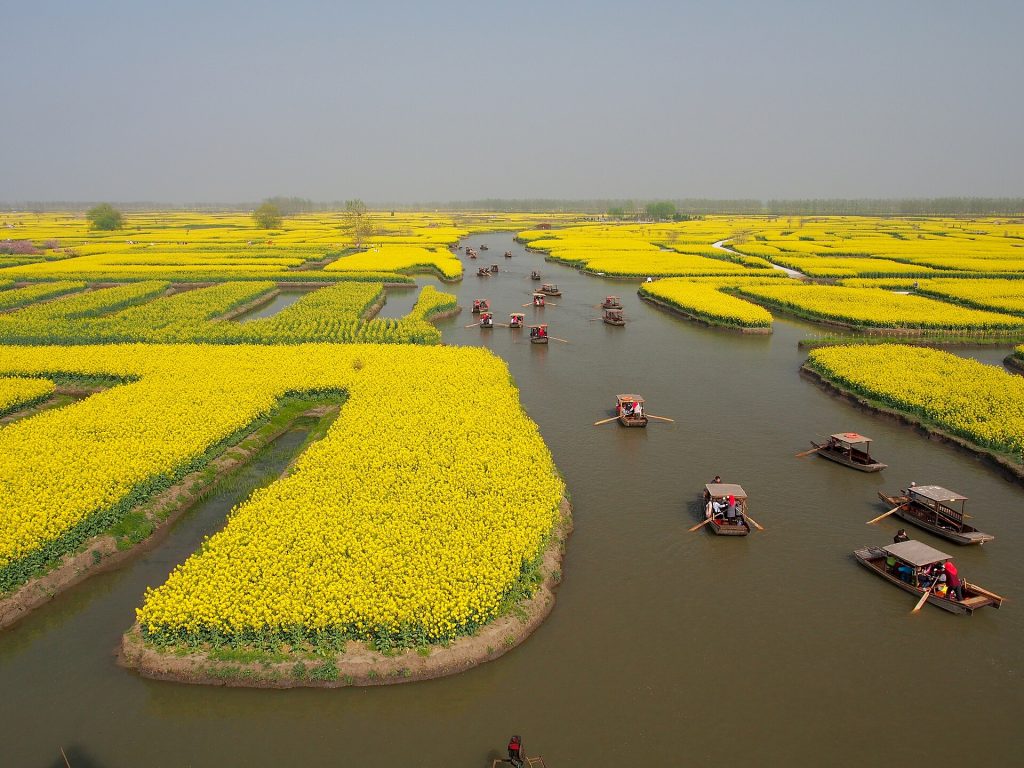
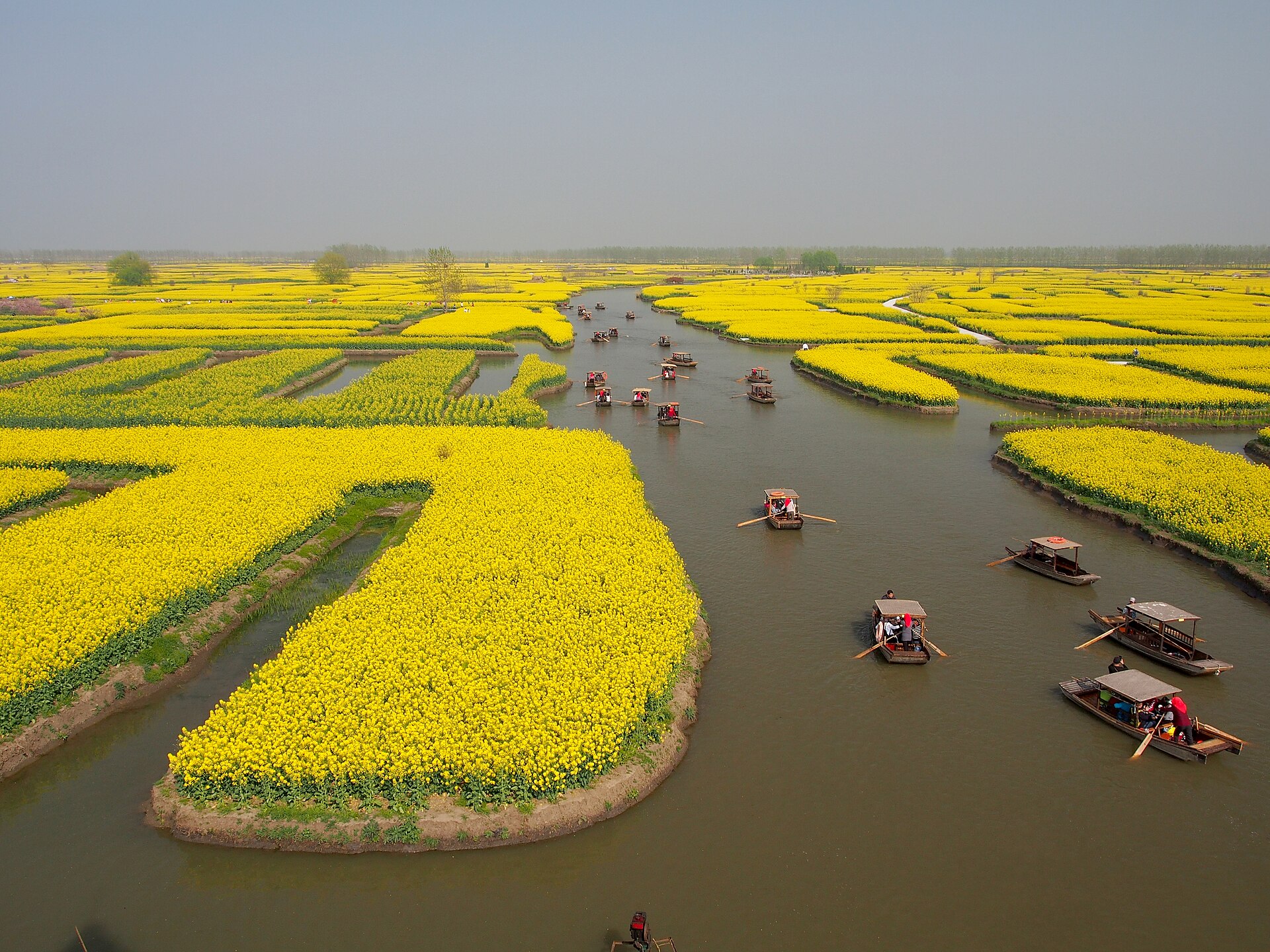
The minibus rattles north out of Xinghua city, the grey apartment blocks giving way to flat fields stitched together by canals. By the time the driver pulls into the gravel lot at Qianduo, the air smells of damp earth and something sweet, almost floral, rising off the water. You step down onto a wooden jetty where a flat-bottomed boat waits, its diesel engine ticking over. The boatman, a woman in a faded blue jacket, gestures you aboard without a word. As the prow pushes into the main channel, the banks fall away and you are suddenly inside a maze of green islands, each one a perfect rectangle of yellow flowers floating on black water.
When the flowers own the horizon
The rapeflower bloom usually arrives after the spring equinox, sometime between the third lunar month and the start of the fourth. That is the window everyone chases. In a warm year the yellow carpets appear as early as mid-March; a cold snap can push peak color into mid-April. The festival dates shift accordingly, announced only a few weeks ahead on local WeChat accounts. If you arrive on a weekday morning, the canals are quiet enough to hear the oar dip. Weekends bring tour groups from Nanjing and Shanghai, and the narrow waterways turn into a slow-moving parade of painted boats. The light is best two hours after sunrise, when the sun sits low enough to gild the petals but high enough to clear the willow crowns.
Getting there without a tour bus
Most visitors reach Xinghua via Taizhou. The high-speed station in Taizhou sits twenty minutes by taxi from the city’s long-distance bus terminal. From there, a direct coach to Xinghua’s south-eastern bus station runs every half hour and takes about forty minutes. During the flower season, a dedicated shuttle links Taizhou station, Xinghua bus station, and the Qianduo entrance; the round-trip ticket covers the park entry and a standard boat loop. Outside the festival weeks, the shuttle disappears. You then take a local bus marked for “Qianduo” or “Shiyou” from the Xinghua terminal and get off at the park gate, or hire a driver for the day — usually around two hundred yuan return, negotiated in the station forecourt.
Moving through the maze
Inside the scenic area, the only ways forward are boat or foot. The boat routes follow three color-coded loops: red, blue, and green. Red is the shortest, a twenty-minute circle past the two lookout towers. Blue stretches to forty minutes and passes a reconstructed fishing village where an old man sells steamed sweet potatoes from a bamboo steamer. Green is the full hour, reaching the outer islands where the canals widen and the flower fields run to the horizon. Walkers can use the raised boardwalks that connect the larger islands; they are narrow, slippery when wet, and crowded at the towers. Rent a bicycle at the gate only if you plan to stay on the perimeter roads — the boardwalks do not allow wheels.
Eating where the water meets the field
Lunch in the park means simple river food. The floating restaurant moored near the red-loop dock serves a set menu: braised pork belly with preserved vegetables, stir-fried river shrimp with garlic chives, a bowl of clear soup with hand-torn tofu skin, and steamed buns made from wheat flour mixed with a pinch of cornmeal. The shrimp should snap when you bite them, sweet and firm; the pork falls apart with a nudge of chopsticks, the fat translucent and glossy. If you prefer to picnic, vendors at the gate sell vacuum-packed salted duck, lotus root slices pickled in chili oil, and plastic cups of cold soy milk. Bring wet wipes — the tables are wiped down with a rag that has seen a hundred hands.
- Braised pork belly: pork belly cubes, soy sauce, rock sugar, star anise, preserved mustard greens, water. Simmer ninety minutes until sauce clings.
- River shrimp: live shrimp, garlic chives, ginger, rice wine, salt. High heat, thirty seconds, finish with a splash of vinegar.
- Tofu skin soup: dried tofu skin sheets, chicken stock, dried shrimp, scallion, white pepper. Tear sheets, blanch ten seconds, ladle hot stock over.
- Cornmeal buns: wheat flour, fine cornmeal, yeast, warm water. Knead, prove, steam fifteen minutes over boiling water.
What newcomers get wrong
First, they assume the flowers last all month. A heavy rain or a sudden heat wave can strip the petals in two days. Check the park’s WeChat mini-program the night before; locals post real-time photos in the comment thread. Second, they wear white sneakers. The jetty planks are slick with algae, and the boardwalk gaps swallow laces. Rubber boots or quick-dry hiking shoes are the only sensible choice. Third, they skip the lookout towers because the stairs look steep. The climb is thirty meters of narrow steel steps, but from the top you see the true pattern — thousands of green islands floating in a yellow sea, the canals drawing characters no calligrapher could plan. Fourth, they forget cash. The boatman, the sweet-potato seller, and the bun vendor do not scan QR codes. Carry small bills; a fifty-yuan note for a twenty-yuan ride creates a negotiation you do not want.
Beyond the bloom
When the rapeflowers fade, Xinghua does not close. The canals remain, and the town’s rhythm shifts to the rice transplanting season in the fifth lunar month. Farmers stand knee-deep in mud, planting seedlings in perfect rows while egrets stalk the furrows. The Qianduo boardwalks stay open, and the boatmen still run the loops, now pointing out lotus buds instead of yellow flowers. In the city, the old street behind the Drum Tower wakes at dusk: stalls rolling out grilled oysters brushed with fermented bean paste, bowls of hand-pulled noodles in pork-bone broth, and piles of green dumplings colored with mugwort juice for the Qingming festival. You can spend a night in a courtyard guesthouse near the Confucian temple, wake to the sound of a rooster and the distant chime of a temple bell, and catch the first boat out at dawn — just you, the boatwoman, and the mist rising off the water.