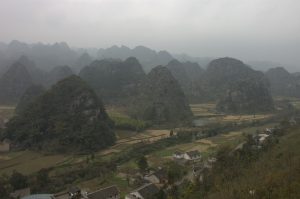
The minibus shuddered to a halt on a dusty pull-off at the foot of the Taihang Mountains, the engine coughing into silence. Through the open door, the air didn’t just smell like pine and damp earth — it tasted cooler, scrubbed clean by elevation. A vendor at a folding table was hacking a watermelon into crescents, the pink flesh glistening against the green rind. I bought a slice, juice running down my wrist, and looked up at the sheer limestone cliffs of Bali Gully cutting a dark slash across the pale morning sky. That first breath, that first sticky handful of fruit, was the moment Xinxiang stopped being a name on a train ticket and became a place I could touch.
Reading the Land Before You Go
Xinxiang sits on the northern edge of Henan, the Yellow River lapping at its border like a lazy seam. The city proper spreads across the flat North China Plain, but the real drama begins where the Taihang Mountains rear up along the western fringe. This geography dictates everything: the wind that scours the plains in spring, the sudden thunderstorms that boil over the peaks in July, the way the temperature drops ten degrees the moment you climb into the valleys.
I learned to ignore the Gregorian calendar here. The old farmers I met in the mountain villages still plant by the lunar cycles. If you arrive during the third lunar month — usually April — the peach blossoms in the gullies explode in clouds of pink, and the hiking trails are crowded with family groups spreading picnic blankets on rocky ledges. By the sixth lunar month, the cicadas scream from the plane trees along Renmin Road, and the city seeks refuge in air-conditioned malls and bowls of ice-cold liangpi. The ninth lunar month brings the chrysanthemum shows at Baiquan, the petals tight and perfect against the cooling air. Winter, the twelfth lunar month onward, is biting and dry; the mountain roads sometimes ice over, but the hot springs at the foot of the range steam invitingly in the frost.
Moving Through the City and Into the Hills
The high-speed rail station sits on the eastern edge, a glass-and-steel beacon that feels disproportionate to the sleepy streets around it. From there, the subway Line 1 cuts a straight arrow west toward the university district and the older neighborhoods. It’s clean, quiet, and the announcements come in Mandarin and English. But the subway stops where the mountains begin.
To reach the scenic areas — Bali Gully, Wanxian Mountain, the Bigan Temple complex — you need wheels. I’ve done it three ways. The tourist buses from the square outside the main railway station leave when full, usually around 8 a.m., and drop you at the main ticket gates. Cheap, but you’re on their clock. A shared Didi to the Bali Gully entrance costs about the price of a decent lunch and buys you freedom. The third option, the one I prefer now: hire a driver for the day through your guesthouse. Mine was a man named Lao Zhang, cigarettes tucked behind his ear, who knew which parking lot had the cleanest toilets and which trailhead avoided the tour groups. He waited in the van with a thermos of chrysanthemum tea while I hiked, and drove me to a farmhouse lunch afterward where the menu was whatever the grandmother had pulled from the garden that morning.
What the Mountains Actually Feel Like
Bali Gully is the postcard star: a narrow canyon where a boardwalk clings to the cliff face above a turquoise stream. The marketing photos show empty paths and misty waterfalls. The reality on a Golden Week holiday is a conga line of selfie sticks and matching couple outfits. Go on a weekday in the fourth lunar month, though, and you’ll have the upper reaches nearly to yourself. The rock underfoot is slick with spray. Swifts dart through the gaps in the cliff. The air smells of wet stone and something floral I never identified — maybe wild ginger.
Wanxian Mountain, farther north, is broader, gentler. The highlight there isn’t a gorge but a plateau: rolling meadows dotted with yurts where herders still bring sheep in summer. I walked the ridge trail at sunset, the grass brushing my calves, watching the light turn the limestone gold. No guardrails. No ticket takers once you’re past the main gate. Just a few weathered shrines tucked into rock clefts, incense ash cold in their bowls.
Bigan Temple, back toward the plain, is different again — not a hike but a courtyard complex honoring a Shang dynasty loyalist who, legend says, had his heart cut out for speaking truth to power. The current buildings are Ming and Qing reconstructions, but the ginkgo trees in the front courtyard are genuinely ancient, their trunks so wide three people can’t link hands around them. In late autumn the ground becomes a carpet of golden fans. Elderly men play xiangqi on stone tables under the canopy, slapping pieces down with rhythmic clicks. They’ll invite you to watch. They will not invite you to play unless you speak dialect.
Eating Where the Locals Actually Eat
Xinxiang cuisine doesn’t announce itself. It’s salty, vinegary, heavy on wheat and mutton — fuel for bodies that work outdoors. The signature dish is hulatang, a peppery soup thickened with gluten and starch, loaded with beef, vermicelli, and a blizzard of cilantro. You eat it for breakfast from a plastic stool at a streetside stall, the bowl scalding your fingertips, the heat blooming behind your ears. The best one I found was in a back alley behind the People’s Hospital, where the broth has been simmering since 3 a.m.
For a sit-down meal, order yangrou paomo: hand-torn flatbread soaked in mutton broth with glass noodles and chili oil. You tear the bread yourself — thumb-sized pieces, not chunks — so the starch releases slowly. The broth should be milky, not clear. A side of pickled garlic cloves, sweet-sour and crisp, cuts the richness. And guokui, the sesame-crusted flatbread baked against the wall of a clay oven, split open and stuffed with minced lamb and cumin. Eat it hot; the crust shatters.
- Hulatang breakfast: beef broth, wheat gluten, vermicelli, cilantro, chili oil, black vinegar, pepper.
- Yangrou paomo: mutton broth, hand-torn flatbread, glass noodles, chili oil, pickled garlic.
- Guokui: wheat dough, sesame seeds, minced lamb, cumin, salt.
Home method for hulatang: simmer beef bones six hours. Strain. Add gluten balls, vermicelli, diced cooked beef. Thicken with potato starch slurry. Finish with white pepper, vinegar, sesame oil, cilantro. The trick is the pepper — white, not black, and more than you think polite.
What Trips Up Newcomers
First mistake: assuming the city center has the best food. The famous laozhao noodles — hand-pulled in a broth of fermented bean curd — are made in a courtyard house in a village twenty minutes west of the ring road. The address won’t appear on maps. Ask a taxi driver to take you to “the old Zhao place near the brick kiln.” He’ll know. Or he’ll pretend not to, because the family only cooks fifty bowls a day and he wants one for himself.
Second mistake: packing only sneakers. The boardwalks in Bali Gully are metal grating. Wet grating eats soft soles. Bring trail shoes with grip, or buy a pair of the cheap canvas high-tops the local hikers wear — they cost twenty yuan at the market near the bus station and last a week of scrambling.
Third mistake: expecting English signage past the main ticket gates. The trail markers are Chinese only. Download offline maps before you leave the hotel. Learn the characters for “exit” (出口), “toilet” (厕所), and “danger” (危险). I once followed a faded red arrow painted on a rock for forty minutes before realizing it pointed to a ranger station, not the loop trail. The ranger gave me a pear and pointed me back the way I came. He didn’t speak a word of Mandarin I understood, just the local dialect, but the gesture was universal.
Fourth mistake: skipping the night market on Pingyuan Road because a guidebook called it “touristy.” It is touristy. It’s also where the university students eat grilled squid on sticks at midnight, where the mutton kebabs arrive on newspapers dusted with cumin and chili flakes, where the beer is warm but the company is loud and generous. Sit on a plastic stool. Order two kebabs and a bottle of Snow. Listen to the arguments about basketball. That’s the city talking.
Staying Put Without Regret
The chain hotels near the high-speed rail station are fine — clean sheets, reliable hot water, English-speaking front desk. But they could be anywhere. I stay in a courtyard guesthouse in the old Muslim quarter, down a lane too narrow for cars. The owner, Auntie Ma, wakes me with the smell of frying youtiao and the clang of the mosque’s call to prayer. The room has a kang bed — heated brick platform — and a window that frames a jujube tree. No elevator. The wifi is spotty. The shower runs cold if someone else turns on a tap. I wouldn’t trade it.
Book through a Chinese platform, not an international one. The photos lie less. Message the host in advance — WeChat, not email — and ask if they can pick you up from the station. Most will. They’ll also tell you which day the mountain road is closed for rockfall clearance, which vendor makes the best cold skin noodles, and whether the ginkgo leaves have turned yet. That last one changes every year. This year, the ninth lunar month. Next year, who knows. The trees keep their own calendar.