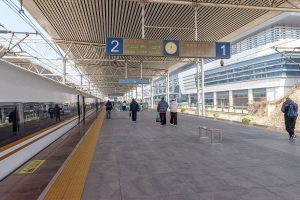
The high-speed train from Shanghai Hongqiao slides into Zhangjiagang Station just after lunch. Outside, the taxi queue moves fast — drivers already know the hotel names, the park entrances, the factory gates where shift workers stream out in blue jackets. No haggling, no smoke, just a clean sedan that smells of lemon cleaner. Twenty minutes later you are standing under a row of metasequoias in Phoenix Park, watching koi break the surface of a lotus pond while a retiree practices tai chi in silk pajamas. The air feels washed.
Getting There Without a Headache
Most visitors arrive by rail. The station sits on the Shanghai–Nantong line; trains from Shanghai Hongqiao take forty minutes, from Nanjing South just over an hour. Buy tickets on the 12306 app or at the window — passport required. If you land at Pudong, the airport bus to Zhangjiagang leaves from Terminal 2 every ninety minutes; the ride is two hours and costs roughly the same as a fast-food meal. Long-distance coaches from Suzhou, Wuxi, and Nanjing pull into the south bus station near the river; they run until late evening and accept cash or QR payment.
- High-speed rail: Shanghai Hongqiao → Zhangjiagang (40 min), Nanjing South → Zhangjiagang (1 hr 10 min).
- Pudong airport bus: Terminal 2, fixed schedule, 2 hrs.
- Coach: south bus station, frequent departures, ¥30–60.
Moving Around the Grid
The city center fits inside a rectangle of wide boulevards lined with camphor trees. Sidewalks are broad enough for two electric scooters to pass abreast. Rent a shared e-bike — scan the QR on the handlebar, ¥1.5 per half hour — and you can reach every major park within fifteen minutes. Taxis start at ¥10 and rarely exceed ¥30 cross-town. DiDi works, but drivers often cancel short trips during rush hour. Bus routes are numbered and announced in Mandarin only; download the “Zhangjiagang Bus” mini-program for real-time tracking. Walking after dark is safe; streetlights stay on until the last factory shuttle passes.
- Shared e-bike: HelloRide or Meituan, unlock via Alipay/WeChat.
- Taxi flag drop ¥10, ¥2.4 per km after 3 km.
- Bus mini-program: search “张家港公交” in WeChat.
Parks That Feel Like Forests
Phoenix Park (Fenghuang Gongyuan) is the showpiece. A central lake reflects a nine-story pagoda; winding paths thread through bamboo groves, camellia gardens, and a wetland boardwalk where egrets stalk at dawn. In the third lunar month the cherry blossoms explode — locals bring fold-up stools and thermoses of jasmine tea. Shazhou Park, nearer the river, has a sculpture trail and a children’s traffic garden where kids pedal miniature cars under working signals. For quiet, slip into the back gate of Jiyang Lake Wetland at sunset; the boardwalk stretches two kilometers over reeds, and the only sound is wind in the phragmites.
- Phoenix Park: main gate on Renmin Road, open 5:30–21:00, free.
- Shazhou Park: sculpture trail, traffic garden, bike rental at east gate.
- Jiyang Lake Wetland: back gate near Yangshe Bridge, best at golden hour.
Old Streets and River Memories
Jiyang Ancient Town sits on the south bank of the Yangtze tributary. The pedestrian lane curves past white-walled, black-tile shophouses selling hand-rolled incense, copper teapots, and steamed buns stuffed with pork and preserved vegetable. A stone bridge arches over a canal where grandmothers wash rice in plastic basins. Climb the drum tower at the lane’s end for a view of cargo barges sliding downstream, their horns low and patient. The town museum, housed in a restored guild hall, displays a single room of Neolithic pottery shards — evidence the river fed people here seven thousand years ago.
- Jiyang Ancient Town: pedestrian only, 9:00–21:00, free entry.
- Must-try snack: crab-meat xiaolongbao at the stall with the red lantern.
- Drum tower climb: steep wooden stairs, not suited for bad knees.
Eating Where Workers Eat
Lunch breaks at the industrial parks spill into canteens that serve the best home-style Jiangsu food in the city. Order the braised pork belly (hongshao rou) — dark, glossy, melting — with a side of stir-fried river shrimp still wearing their shells. Breakfast means a bowl of wonton soup from the cart near the north gate of Phoenix Park: thin wrappers, ginger-scallion broth, a drizzle of chili oil. For dinner, follow the smell of charcoal to the night market behind the south bus station; skewers of lamb, lotus root, and gluten puff arrive on a metal tray with a pile of cumin salt.
- Canteen near Zhangjiagang Bonded Zone: hongshao rou, river shrimp, rice ¥25.
- Wonton cart: north gate Phoenix Park, 6:00–9:30, ¥8 a bowl.
- Night market: behind south bus station, opens 18:00, cash or QR.
What Trips Up First-Timers
Assuming English works everywhere. Hotel front desks and train staff speak some; taxi drivers and market vendors rarely do. Screenshot your destination in Chinese characters before you leave the hotel. Ignoring the e-bike lanes. Pedestrians who wander into the blue-painted strips get a sharp bell and a near-miss. Carrying only large bills. Small stalls and buses often cannot break ¥100. Expecting nightlife after 22:00. The city powers down early — parks lock gates, streets empty, even convenience stores dim their lights. Finally, skipping the river view at dusk. The Yangtze turns the color of bruised plum, and the bridge lights flicker on one by one. That moment is why you came.
- Save Chinese addresses: hotel, parks, station, hospital.
- Stay out of blue e-bike lanes; use sidewalks.
- Keep ¥20 and ¥50 notes for small purchases.
- Plan evening activities before 21:00.
- Walk the river promenade at sunset — no ticket, no crowd.